
Conversion Bottleneck: Why It Matters for Shopify Stores
Most Shopify store owners lose up to 70 percent of potential sales to hidden conversion bottlenecks that seem impossible to fix without technical help. This challenge is not limited to American businesses but affects online stores everywhere. If you want to grow revenue fast by removing friction from your customer journey, understanding and spotting bottlenecks is critical. This guide shows how even non-technical owners can pinpoint and improve weak spots using AI-powered A/B testing, making real sales improvement possible without hiring a developer.
Table of Contents
- Defining Conversion Bottlenecks In ECommerce
- Common Types Of Conversion Bottlenecks
- Key Characteristics And Signs To Watch
- Impacts On Shopify Store Revenue
- Effective Solutions Using Ai-Powered Testing
Key Takeaways
| Point | Details |
|---|---|
| Understanding Conversion Bottlenecks | Identify the specific points in the customer journey that lead to cart abandonment to optimize sales. |
| Focus Areas for Improvement | Analyze page load speeds, mobile responsiveness, and product clarity to enhance user experience. |
| Use Data Analytics | Leverage both quantitative metrics and qualitative feedback to spot and address friction points effectively. |
| Implement AI-Powered Solutions | Adopt AI testing methods for real-time insights and personalized optimization to increase conversion rates. |
Defining Conversion Bottlenecks in eCommerce
A conversion bottleneck represents the precise point in an online shopping journey where potential customers abandon their purchase path, preventing successful transactions. In the competitive world of eCommerce, these bottlenecks are critical obstacles that directly impact a store’s revenue and growth potential. Detailed statistical analysis reveals these bottlenecks often emerge from complex user interaction challenges that interrupt the smooth progression from initial interest to final purchase.
Conversion bottlenecks manifest across multiple stages of the customer journey, including product discovery, information evaluation, checkout processes, and payment completion. Research demonstrates that even minor friction points can significantly reduce conversion rates. For instance, a complicated checkout procedure, unclear product information, unexpected shipping costs, or limited payment options can trigger potential buyers to abandon their shopping carts. Bayesian data analysis shows these interruption points are not random but follow predictable patterns that can be systematically identified and optimized.
For Shopify store owners, understanding conversion bottlenecks requires a comprehensive approach that combines quantitative metrics with qualitative user experience insights. Key areas to examine include page load speeds, mobile responsiveness, product page clarity, navigation simplicity, and transaction security. By mapping each stage of the customer journey and identifying potential drop-off points, store owners can implement targeted improvements that transform potential lost sales into successful conversions.
Pro Tip: Conduct regular user experience audits by walking through your own checkout process as if you were a first-time customer, noting any moments of confusion or unnecessary complexity.
Common Types of Conversion Bottlenecks
Conversion bottlenecks in Shopify stores can be strategically categorized into different types based on their specific impact on the customer journey. Systematic bottleneck analysis reveals that these obstacles are not uniform but emerge from distinct systemic challenges across various stages of online shopping. Understanding these variations allows store owners to develop targeted strategies for minimizing conversion friction.
Three primary categories of conversion bottlenecks dominate the eCommerce landscape. First, product discovery bottlenecks occur when potential customers struggle to find or understand products. These might include poor site navigation, inadequate search functionality, or unclear product descriptions that fail to communicate value. Second, conversion process bottlenecks represent technical and experiential barriers during the purchasing journey. E-commerce funnel analysis highlights specific challenges like complex checkout procedures, limited payment options, unexpected shipping costs, and slow page load times that interrupt buyer momentum.

The third critical category involves psychological bottlenecks, which relate to customer trust and confidence. These bottlenecks emerge from factors like insufficient product information, lack of customer reviews, unclear return policies, or security concerns. Shopify store owners must recognize that conversion barriers are multifaceted, requiring a holistic approach that addresses technical, informational, and emotional dimensions of the online shopping experience. By systematically identifying and addressing these bottlenecks, stores can create smoother, more intuitive pathways that guide customers from initial interest to successful purchase.
Here’s a comparative overview of common conversion bottleneck categories and their typical impact areas:
| Bottleneck Category | Key Impact Area | Example Challenge |
|---|---|---|
| Product Discovery | Navigation & Search | Confusing site structure |
| Conversion Process | Checkout & Transactions | Complex multi-step checkout |
| Psychological | Trust & Confidence | Lack of clear return policy |
Pro Tip: Create a detailed customer journey map that visually tracks potential friction points, helping you proactively identify and eliminate conversion obstacles.
Key Characteristics and Signs to Watch
Identifying conversion bottlenecks requires a nuanced understanding of their key performance indicators. These indicators manifest through specific measurable patterns that signal potential disruptions in the customer conversion process. Shopify store owners must develop a keen eye for detecting subtle signs of conversion impediments before they significantly impact overall sales performance.

Primary signs of conversion bottlenecks include quantitative metrics and qualitative observations. Quantitative indicators encompass high abandonment rates, extended time spent on specific pages, reduced click-through rates, and sudden drops in conversion percentages. Specific red flags include checkout page exit rates above 30%, product page bounce rates exceeding industry standards, and prolonged page load times. These numerical signals provide concrete evidence of potential friction points that interrupt the smooth customer journey.
Qualitative signs are equally critical in diagnosing conversion challenges. These include customer feedback, support ticket frequency, and user behavior patterns. Research on bottleneck analysis highlights that persistent customer confusion, repeated questions about product details, or consistent complaints about website navigation represent deeper systemic issues. Store owners should pay special attention to user interaction patterns, such as users repeatedly returning to previous pages, struggling to complete purchases, or abandoning carts at specific stages of the buying process. Understanding these nuanced signals requires a holistic approach that combines data analysis with empathetic user experience design.
Pro Tip: Implement user session recording tools to capture real-time customer interactions, providing unprecedented insights into potential conversion bottlenecks.
Impacts on Shopify Store Revenue
Conversion bottlenecks represent more than just technical challenges—they are direct revenue killers for Shopify stores. Conversion rate analysis reveals that typical Shopify stores experience conversion rates ranging between 1.4% and 5%, making every potential customer interaction critically important. Even minor friction points can translate into substantial financial losses, with each abandoned cart representing a tangible revenue opportunity permanently forfeited.
The financial implications of conversion bottlenecks extend far beyond immediate transaction losses. When potential customers encounter obstacles during their shopping experience, they not only fail to complete current purchases but are also less likely to return in the future. These compounded losses can dramatically reduce a store’s lifetime customer value, undermining long-term revenue potential. Metrics such as cart abandonment rates, average time spent on product pages, and checkout completion percentages serve as direct indicators of potential revenue hemorrhage caused by systemic conversion barriers.
Moreover, conversion bottlenecks create a cascading effect on overall store performance. Reduced conversion rates negatively impact key business metrics like customer acquisition cost, marketing efficiency, and overall return on investment. Revenue uplift strategies become essential for Shopify store owners seeking to mitigate these financial risks. By systematically identifying and eliminating conversion obstacles, stores can transform potential revenue leakage into sustainable growth, turning marginal improvements into significant financial gains.
Pro Tip: Calculate your store’s potential revenue loss by multiplying average order value with monthly cart abandonment rate to quantify the real financial impact of conversion bottlenecks.
Effective Solutions Using AI-Powered Testing
AI-powered testing represents a revolutionary approach to addressing conversion bottlenecks in Shopify stores, transforming traditional optimization methods. Machine learning techniques enable store owners to detect, predict, and manage conversion obstacles with unprecedented precision and speed. By analyzing vast amounts of user interaction data, AI systems can identify subtle friction points that human analysts might overlook, providing actionable insights that directly impact store performance.
The core strength of AI-driven testing lies in its ability to create highly personalized optimization strategies. Traditional A/B testing methods often require manual configuration and lengthy implementation cycles, whereas AI-powered solutions can dynamically generate and deploy test variations in real-time. AI A/B testing strategies have demonstrated the potential to increase conversion rates by up to 35%, making them a game-changing approach for Shopify store owners seeking to maximize their online revenue. These intelligent systems continuously learn from user interactions, automatically adjusting test parameters and recommendations to improve store performance.
This table summarizes how AI-powered testing enhances conversion optimization compared to traditional A/B testing:
| Approach | Speed of Insights | Personalization Level | Adaptability Over Time |
|---|---|---|---|
| Traditional A/B Testing | Slow; manual analysis | Limited, generic segments | Needs frequent manual updates |
| AI-Powered Testing | Real-time, automated | Highly individualized | Continuously self-learning |
Implementing AI-powered testing involves a strategic approach that goes beyond simple statistical analysis. The most effective solutions integrate multiple data sources, including user behavior metrics, site performance indicators, and contextual information about customer segments. By creating adaptive testing environments that can quickly identify and respond to emerging conversion challenges, Shopify stores can develop a proactive optimization strategy that evolves with changing customer preferences and market dynamics.
Pro Tip: Start with AI-powered testing on high-traffic pages to quickly validate optimization strategies and minimize potential revenue disruption.
Unlock Your Shopify Store’s Full Sales Potential by Eliminating Conversion Bottlenecks
Conversion bottlenecks harm your revenue by blocking customers during crucial moments like checkout or product discovery. The article highlights how complex checkout processes, unclear product information, and low customer confidence can cause your buyers to abandon carts. Your goal should be to identify and remove these friction points quickly to prevent lost sales and build lasting trust.
This is where Automagic.li steps in with AI-powered A/B testing tailored specifically for Shopify stores. Our platform offers over 40 ready-made, high-impact test variations that require no coding skills. These tests target key bottleneck issues from navigation to checkout simplification and trust-building elements. By automating test deployment with AI-driven code adjustments, we help you optimize faster, reduce guesswork, and directly increase conversions.
Experience the difference of smart optimization that scales with your store’s needs. Start now to transform hidden bottlenecks into revenue growth opportunities.
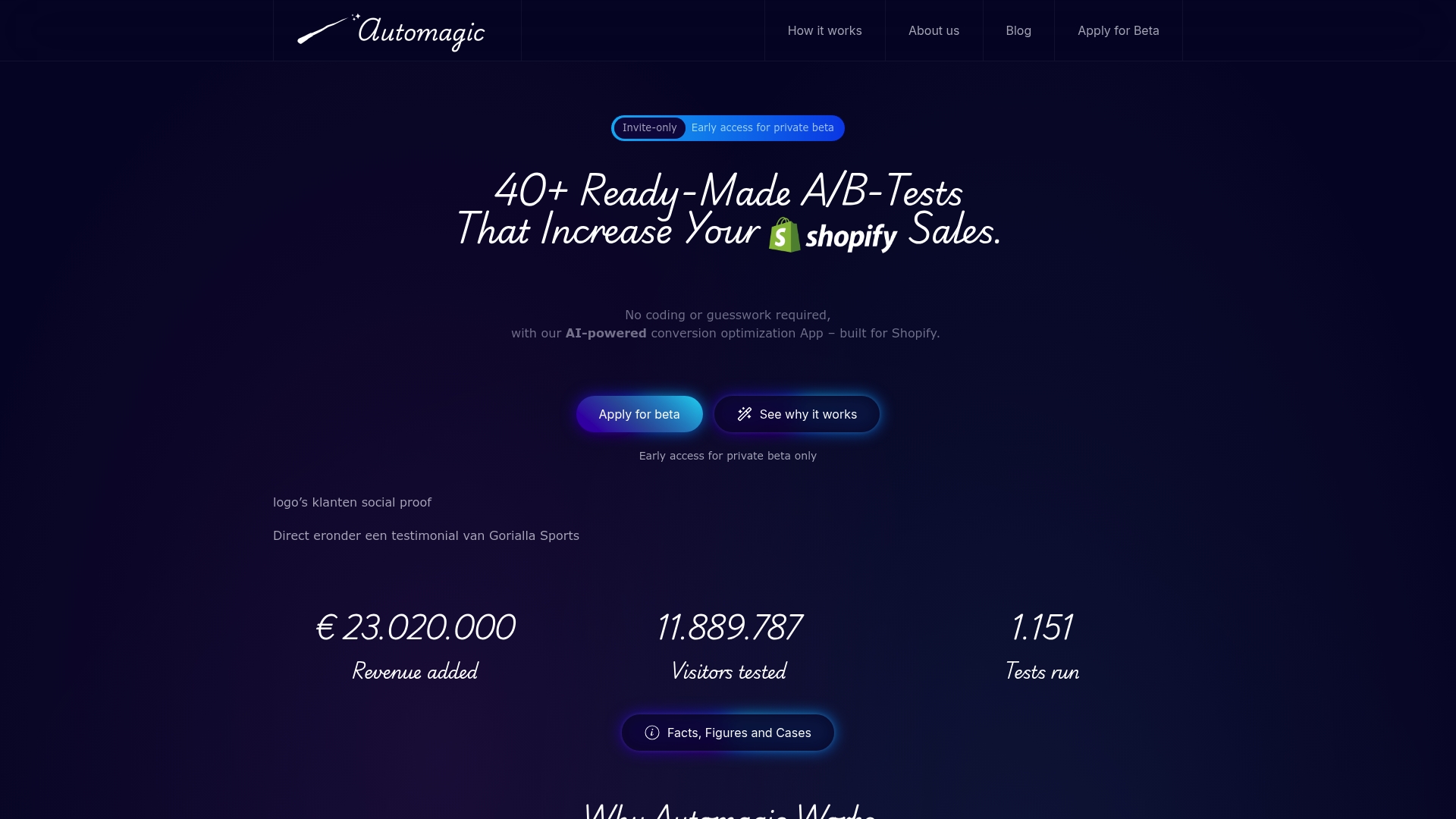
Don’t let bottlenecks steal your hard-earned sales. Visit Automagic.li today and accelerate your Shopify store’s growth with effortless AI-powered optimization.
Frequently Asked Questions
What are conversion bottlenecks in eCommerce?
Conversion bottlenecks refer to specific points in the online shopping journey where potential customers abandon their purchases, hindering successful transactions and impacting store revenue.
What are common types of conversion bottlenecks for Shopify stores?
The main types include product discovery bottlenecks, which affect how customers find and understand products; conversion process bottlenecks, which hinder the checkout experience; and psychological bottlenecks, which relate to customer trust and confidence in the purchasing process.
How can I identify conversion bottlenecks in my Shopify store?
You can identify conversion bottlenecks by analyzing quantitative metrics such as high abandonment rates and bounce rates, along with qualitative feedback from users regarding their shopping experience and any obstacles they encountered.
What solutions can help mitigate conversion bottlenecks in eCommerce?
Implementing AI-powered testing can provide a revolutionary approach to identify and address conversion bottlenecks quickly. AI tools analyze user interaction data to suggest personalized optimization strategies that can enhance the shopping experience and improve conversion rates.