
7 Steps Shopify Optimization Checklist for Better Conversions
Nearly 70 percent of Shopify stores never reach their full conversion potential, leaving serious profits on the table for American and international entrepreneurs alike. Tackling this challenge is not just about technical fixes. Simple AI powered solutions can help any Shopify owner make smart improvements without complex coding. From pinpointing bottlenecks to creating trust and speeding up checkout, discover practical strategies that raise conversion rates using the power of automation.
Table of Contents
- 1. Analyze Store Performance For Conversion Bottlenecks
- 2. Implement High-Impact AI-Powered A/B Tests
- 3. Optimize Product Pages For Trust And Clarity
- 4. Enhance Checkout Flow For Ease And Speed
- 5. Leverage Social Proof And User Reviews Effectively
- 6. Personalize Shopping Experience Using AI
- 7. Monitor Results And Refine Optimizations Continuously
Quick Summary
| Key Message | Explanation |
|---|---|
| 1. Identify Conversion Bottlenecks | Analyze user behavior and key metrics to pinpoint where potential customers drop off during their purchasing journey. |
| 2. Conduct AI-Powered A/B Testing | Utilize AI to create and track experiments, optimizing elements that significantly affect conversion rates. |
| 3. Optimize Product Pages for Trust | Enhance product pages with clear information and trust signals like reviews and high-quality images to encourage purchases. |
| 4. Streamline Checkout Process | Simplify the checkout experience by reducing steps and displaying clear pricing to minimize cart abandonment. |
| 5. Utilize Social Proof Effectively | Place customer testimonials and reviews strategically to reduce purchase anxiety and build trust with new shoppers. |
1. Analyze Store Performance for Conversion Bottlenecks
Understanding your Shopify store’s performance requires a systematic approach to identifying where potential customers drop off in their purchasing journey. Conversion funnel analysis provides critical insights into which stages of your online store experience friction or barriers.
To effectively analyze conversion bottlenecks, you’ll need to examine multiple data points across your customer journey. This involves tracking user behavior from initial landing page through checkout, identifying specific points where potential buyers exit or hesitate.
Key metrics to monitor include:
Webpage Performance Indicators:
- Bounce rates on product pages
- Time spent on site
- Cart abandonment percentage
- Conversion rates per page
Quantitative Analysis Methods:
- Review Google Analytics conversion reports
- Analyze heatmaps showing user click patterns
- Track user session recordings
- Examine funnel visualization reports
Qualitative research complements these metrics by helping you understand user emotions and motivations. By combining hard data with user experience insights, you can pinpoint exact conversion barriers.
Pro tip: Use cohort analysis to track how different customer segments interact with your store and identify nuanced conversion patterns that generic reports might miss.
2. Implement High-Impact AI-Powered A/B Tests
A/B testing represents a powerful strategy for systematically improving your Shopify store’s conversion rates through intelligent experimentation. Conversion Rate Optimization leverages artificial intelligence to transform how online businesses enhance their performance.
AI powered testing allows you to move beyond traditional guesswork by analyzing user behavior with unprecedented precision. These advanced tests automatically identify which website variations generate the most conversions, reducing manual effort and accelerating optimization.
Key Components of AI Driven A/B Testing:
- Automatic variant generation
- Real time performance tracking
- Intelligent statistical analysis
- Dynamic experiment adaptation
Successful A/B tests focus on critical elements like product page layouts, call to action buttons, pricing displays, and checkout processes. By implementing targeted experiments, you can incrementally improve user experience and increase conversion potential.
Recommended Testing Priorities:
- Product page image placement
- Checkout button color and size
- Purchase incentive messaging
- Navigation menu design
- Pricing presentation strategies
Pro tip: Prioritize tests with highest potential impact by analyzing current conversion data and focusing on elements most likely to drive meaningful improvements.
3. Optimize Product Pages for Trust and Clarity
Product pages serve as the critical conversion point where potential customers decide whether to purchase or abandon their shopping journey. Shopify Product Page Optimization requires strategic design that builds immediate trust and provides crystal clear information.
Customers make split second decisions based on visual and textual elements. Your product page must communicate value propositions quickly and eliminate any potential purchasing hesitations.
Key Trust Building Elements:
- High quality professional product images
- Transparent pricing information
- Clear product specifications
- Genuine customer reviews
- Security trust badges
- Detailed product descriptions
Essential Product Page Components:
- Multiple product angle photographs
- Size and dimension details
- Material and quality information
- Shipping and return policies
- Stock availability status
- Compatible accessories or variants
Psychological Trust Signals:
- Money back guarantee icons
- SSL certificate displays
- Payment method variety
- Verified customer testimonials
- Industry certification logos
- Social proof elements
Pro tip: Implement professional product photography with consistent backgrounds and lighting to create visual credibility and help customers feel confident about their potential purchase.
4. Enhance Checkout Flow for Ease and Speed
The checkout process represents the most critical conversion moment in your Shopify store where potential sales can quickly evaporate due to friction or complexity. Conversion optimization strategies focus heavily on streamlining this crucial customer experience.
Customers demand simplicity and speed during checkout. Every additional step or moment of confusion increases the likelihood they will abandon their purchase. Your goal is to create a frictionless path from product selection to transaction completion.
Checkout Optimization Strategies:
- Minimize form fields
- Offer guest checkout options
- Display security trust signals
- Provide multiple payment methods
- Enable one click purchasing
- Show clear price breakdowns
Psychological Checkout Design Elements:
- Progress indicator bars
- Transparent shipping costs
- Mobile responsive design
- Autofill capabilities
- Immediate error correction
- Clear error messaging
Conversion Reducing Checkout Barriers:
- Complex registration processes
- Hidden fees
- Limited payment options
- Slow loading pages
- Mandatory account creation
- Unexpected shipping charges
Pro tip: Implement a single page checkout design that displays all necessary information simultaneously to reduce cognitive load and increase purchase completion rates.
5. Leverage Social Proof and User Reviews Effectively
Social proof represents the psychological phenomenon where potential customers make purchasing decisions based on the experiences and recommendations of others. Feedback plays a critical role in building trust and credibility for your Shopify store.
Modern online shoppers are skeptical and seek validation through authentic user experiences. Strategic placement of reviews and testimonials can dramatically increase conversion rates by reducing purchase anxiety and demonstrating real world product performance.
Strategic Social Proof Locations:
- Product page testimonials
- Homepage customer success stories
- Checkout page trust indicators
- Category page review snippets
- Pop up customer feedback displays
- Social media integration sections
Types of Compelling Social Evidence:
- Verified customer reviews
- Star rating displays
- Detailed written testimonials
- Video customer experiences
- Case study highlights
- Influencer endorsements
- User generated content
Psychological Trust Building Strategies:
- Display recent purchase notifications
- Show total number of satisfied customers
- Include customer photos with reviews
- Highlight detailed user experiences
- Demonstrate product impact through stories
- Share quantifiable customer success metrics
Pro tip: Prioritize authentic reviews from verified purchasers and consider implementing a review verification system to enhance credibility and prevent potential manipulation.
6. Personalize Shopping Experience Using AI
Artificial intelligence enables hyper targeted shopping experiences that transform how customers interact with online stores. AI powered optimization strategies allow Shopify merchants to deliver individualized interactions at unprecedented scale.
Personalization goes far beyond basic product recommendations. Modern AI technologies analyze complex behavioral patterns to create dynamic shopping journeys that feel uniquely crafted for each customer.
AI Personalization Techniques:
- Dynamic product recommendations
- Individual pricing strategies
- Custom homepage configurations
- Intelligent search result ranking
- Behavior triggered messaging
- Personalized email campaigns
- Real time content adaptation
Customer Data Personalization Layers:
- Purchase history analysis
- Browsing behavior tracking
- Geographic location insights
- Device specific interactions
- Time based preference modeling
- Contextual interest mapping
- Demographic segment understanding
Psychological Personalization Triggers:
- Urgency notifications
- Social proof integration
- Scarcity indicators
- Tailored messaging
- Individual product suggestions
- Contextual discount offers
- Preference based navigation
Pro tip: Implement progressive personalization by starting with basic behavioral tracking and gradually introducing more sophisticated AI driven customization as you gather more customer interaction data.
7. Monitor Results and Refine Optimizations Continuously
Successful Shopify stores view conversion optimization as an ongoing journey rather than a destination. Conversion rate optimization requires consistent analysis and strategic refinement to maintain competitive performance.
Continuous monitoring allows you to understand how small changes impact your store’s overall performance. By tracking key metrics and customer behavior patterns, you can make data driven decisions that incrementally improve conversion rates.
Critical Performance Metrics to Track:
- Conversion rate percentage
- Average order value
- Cart abandonment rate
- Time on site
- Bounce rate
- Revenue per visitor
- Customer acquisition cost
Optimization Refinement Strategies:
- Quarterly performance reviews
- Segment specific analysis
- Comparative A/B test evaluations
- Customer feedback integration
- Technical performance checks
- Competitive benchmarking
- User experience audits
Advanced Tracking Techniques:
- Cohort analysis
- Funnel visualization
- Multivariate testing
- Behavioral segmentation
- Predictive performance modeling
- Real time analytics monitoring
- Conversion path investigation
Pro tip: Establish a regular optimization schedule with monthly review sessions and quarterly deep dive analyses to ensure continuous improvement and prevent performance stagnation.
Below is a comprehensive table summarizing the key strategies for optimizing Shopify store performance as discussed in the article.
| Topic | Key Strategies | Outcome/Goal |
|---|---|---|
| Identify Conversion Bottlenecks | Utilize tools like Google Analytics and heatmaps to analyze user behavior; monitor metrics such as bounce rates and cart abandonment. | Pinpoint and reduce obstacles within the purchasing process. |
| Implement A/B Testing with AI | Execute AI-driven testing to evaluate site elements like product pages and checkout buttons. | Increase conversion rates by identifying effective design and strategy changes. |
| Optimize Product Pages | Use high-quality images, transparent pricing, and detailed descriptions to build trust. | Enhance customer confidence and clarify product offerings. |
| Streamline Checkout Process | Simplify the process by reducing steps, offering guest checkout, and ensuring mobile responsiveness. | Minimize cart abandonment and improve transaction completion. |
| Leverage Social Proof | Display verified reviews, testimonials, and trust indicators prominently on pages. | Build trust, reduce buyer hesitation, and improve credibility. |
| Personalize the Shopping Experience | Employ AI to provide dynamic recommendations and personalized shopping journeys. | Boost customer engagement and satisfaction. |
| Continuously Refine Optimization | Regularly evaluate metrics such as conversion rates and AOV; adapt strategies based on data insights. | Maintain competitive performance and achieve incremental improvements. |
Unlock Higher Shopify Conversions with AI-Powered Optimization
If you are following the “7 Steps Shopify Optimization Checklist for Better Conversions,” you already know that analyzing store performance and running targeted A/B tests are crucial to eliminating conversion bottlenecks. However, manually creating and managing these detailed experiments can be overwhelming and time-consuming. Key pain points like identifying the most impactful test ideas, customizing tests to your unique store design, and continuously refining optimizations without technical expertise often hold back Shopify store owners from reaching peak sales.
That is where Automagic.li steps in. Automagic.li is a SaaS platform crafted specifically for Shopify merchants who want to supercharge their conversion rates through AI-driven, ready-made A/B tests. You get instant access to over 40 proven test variations that require no coding. The platform adapts tests automatically to your site’s unique code using artificial intelligence, removing barriers like developer costs and complex setup. By automating high-impact split testing with scientific precision, you can rapidly increase trust, simplify checkout flow, and personalize shopping experiences exactly as the checklist recommends.
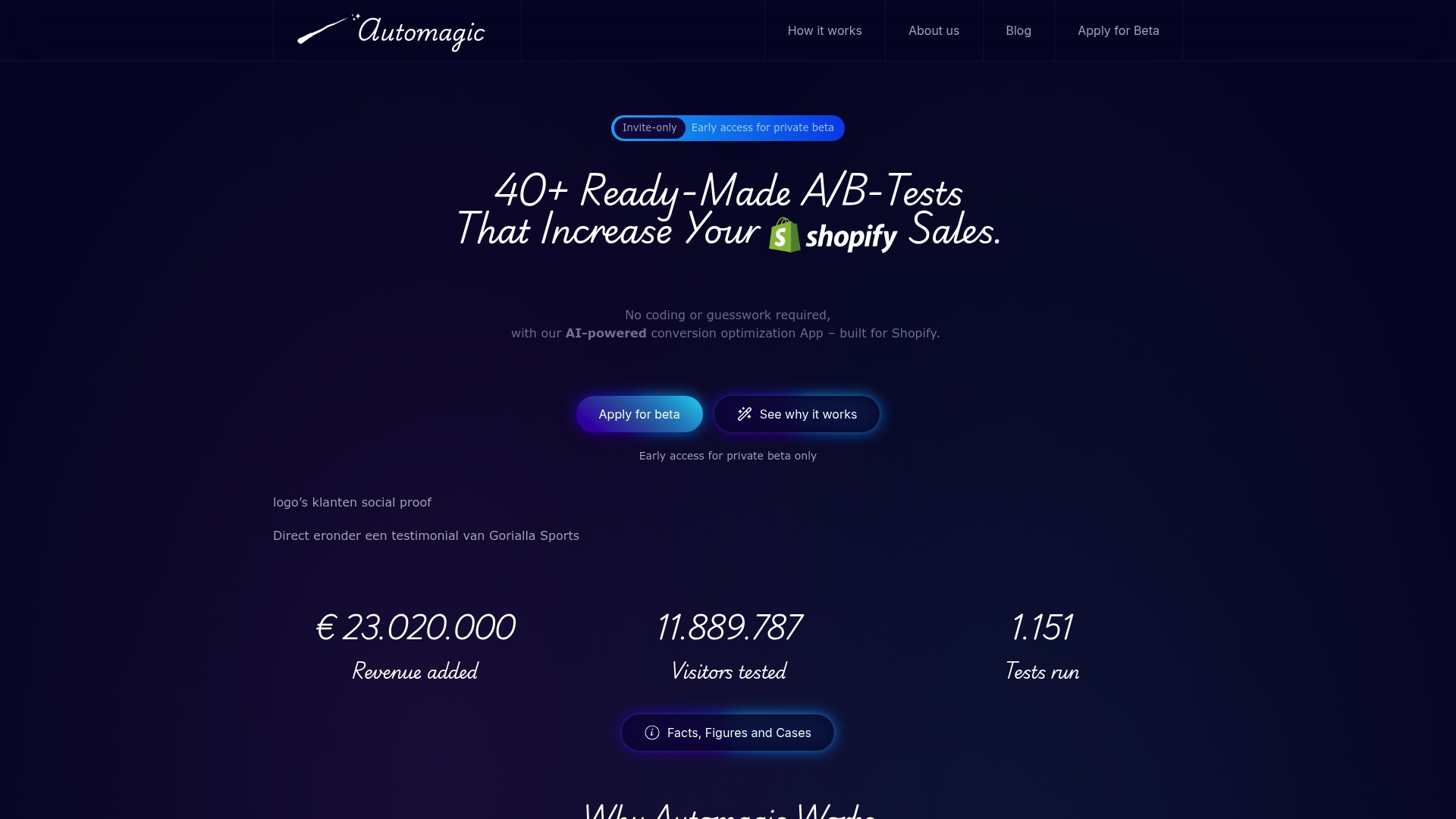
Experience how easy it is to implement conversion optimizations that align perfectly with each key step in your Shopify growth journey. Start making data-driven improvements today. Visit Automagic.li now to begin transforming your store into a high-performance selling machine and bring your Shopify optimization goals to life.
Frequently Asked Questions
How can I identify conversion bottlenecks in my Shopify store?
To identify conversion bottlenecks, track key metrics such as bounce rates, cart abandonment rates, and conversion rates per page. Analyze user behavior from landing to checkout by reviewing Google Analytics and heatmaps to pinpoint where customers drop off.
What elements should I A/B test on my Shopify store for better conversions?
Focus on critical elements like product page layouts, checkout button design, and pricing displays when conducting A/B tests. By implementing these tests, you can optimize for the highest potential impact, aiming for measurable improvements in conversions within a few weeks.
How can I optimize my product pages to build customer trust?
To optimize product pages, ensure you include high-quality images, transparent pricing, and genuine customer reviews. Incorporate these elements to enhance clarity and trust, which can significantly lower hesitation and boost conversion rates.
What are the best practices for streamlining the checkout process?
Best practices for streamlining the checkout process include minimizing form fields, offering guest checkout options, and displaying clear security signals. Implement these strategies to create a faster, user-friendly experience that could reduce cart abandonment by up to 30%.
How should I effectively use social proof to increase conversions?
Utilize social proof by prominently displaying verified customer reviews and testimonials throughout your site, especially on product and checkout pages. This can alleviate purchase anxiety and build trust, which may lead to higher conversion rates in your Shopify store.
How can personalization using AI improve my Shopify store’s performance?
Personalization through AI can enhance customer experiences by delivering tailored product recommendations and individualized messaging. Start with basic behavior tracking and move towards more complex customization to engage users better and potentially increase sales by 10–15%.