
7 Essential Shopify Optimization Tips 2025 for Higher Sales
Nearly 65 percent of all global online shopping now happens on mobile devices, a shift that is impossible for any American store owner to ignore. With giant competitors refining the buying journey every day, providing a fast and intuitive experience matters more than ever. This guide reveals practical, AI-powered methods that help Shopify entrepreneurs worldwide improve conversion rates without needing technical expertise.
Table of Contents
- 1. Prioritize Mobile Optimization For Seamless Shopping
- 2. Use AI-Driven A/B Testing For Quick Wins
- 3. Streamline Checkout To Minimize Cart Abandonment
- 4. Leverage Social Proof For Instant Credibility
- 5. Optimize Product Pages With High-Impact Variations
- 6. Automate Repetitive Tasks To Save Time
- 7. Track Success With Data-Driven Analytics Tools
Quick Summary
| Key Message | Explanation |
|---|---|
| 1. Prioritize Mobile Optimization | Ensure your Shopify store delivers an exceptional mobile experience, focusing on responsive design and fast load times. |
| 2. Utilize AI for A/B Testing | Leverage AI-driven A/B testing to quickly identify optimization opportunities, providing faster and more accurate insights. |
| 3. Simplify Checkout Process | Create a smoother checkout experience to reduce cart abandonment by minimizing form fields and displaying total costs upfront. |
| 4. Implement Social Proof | Use customer reviews and testimonials to build trust and credibility, persuading potential buyers to make a purchase. |
| 5. Automate Repetitive Tasks | Save time by automating workflows like order processing and customer support, allowing you to focus on strategic growth. |
1. Prioritize Mobile Optimization for Seamless Shopping
In 2025, mobile optimization is no longer optional for Shopify stores it’s absolutely essential. With approximately 64.9% of global e-commerce site traffic coming from mobile devices, your online store must deliver an exceptional mobile shopping experience.
Mobile optimization goes beyond simply making your website look good on smaller screens. It involves creating a seamless, user friendly journey that reduces friction and encourages purchases. This means designing responsive layouts that automatically adjust to different screen sizes, ensuring fast load times, simplifying navigation, and streamlining the checkout process.
Key strategies include implementing touch-friendly interfaces, reducing form fields, supporting mobile payment methods, and optimizing image sizes for quick loading. Your goal is to make every interaction smooth and intuitive for mobile shoppers.
Advanced mobile optimization also involves leveraging emerging technologies. Consider implementing progressive web apps (PWAs), which provide app-like experiences directly through web browsers, and exploring augmented reality features that allow customers to visualize products in their own environment.
Performance Metrics Matter
Google Core Web Vitals now heavily emphasize mobile performance. Websites that load quickly, provide stable visual experiences, and offer responsive interactions will rank higher in search results. This means faster load times directly impact not just user experience but also your store’s visibility.
Practical Implementation Steps
- Use responsive design frameworks
- Compress and optimize images
- Minimize HTTP requests
- Implement lazy loading for images
- Test your site on multiple mobile devices
Pro tip: Conduct monthly mobile usability testing to identify and eliminate potential friction points in your shopping experience.
2. Use AI-Driven A/B Testing for Quick Wins
AI-driven A/B testing represents a game changing approach for Shopify store optimization in 2025. By leveraging advanced algorithms and machine learning, you can transform your conversion strategy from guesswork to precision.
AI-enabled testing automates experimentation and analyzes large datasets in real-time, allowing you to uncover optimization opportunities faster than traditional methods. Unlike manual testing which can be time consuming and limited, AI algorithms dynamically adapt experiments based on real user behavior.
Key Benefits of AI A/B Testing
- Automated experiment design
- Faster insights generation
- Personalized user experience optimization
- Reduced human bias in testing
- Simultaneous multivariate testing
The power of AI testing lies in its ability to process complex data patterns. Traditional A/B testing might take weeks or months to generate meaningful results. AI condenses this timeline dramatically, providing actionable insights within days or even hours.
Practical Implementation Strategies
- Select an AI powered A/B testing platform
- Define clear conversion goals
- Start with low risk elements like button colors or headline variations
- Monitor AI generated recommendations
- Continuously refine your testing approach
Pro tip: Implement AI A/B testing incrementally and track performance metrics to build confidence in the technology.
3. Streamline Checkout to Minimize Cart Abandonment
Cart abandonment is the silent killer of e-commerce revenue, with potential losses reaching hundreds of thousands of dollars annually for Shopify stores. Your checkout process can make or break a sale in mere seconds.
Effective checkout optimization requires addressing primary reasons customers abandon their carts, such as unexpected fees, complex forms, and security concerns. Your goal is to create a frictionless purchasing experience that feels smooth and trustworthy.
Critical Checkout Optimization Strategies
- Enable guest checkout options
- Minimize form fields
- Display total costs upfront
- Offer multiple payment methods
- Use security badges and trust indicators
- Implement mobile responsive design
By strategically reducing complexity, you can recover up to 35% of potentially lost sales. This means transforming your checkout from a potential roadblock into a welcoming pathway for customer purchases.
User Experience Considerations
- Load times matter more than ever
- Simplify navigation between cart and checkout
- Provide clear error messages
- Allow easy cart modification
- Support quick payment options like Apple Pay and Google Pay
Pro tip: Conduct monthly checkout flow audits and gather user feedback to continuously refine and simplify your purchasing process.
4. Leverage Social Proof for Instant Credibility
In the competitive world of online shopping, social proof is your secret weapon for transforming hesitant browsers into confident buyers. It’s about showing potential customers that others have already trusted and loved your products.
Social proof empowers commerce through powerful social validation mechanisms that reduce perceived purchase risks and enhance consumer trust. When shoppers see real people vouching for your products, their buying resistance drops dramatically.
Strategic Social Proof Elements
- Customer reviews and ratings
- Detailed testimonials
- User generated content
- Influencer endorsements
- Real customer photos
- Purchase count displays
Carefully curated social proof acts like a digital recommendation network. It signals to new customers that your products are not just good but proven and reliable. The key is authenticity transparent, unbiased feedback that resonates with your target audience.
Best Implementation Practices
- Feature verified customer reviews prominently
- Include specific details in testimonials
- Showcase diverse customer experiences
- Update social proof regularly
- Highlight specific product benefits through customer stories
Pro tip: Encourage customers to share genuine experiences by offering small incentives like discount codes for detailed product reviews.
5. Optimize Product Pages With High-Impact Variations
Your product pages are more than just digital catalogs they are your most powerful conversion tools. In 2025, successful Shopify stores understand that every visual element and description can dramatically influence buyer decisions.
Optimized product pages serve as critical conversion tools by engaging customers early in their buying journey, transforming passive browsers into active buyers.
Strategic Product Page Optimization Elements
- High resolution product images
- Multiple viewing angles
- Detailed size and specification charts
- Clear pricing information
- Color and variant selections
- Prominent customer reviews
- Responsive mobile design
Effective product variation management goes beyond simply showing different colors or sizes. It requires creating an immersive experience that helps customers visualize themselves using your product. Each variation should tell a compelling story that addresses potential customer questions and concerns.
Advanced Optimization Techniques
- Use lifestyle product images
- Create variant specific descriptions
- Implement zoom and 360 degree view features
- Show real customer photos
- Highlight unique product benefits
- Demonstrate product versatility
Pro tip: Regularly analyze your product page heat maps and user interaction data to continuously refine and improve your variation presentations.
6. Automate Repetitive Tasks to Save Time
Time is your most valuable resource as an online entrepreneur. Automation transforms how Shopify store owners manage their businesses by eliminating mundane tasks and freeing you to focus on strategic growth.
Task automation helps scale operations by streamlining repetitive workflows across order management, inventory tracking, and customer support. Instead of getting bogged down in manual processes, you can create smart systems that work continuously in the background.
Key Areas for Automation
- Order processing
- Customer segmentation
- Inventory management
- Email marketing
- Customer support responses
- Social media posting
- Abandoned cart recovery
The goal of automation is not just saving time but creating a more responsive and efficient business ecosystem. Modern e-commerce tools allow you to build complex workflows without writing a single line of code, making advanced automation accessible to every store owner.
Strategic Automation Implementation
- Map out current manual processes
- Identify time consuming repetitive tasks
- Research no code automation tools
- Start with simple workflows
- Continuously refine and optimize
- Monitor performance metrics
Pro tip: Begin with one automation workflow and expand gradually to prevent overwhelming your systems and ensure smooth implementation.
7. Track Success With Data-Driven Analytics Tools
In the competitive world of e-commerce, flying blind is no longer an option. Data-driven analytics transform raw numbers into actionable insights that can dramatically boost your Shopify store’s performance.
Big data analytics in e-commerce harnesses vast datasets to improve business performance and competitive advantage, offering unprecedented visibility into customer behavior and store dynamics.
Critical Analytics Metrics to Monitor
- Conversion rates
- Average order value
- Customer acquisition cost
- Website traffic sources
- Cart abandonment rate
- Customer lifetime value
- Product performance
Successful analytics go beyond simple number tracking. They help you understand the story behind the data transforming complex information into clear strategic direction. Modern analytics tools can process historical and real-time data, providing instant insights that enable rapid business decisions.
Strategic Analytics Implementation
- Select comprehensive analytics platforms
- Set clear key performance indicators
- Create custom dashboards
- Schedule regular performance reviews
- Compare metrics across different time periods
- Use insights for targeted improvements
Pro tip: Focus on tracking 3-5 core metrics consistently rather than getting overwhelmed by excessive data points.
Below is a comprehensive table summarizing the main strategies and steps discussed in the article for enhancing Shopify store performance in 2025.
| Area of Focus | Strategies | Key Benefits |
|---|---|---|
| Mobile Optimization | Design responsive layouts, minimize load times, and implement touch-friendly interfaces. | Enhance user experience, improve search rankings, and boost conversions. |
| AI-Driven A/B Testing | Utilize AI platforms to conduct automated, behavior-driven testing and generate actionable results. | Accelerate insight generation and optimize user-specific interactions. |
| Checkout Streamlining | Simplify forms, provide multiple payment options, and allow easy navigation | Reduce cart abandonment and increase completed purchases. |
| Social Proof | Showcase customer reviews, testimonials, and influencer endorsements. | Build trust with prospective buyers and enhance credibility. |
| Product Page Optimization | Use high-quality images, clear information, and responsive design. | Improve engagement and conversion rates. |
| Workflow Automation | Implement tools to manage tasks like order processing and marketing automation. | Save time and focus on strategic business growth |
| Data-Driven Analytics Implementation | Track metrics like conversion rates and traffic sources. Create dashboards for regular monitoring. | Gain actionable insights and make informed decisions. |
Boost Your Shopify Sales with AI-Powered Optimization Today
Struggling to implement AI-driven A/B testing or optimize your mobile and checkout experiences efficiently Can you afford to wait weeks for insights while your conversions slip away Automagic.li specializes in transforming these exact challenges into fast, data-backed wins for Shopify store owners. Our platform offers 40+ ready-made, high-impact A/B test variations customized with AI to match your unique store design without any coding required. This means you can prioritize mobile optimization, streamline checkout flows, and leverage social proof with minimal effort and maximum results.
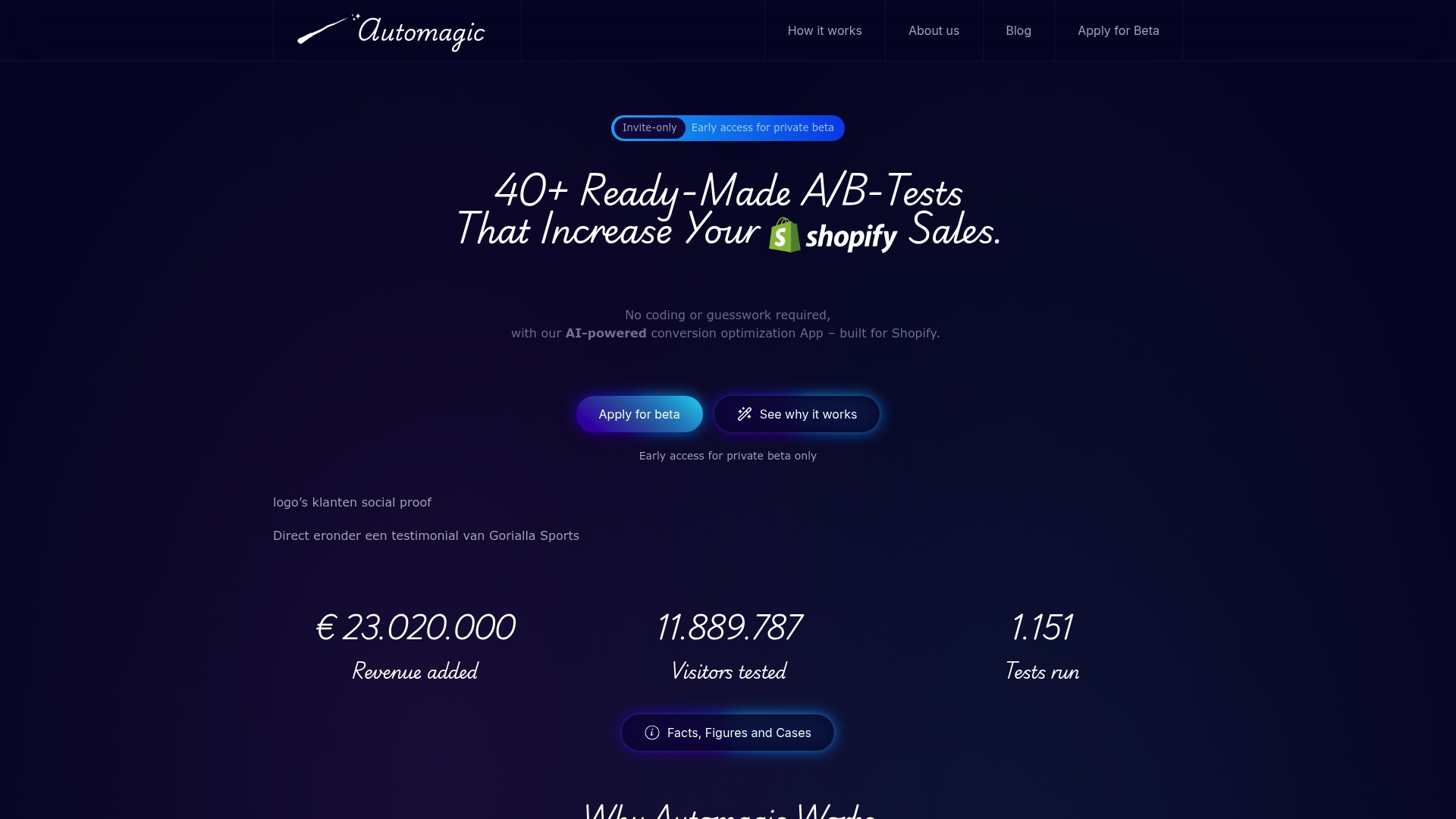
Take control of your Shopify store’s growth right now by visiting Automagic.li and unlock expert AI-powered testing that accelerates sales improvements. See how easy it is to reduce cart abandonment and enhance product pages with test variations proven to perform. Don’t miss out on the chance to transform complex optimization processes into simple, actionable solutions tailored for your business.
Frequently Asked Questions
How can I prioritize mobile optimization for my Shopify store in 2025?
To prioritize mobile optimization, focus on creating a seamless user experience that encourages purchases. Implement responsive layouts and conduct monthly mobile usability testing to identify and fix any friction points in your shopping experience.
What are effective strategies for AI-driven A/B testing in my Shopify store?
AI-driven A/B testing can help you quickly uncover optimization opportunities by automating experiments based on real user behavior. Start by selecting an AI-powered testing platform and defining clear conversion goals to enhance your store’s performance.
How can I reduce cart abandonment during the checkout process?
To reduce cart abandonment, streamline your checkout process by enabling guest checkout and minimizing form fields. Aim to provide clear total costs upfront and multiple payment options to create a frictionless purchasing experience, potentially recovering up to 35% of lost sales.
What social proof elements should I include on my product pages?
Include customer reviews, detailed testimonials, and user-generated content on your product pages to build trust with potential buyers. Highlight specific product benefits through authentic feedback to enhance credibility and encourage purchases.
How can I optimize my product pages for better conversions?
To optimize product pages, use high-resolution images, detailed descriptions, and clear pricing information. Focus on creating an immersive experience that addresses customer concerns and visualize different product variations effectively.
What repetitive tasks can I automate to save time as a Shopify store owner?
Automate repetitive tasks such as order processing, customer segmentation, and email marketing to streamline your operations. Start by mapping out your current manual processes and implement simple automation workflows to enhance efficiency and focus on strategic growth.