
AI-Powered Ecommerce Optimization for Shopify Success
More than 85 percent of American Shopify stores struggle to consistently increase conversion rates without technical expertise. For small and medium-sized businesses worldwide, the pressure to compete with bigger brands is relentless. AI-powered optimization now offers a smarter path, combining advanced algorithms and real-time insights to personalize your online shop and drive measurable results. Discover how automated A/B testing can transform your store’s performance, making high-level strategies accessible without any coding.
Table of Contents
- Defining AI-Powered Ecommerce Optimization
- Types of AI Tools for Shopify Stores
- How AI A/B Testing Drives Conversions
- Key Benefits: Personalization, Speed, ROI
- Common Pitfalls and Success Factors
Key Takeaways
| Point | Details |
|---|---|
| AI-Powered Personalization | Using AI to tailor experiences enhances engagement and improves conversion rates. |
| Dynamic Optimization | AI continuously analyzes data to adapt strategies in real time, reducing the need for manual adjustments. |
| Enhanced A/B Testing | AI-driven A/B testing allows for rapid experimentation and more precise improvements to conversion elements. |
| Strategic Implementation | A comprehensive strategy is essential for successful AI integration, focusing on data quality and aligned organizational goals. |
Defining AI-Powered Ecommerce Optimization
AI-powered ecommerce optimization represents a transformative approach to digital retail strategy, leveraging advanced machine learning technologies to enhance online shopping experiences. At its core, this methodology uses artificial intelligence to analyze complex customer data, predict behavior patterns, and dynamically improve store performance without manual intervention.
The fundamental goal of AI-powered optimization is to create intelligent, adaptive systems that can process vast amounts of user interaction data in real time. Advanced machine learning techniques enable these systems to understand customer preferences, recommend personalized products, and optimize conversion pathways automatically. This goes beyond traditional static website design by creating a responsive environment that evolves with each customer interaction.
Key components of AI-powered ecommerce optimization typically include:
- Personalized product recommendations
- Dynamic pricing strategies
- Automated customer segmentation
- Predictive inventory management
- Real-time user experience customization
Artificial intelligence transforms traditional ecommerce by turning raw data into actionable insights, allowing Shopify store owners to make precise, data-driven decisions that dramatically improve sales performance. The technology continuously learns and adapts, providing increasingly sophisticated optimization strategies without requiring constant manual adjustments.
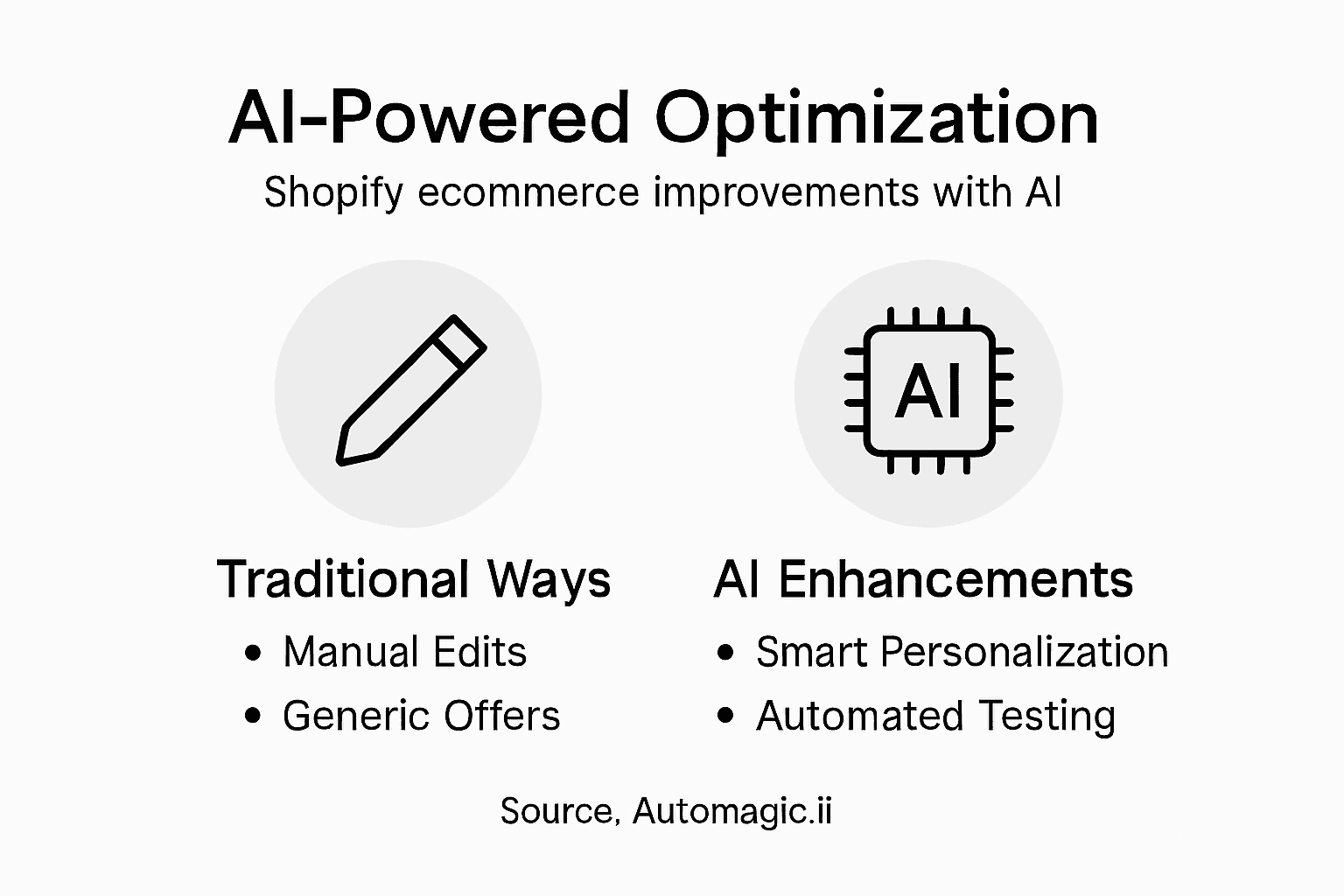
Here’s a concise comparison of traditional vs. AI-powered ecommerce optimization:
| Aspect | Traditional Optimization | AI-Powered Optimization |
|---|---|---|
| Personalization | Generic for all shoppers | Tailored to each individual |
| Data Processing | Manual analysis, slow updates | Automatic, real-time computation |
| Conversion Improvement | Incremental and guesswork-driven | Predictive, rapid, adaptive |
| Maintenance Effort | High and continuous | Low, self-adjusting algorithms |
Pro tip: Start with small, incremental AI-driven tests on your Shopify store to understand how machine learning can progressively enhance your conversion rates and customer experience.
Types of AI Tools for Shopify Stores
Shopify store owners have access to a diverse ecosystem of AI-powered tools designed to streamline operations, enhance customer experiences, and drive sales growth. AI tools for Shopify encompass multiple strategic categories that address different aspects of ecommerce performance, from content generation to customer support and marketing optimization.
The primary categories of AI tools for Shopify stores include:
- Content Generation Tools
- AI-powered product description writers
- Copywriting assistants
- Brand voice alignment generators
- Customer Interaction Tools
- Intelligent chatbots
- Automated support platforms
- Customer engagement systems
- Marketing Optimization Tools
- AI advertising creative generators
- Personalized recommendation engines
- Dynamic pricing algorithms
These AI technologies transform traditional ecommerce by introducing unprecedented levels of automation and personalization. Intelligent systems can now analyze customer behavior, generate compelling content, provide instant support, and create targeted marketing strategies with minimal human intervention. The result is a more responsive, efficient, and customer-centric online shopping environment that adapts in real time to user preferences and market dynamics.
Below is a summary table highlighting how different AI tool categories impact Shopify store growth:
| Tool Category | Primary Purpose | Example Benefit |
|---|---|---|
| Content Generation | Automate product descriptions | Boosts SEO and consistency |
| Customer Interaction | 24/7 shopper engagement | Increases satisfaction and trust |
| Marketing Optimization | Smarter campaign management | Maximizes ad ROI and targeting |
Pro tip: Start by implementing one AI tool in your most challenging business area to understand its impact and gradually expand your AI-powered optimization strategy.
How AI A/B Testing Drives Conversions
AI-powered A/B testing represents a revolutionary approach to conversion optimization for Shopify stores, transforming traditional experimentation methods into intelligent, data-driven strategies. Advanced AI testing techniques enable store owners to move beyond manual guesswork, leveraging machine learning algorithms that can rapidly analyze complex user behaviors and predict optimal website variations.
The key advantages of AI-driven A/B testing include:
- Rapid Experimentation
- Automated test design
- Accelerated data collection
- Real-time result analysis
- Intelligent Optimization
- Predictive user response modeling
- Dynamic variation adjustment
- Continuous performance learning
- Enhanced Decision Making
- Statistical confidence at scale
- Reduced manual intervention
- Precision-targeted improvements
Traditional A/B testing often requires significant time and technical expertise, limiting smaller Shopify stores from conducting sophisticated experiments. AI disrupts this limitation by introducing intelligent systems that can automatically generate, run, and analyze tests with minimal human input. These advanced algorithms can detect nuanced patterns in user interaction, suggesting and implementing improvements that human analysts might overlook.

Pro tip: Select one critical conversion element like product page layout or checkout process and apply AI-powered A/B testing to systematically improve its performance.
Key Benefits: Personalization, Speed, ROI
AI-powered optimization transforms Shopify stores by delivering unparalleled advantages that directly impact business performance. AI-powered personalization technologies enable store owners to create hyper-targeted shopping experiences that significantly boost engagement, conversion rates, and customer loyalty.
The three core benefits of AI-driven optimization include:
- Personalization
- Real-time adaptive recommendations
- Individualized customer journey mapping
- Dynamic content customization
- Speed
- Rapid data processing
- Instant performance insights
- Automated optimization cycles
- Return on Investment (ROI)
- Increased average order value
- Higher conversion rates
- Reduced customer acquisition costs
Traditional ecommerce strategies often rely on generic, one-size-fits-all approaches that fail to address individual customer preferences. AI disrupts this model by continuously learning from user interactions, creating a responsive ecosystem that evolves with customer behavior. By analyzing thousands of data points in milliseconds, AI can predict customer needs, suggest personalized products, and optimize pricing strategies with unprecedented precision.
Pro tip: Implement AI-driven personalization by starting with product recommendation features that can be easily integrated into your existing Shopify store design.
Common Pitfalls and Success Factors
Shopify store owners must navigate a complex landscape when implementing AI-powered optimization strategies. Common AI ecommerce challenges can derail even the most promising technological investments if not carefully managed and strategically approached.
Key pitfalls that Shopify entrepreneurs must proactively address include:
- Data Infrastructure Challenges
- Incomplete or low-quality data
- Fragmented data sources
- Inconsistent data collection methods
- Strategic Alignment Issues
- Unclear project objectives
- Misaligned organizational goals
- Unrealistic performance expectations
- Technical Implementation Barriers
- Complex integration requirements
- Scalability limitations
- Performance monitoring gaps
Successful AI optimization requires a methodical approach that transcends technological implementation. Store owners must develop a holistic strategy that integrates cross-functional collaboration, continuous learning, and adaptive performance metrics. This means moving beyond simply purchasing AI tools and instead creating a comprehensive ecosystem where data, technology, and business objectives work in seamless harmony.
Pro tip: Start with a small-scale AI pilot project that targets a specific, measurable business challenge to validate your approach before full-scale implementation.
Unlock AI-Powered Conversion Growth for Your Shopify Store
Struggling with slow conversion improvements or complex AI implementations on your Shopify site The article reveals how AI-driven optimization and A/B testing can deliver rapid, personalized results without overwhelming technical demands. Key pain points like the need for real-time experimentation, data-driven decisions, and easy deployment are exactly what many Shopify merchants face daily. With terms like AI-powered A/B testing and dynamic variation adjustment, the challenge is to harness machine learning without needing to hire developers or become an expert yourself.
At Automagic.li, we transform those challenges into opportunities by offering a SaaS platform built specifically for Shopify stores to simplify AI-powered conversion optimization Our library of over 40 pre-tested, high-impact A/B test variations require no coding knowledge and adapt automatically to your unique store design. This lets you quickly apply intelligent experiments that boost sales and improve user experience — all while eliminating manual guesswork and technical barriers.
Automagic.li empowers Shopify entrepreneurs to leverage the precise, predictive benefits of AI outlined in the article like real-time optimization and personalized testing without the heavy lifting.
Take control of your ecommerce success today and experience how AI-driven A/B testing accelerates revenue growth and delivers measurable ROI.
Discover how to automate your Shopify store optimization now
Frequently Asked Questions
What is AI-powered ecommerce optimization?
AI-powered ecommerce optimization utilizes advanced machine learning technologies to analyze customer data and enhance online shopping experiences by providing personalized recommendations, dynamic pricing, and automated customer segmentation.
How can AI tools improve my Shopify store’s performance?
AI tools enhance performance by automating tasks such as content generation, customer interaction, and marketing optimization, leading to increased engagement, conversion rates, and overall sales growth.
What advantages does AI-powered A/B testing offer for Shopify stores?
AI-powered A/B testing enables rapid experimentation, intelligent optimization, and enhanced decision-making by automatically generating and analyzing tests to predict the best website variations based on user behavior.
What are some common pitfalls to avoid when implementing AI in ecommerce?
Common pitfalls include challenges with data quality and infrastructure, unclear project objectives, misalignment with business goals, and technical implementation barriers that can hinder effective AI integration.