
Why Use Shopify for Ecommerce Success
Nearly 30 percent of American online retailers pick Shopify as their first step into ecommerce, and it is not hard to see why. For busy store owners without a technical background, understanding this platform can clear the path to smarter growth. If you want a user-friendly, scalable solution that pairs perfectly with AI-driven A/B testing, this overview brings clear answers and actionable insights to help you thrive.
Table of Contents
- Shopify Platform For Ecommerce Explained
- Key Features Powering Shopify Stores
- Types Of Shopify Plans And Options
- Essential Costs And Financial Implications
- Comparing Shopify To Other Platforms
- Practical Risks And Common Mistakes To Avoid
Key Takeaways
| Point | Details |
|---|---|
| User-Friendly Platform | Shopify enables entrepreneurs to create and manage online stores easily, ideal for those with minimal technical expertise. |
| Comprehensive Features | The platform offers powerful tools for inventory management, marketing, and multi-channel selling, enhancing overall business functionality. |
| Flexible Pricing Plans | Shopify provides diverse pricing options suited for various business stages, allowing for seamless scaling as needs evolve. |
| Risk Management Awareness | Store owners should proactively manage security vulnerabilities and prioritize ongoing updates to ensure business sustainability. |
Shopify platform for ecommerce explained
Shopify is a powerful, user-friendly cloud-based ecommerce platform designed to help entrepreneurs and businesses create and manage online stores seamlessly. Founded in 2006 and headquartered in Canada, Shopify has rapidly transformed how small and medium enterprises establish their digital retail presence, supporting over 5 million customers worldwide.
The platform offers comprehensive features that simplify online selling, including customizable website templates, integrated payment processing, inventory management, and marketing tools. Merchants can quickly set up professional online stores without extensive technical knowledge, choosing from hundreds of design themes and adding products through an intuitive interface. Shopify supports multiple sales channels, enabling businesses to sell not just through their website, but also via social media platforms, marketplaces, and physical point-of-sale systems.
One of Shopify’s most significant advantages is its scalability and flexibility. Whether you’re a solo entrepreneur launching your first product or an established brand seeking global expansion, the platform provides robust solutions. Its open-source template language called Liquid allows advanced customization, while extensive app integrations enable businesses to extend functionality according to their unique requirements.
Pro Tip: Start with Shopify’s basic plan and gradually upgrade as your business grows, leveraging their flexible pricing structure to match your evolving ecommerce needs.
Key features powering Shopify stores
Shopify provides a comprehensive suite of ecommerce features designed for seamless online selling, empowering entrepreneurs to build and manage sophisticated digital storefronts with minimal technical expertise. The platform’s robust infrastructure supports businesses of all sizes through integrated tools that streamline every aspect of online retail operations.
Key functionalities include advanced product management, allowing merchants to upload unlimited products with detailed descriptions, images, and variations. The platform offers customizable website templates that enable quick store setup, complemented by powerful marketing tools for search engine optimization, email campaigns, and social media integration. Merchants can leverage multiple payment processing options, including Shopify Payments, which simplifies transaction management and reduces complexity for store owners.

Multi-channel selling represents another critical feature, enabling businesses to expand their reach beyond traditional websites. Shopify supports seamless integration with social media platforms, marketplaces, and physical point-of-sale systems, allowing entrepreneurs to synchronize inventory, track sales, and manage customer interactions across different channels. The extensive app ecosystem further enhances platform capabilities, providing specialized solutions for shipping, inventory tracking, customer service, and advanced analytics.
Pro Tip: Explore Shopify’s app store strategically, focusing on apps that directly address your specific business challenges and can demonstrably improve your store’s performance and customer experience.
Types of Shopify plans and options
Shopify offers a diverse range of pricing plans designed to accommodate businesses at every stage, from solo entrepreneurs to large enterprises. The platform’s flexible approach ensures that merchants can find a solution that matches their specific operational needs and budget constraints.
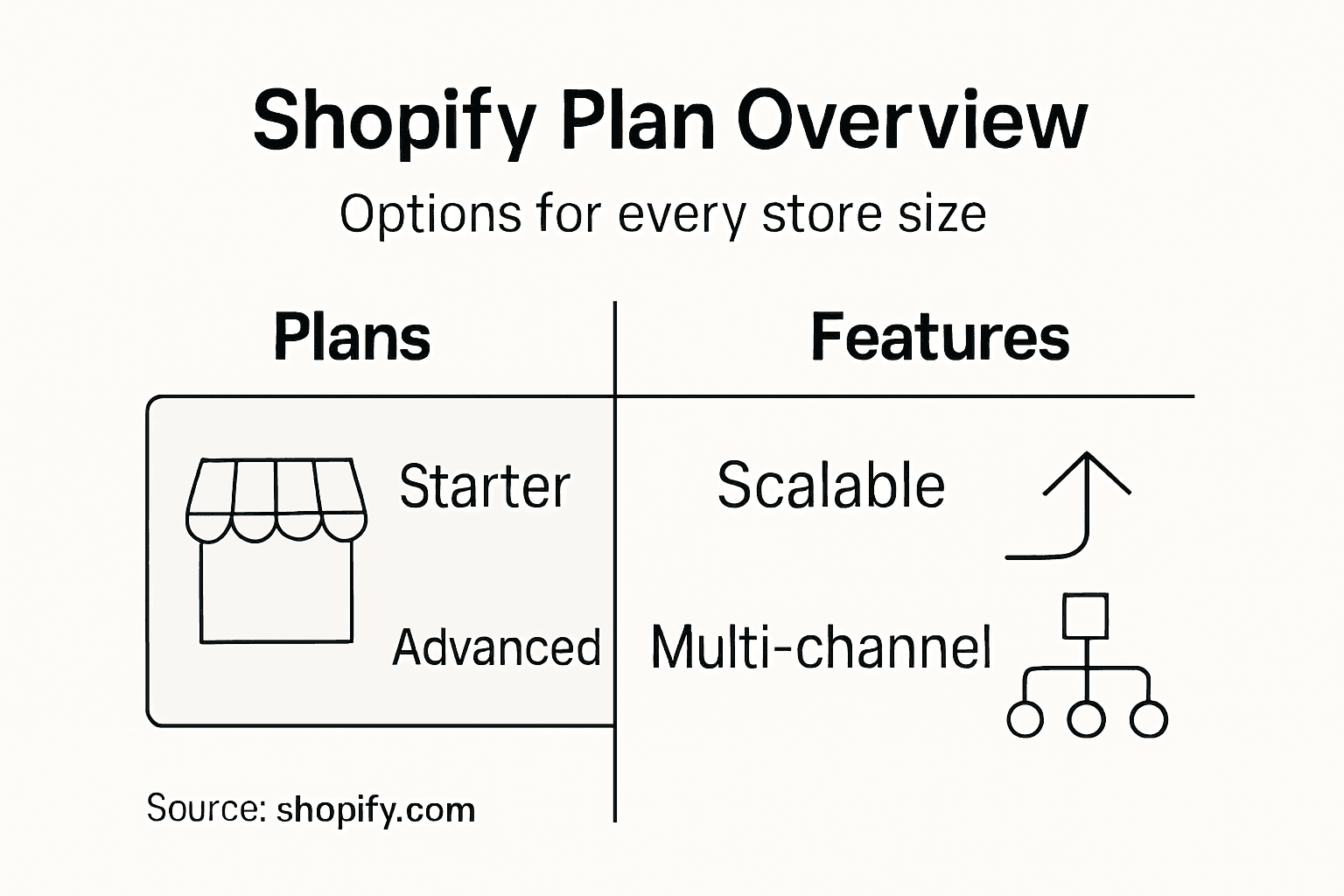
The pricing spectrum begins with the Starter plan at $5 per month, ideal for influencers and social media sellers wanting to test ecommerce waters. Small businesses typically gravitate toward the Basic Shopify plan at $39 monthly, which provides essential features like website and blog hosting, unlimited product uploads, and two staff accounts. For growing businesses requiring more advanced capabilities, the standard Shopify plan at $105 per month offers additional reporting tools and lower transaction fees, making it attractive for small to medium-sized operations.
For established businesses seeking comprehensive functionality, Shopify Advanced at $399 monthly provides sophisticated features like advanced reporting, third-party calculated shipping rates, and the lowest transaction fees. Enterprise-level merchants can access Shopify Plus, a custom solution starting at $2000 monthly that delivers specialized support, dedicated account management, and extensive customization options for high-volume sellers. Each plan strategically removes barriers to entry, allowing businesses to scale seamlessly without switching platforms.
Here is a side-by-side comparison of Shopify’s main pricing plans to assist in choosing the right one:
| Plan Name | Monthly Price | Target Audience | Key Added Value |
|---|---|---|---|
| Starter | $5 | Influencers, social sellers | Quick social channel checkout |
| Basic Shopify | $39 | New small businesses | Website, blog, basic reports |
| Shopify | $105 | Growing companies | Professional reports, lower fees |
| Advanced Shopify | $399 | Scaling or multi-location brands | Advanced reporting, 3rd-party rates |
| Shopify Plus | $2000+ | Enterprises, high-volume sellers | Customization, dedicated support |
Pro Tip: Calculate your potential transaction costs across different plans, considering not just the monthly fee but also per-transaction expenses to determine the most cost-effective option for your specific sales volume.
Essential costs and financial implications
Navigating the financial landscape of Shopify requires a comprehensive understanding of multiple cost components beyond the monthly subscription. Entrepreneurs must carefully analyze the total expense structure, which encompasses not just platform fees but also transaction costs, payment processing charges, and potential additional investments in apps and customization.
Payment processing fees represent a significant financial consideration for Shopify store owners. The platform offers its native Shopify Payments solution, which can help merchants reduce transaction fees compared to using external payment gateways. Depending on the selected plan, transaction fees range from 2.4% + 30 cents to 2.7% + 0 cents per transaction, with more advanced plans providing progressively lower rates. Additional expenses can include third-party app purchases, premium themes, and specialized integrations that enhance store functionality but incrementally increase overall operational costs.
Beyond direct platform expenses, merchants should budget for indirect costs such as marketing, shipping, inventory management, and potential custom development. While Shopify provides robust out-of-the-box solutions, scaling businesses often require specialized tools that come with their own pricing structures. Smart financial planning involves not just minimizing expenses but strategically investing in features that directly contribute to revenue generation and operational efficiency.
The following table summarizes indirect and often-overlooked costs that impact Shopify store profitability:
| Cost Category | Typical Examples | Long-Term Impact |
|---|---|---|
| Marketing | Ads, email campaigns, SEO tools | Drives growth, can erode margins |
| Shipping | Carrier fees, packaging, tracking tools | Affects competitiveness, experience |
| Apps & Themes | Subscription apps, premium store themes | Enhances functionality, adds cost |
| Development | Custom coding, integrations | Boosts uniqueness, increases spend |
| Maintenance | Security, regular platform audits | Ensures reliability, prevents loss |
Pro Tip: Conduct a quarterly audit of your Shopify expenses, meticulously tracking subscription costs, transaction fees, and app investments to ensure your technology stack remains cost-effective and aligned with your business growth strategy.
Comparing Shopify to other platforms
Comparing e-commerce platforms requires a nuanced evaluation of key performance and usability factors. Shopify distinguishes itself through an exceptional blend of user-friendliness, robust features, and scalable infrastructure that sets it apart from competitors like WooCommerce, BigCommerce, and Magento.
The platform’s strengths become evident when examining critical aspects such as setup complexity, customization potential, and total cost of ownership. Unlike some alternatives that demand significant technical expertise, Shopify offers an intuitive interface that enables entrepreneurs with minimal web development skills to launch professional online stores quickly. Its comprehensive app ecosystem provides extensive functionality beyond basic e-commerce requirements, allowing businesses to add sophisticated features like advanced marketing tools, inventory management, and customer relationship management without complex custom development.
Where Shopify truly excels is in its balanced approach to accessibility and advanced capabilities. While platforms like Magento offer deep customization for enterprise-level businesses, they often require substantial technical resources. Conversely, Shopify provides a sweet spot of flexibility and ease of use, supporting businesses from startup to scale-up with seamless upgrade paths. Its integrated point-of-sale system, robust API, and global payment gateway support make it particularly attractive for businesses seeking a comprehensive, future-proof e-commerce solution.
Pro Tip: Before committing to an e-commerce platform, create a detailed checklist of your specific business requirements and test the platform’s capabilities through free trials to ensure optimal alignment with your operational needs.
Practical risks and common mistakes to avoid
Shopify store owners must remain vigilant about potential risks, starting with understanding critical web application security vulnerabilities. Cybersecurity threats can compromise not just technical infrastructure, but customer trust and brand reputation, making proactive risk management essential for sustainable online businesses.
Common mistakes often stem from overlooking fundamental operational details. Many entrepreneurs underestimate the importance of comprehensive market research, resulting in poorly designed websites that fail to convert visitors. Neglecting SEO optimization, payment security standards, and customer engagement strategies can severely limit a store’s potential for growth. Critical errors include using generic website themes without customization, failing to implement robust security protocols, and inadequately configuring payment gateways.
The Shopify ecosystem presents unique challenges that require strategic navigation. Store owners should be cautious about overreliance on default settings, understanding that while the platform provides powerful tools, successful implementation demands active management. This includes regularly updating apps, monitoring transaction security, implementing strong authentication methods, and conducting periodic security audits. Developing a comprehensive understanding of the platform’s capabilities and potential vulnerabilities is crucial for maintaining a secure and profitable online business.
Pro Tip: Conduct a monthly security and performance audit of your Shopify store, systematically reviewing app permissions, transaction logs, and user access to preemptively identify and mitigate potential risks.
Unlock Your Shopify Store’s Full Potential with Automated A B Testing
The article highlights how Shopify provides a scalable and flexible platform for online selling yet optimizing conversion rates remains a crucial challenge for many store owners. You want to avoid common mistakes like overlooking detailed market data and the difficulty of manually customizing tests without technical skills. The pain point many Shopify merchants face is how to efficiently improve sales performance using data driven methods without hiring expensive developers or spending countless hours on trial and error.
Automagic.li offers a perfect solution tailored to these exact challenges. It is a SaaS platform designed specifically for Shopify stores to boost eCommerce conversion rates through AI powered A B testing. With over 40 ready made test variations ranked by impact and certainty, you can quickly identify and deploy high impact changes to your store — no coding expertise needed. This automation transforms the complex process of customization described in the article into a simple, fast, and cost effective growth strategy.
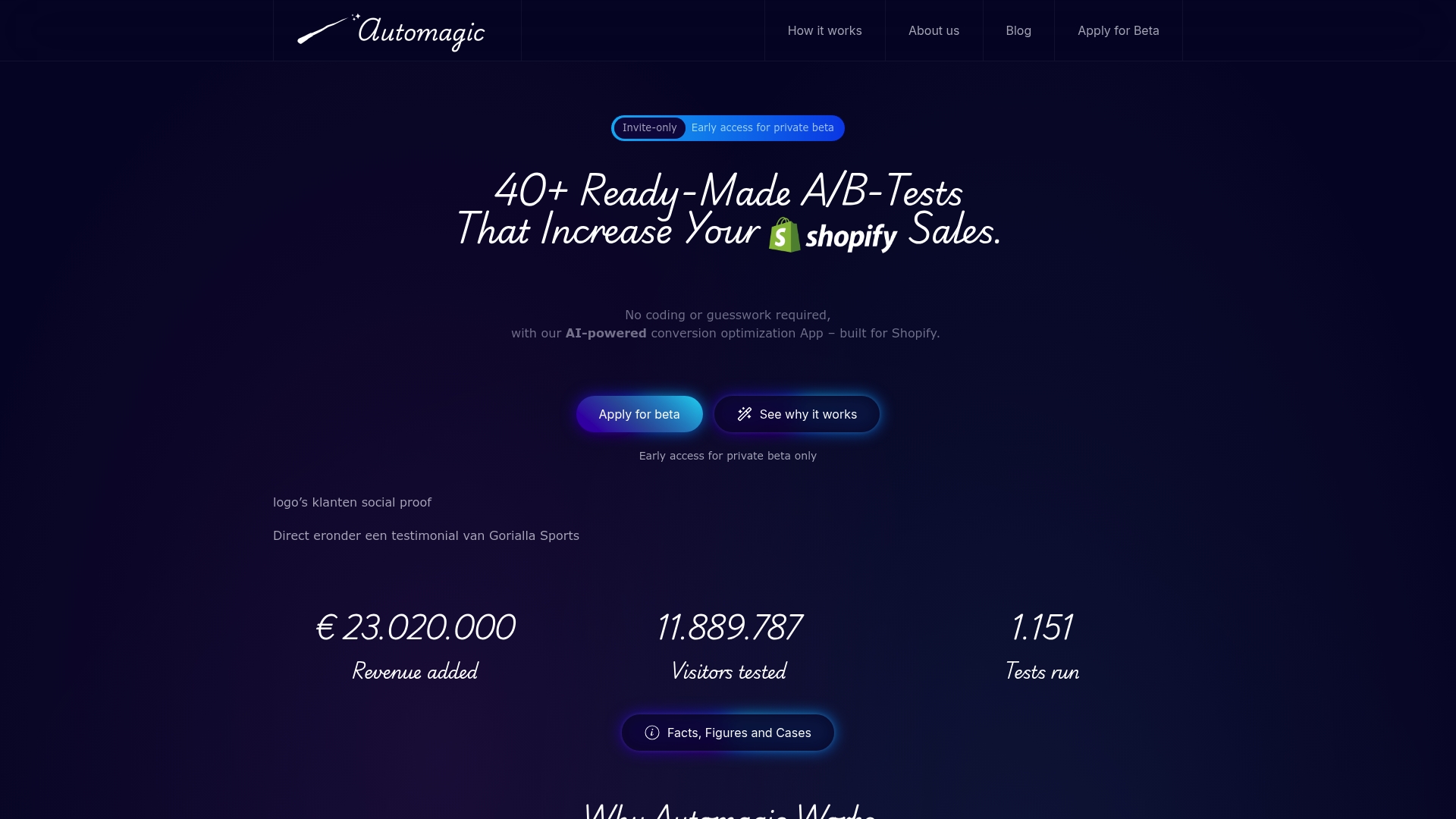
Take the next step toward maximizing your Shopify store’s revenue and customer engagement by visiting Automagic.li today. Explore how you can start deploying proven conversion tests immediately and see measurable improvements. Don’t let manual optimization slow your growth when advanced AI powered tools are available to democratize success at scale. Your Shopify store deserves smarter testing and faster results now.
Frequently Asked Questions
What is Shopify and how does it work for eCommerce?
Shopify is a cloud-based eCommerce platform that allows businesses to create and manage online stores easily. It offers various features such as customizable templates, payment processing, inventory management, and marketing tools, making it user-friendly for entrepreneurs.
What are the main features that make Shopify stand out for online selling?
Shopify provides advanced product management, customizable website themes, multi-channel selling capabilities, and an extensive app ecosystem. These features streamline operations, enhance marketing efforts, and allow merchants to sell across various platforms.
How does Shopify’s pricing structure work?
Shopify offers several pricing plans, starting from a basic plan at $5 per month aimed at small sellers, to comprehensive plans for larger businesses. Each plan includes different features, so merchants can choose one that fits their operational needs and budget.
What are the common costs associated with using Shopify?
In addition to the monthly subscription, Shopify users must consider transaction fees, payment processing charges, and potential costs for additional apps and features. Smart budgeting for these costs will help maintain profitability while scaling the business.