
Why Testing Improves Sales for Shopify Stores
Most American Shopify stores miss out on easy sales gains by skipping automated A/B testing. If you want more purchases but lack coding skills or a developer budget, you are not alone. A/B testing makes website changes scientific—so you know what customers like, not just what you guess. Stores using data-driven experiments see up to 30 percent better conversion rates. You will discover practical ways to boost sales by testing real changes, all without learning complex tech.
Table of Contents
- Defining A/B Testing for Shopify Stores
- Types of A/B Tests in eCommerce
- How Testing Drives Sales Growth
- Key Benefits: Data, Experience, and Revenue
- Common Pitfalls and How to Avoid Them
Key Takeaways
| Point | Details |
|---|---|
| A/B Testing is Essential | Shopify store owners should utilize A/B testing to make data-driven decisions that systematically enhance conversion rates and sales. |
| Focus on Key Elements | Prioritize testing significant variables such as product images, call-to-action buttons, and checkout processes for maximum impact. |
| Continuous Improvement Mindset | Treat A/B testing as an ongoing strategy, regularly running experiments to optimize performance and adapt to customer preferences. |
| Avoid Common Pitfalls | Ensure proper test design by maintaining adequate sample sizes and durations to derive reliable and actionable insights. |
Defining A/B Testing for Shopify Stores
A/B testing represents a powerful optimization strategy for Shopify store owners seeking to improve conversion rates and increase sales systematically. At its core, A/B testing involves comparing two variations of a webpage element to determine which version performs better with real customers. For Shopify entrepreneurs, this means scientifically experimenting with different design, content, and functional elements to understand precisely what drives more purchases.
In practice, A/B testing allows store owners to make data-driven decisions about website improvements. Imagine running two slightly different product page layouts simultaneously – one with a blue “Add to Cart” button and another with a green button. By tracking which version generates more clicks and sales, you eliminate guesswork and base optimizations on actual customer behavior. Ecommerce A/B Testing strategies can reveal nuanced insights about customer preferences that traditional analytics might miss.
Successful A/B testing for Shopify stores typically focuses on key conversion elements like product descriptions, imagery, pricing displays, checkout process, and call-to-action buttons. The goal is not just incremental improvements, but uncovering breakthrough changes that can dramatically boost sales performance. Effective testing requires careful planning, statistical rigor, and a willingness to challenge existing assumptions about what customers want.
Pro tip: Start with high-impact, low-effort A/B tests like button color or headline text to build confidence in your optimization process before tackling more complex experiments.
Types of A/B Tests in eCommerce
E-commerce A/B testing encompasses several strategic approaches designed to optimize different aspects of online stores. Research on systematic A/B testing methodologies reveals three primary categories of tests: visual element tests, algorithmic tests, and workflow optimization tests. Visual element tests are the most common, focusing on design components that directly impact customer engagement and conversion rates.
Visual element tests typically target specific page components like button colors, headline text, product imagery, and layout arrangements. These tests help Shopify store owners understand how small design modifications can significantly influence customer behavior. For instance, changing a button’s color from blue to green might increase click-through rates, or repositioning product images could improve user interaction. Meta-analysis of e-commerce A/B testing interventions demonstrates that strategic design changes can yield substantial improvements in conversion rates, particularly when implemented at critical points in the customer journey.

Algorithmic and workflow optimization tests represent more advanced testing strategies. Algorithmic tests focus on personalization techniques like product recommendation algorithms, while workflow tests examine the efficiency of user processes such as checkout sequences, form designs, and navigation paths. These sophisticated tests require higher traffic volumes and more complex statistical analysis but can unlock profound insights into customer preferences and behavior patterns.
Pro tip: Prioritize A/B tests with the highest potential impact by starting with elements directly connected to conversion, such as call-to-action buttons, pricing displays, and product page layouts.
Here’s a quick summary of the main types of A/B tests in eCommerce and their unique focus:
| Test Type | Focus Area | Typical Elements Tested | Business Impact |
|---|---|---|---|
| Visual Element | Design and aesthetics | Buttons, headlines, layout, imagery | Quick conversion rate improvements |
| Algorithmic | Personalization strategies | Recommendation engines, search logic | Enhanced user engagement and relevance |
| Workflow Optimization | Process efficiency | Checkout flow, forms, navigation | Reduced friction, smoother user journey |
How Testing Drives Sales Growth
A/B testing serves as a powerful mechanism for driving sales growth by systematically uncovering what truly motivates customers to make purchases. Comprehensive research on e-commerce optimization strategies demonstrates that methodical testing can dramatically improve key performance metrics like conversion rates, average order value, and customer retention. By implementing controlled experiments, Shopify store owners can transform guesswork into precise, data-driven decision-making that directly impacts revenue.
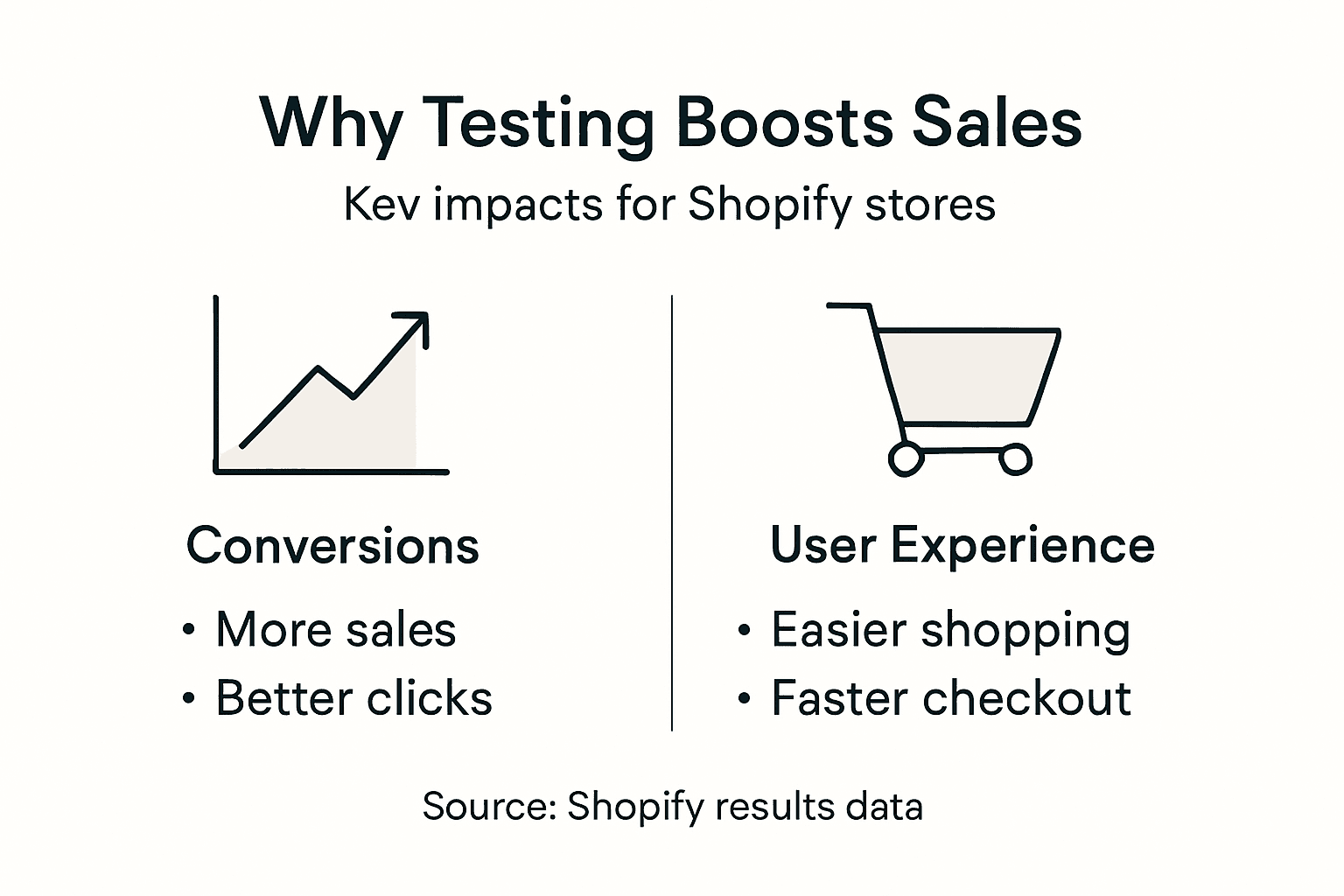
The process of driving sales growth through testing involves multiple strategic approaches. Store owners can analyze customer behavior by experimenting with different elements such as product descriptions, pricing strategies, checkout processes, and visual design. Each test provides granular insights into customer preferences, revealing subtle psychological triggers that influence purchasing decisions. For example, changing a product description’s tone, adjusting pricing presentation, or modifying call-to-action button designs can yield significant improvements in sales performance.
Effective sales growth through testing requires a continuous improvement mindset. Successful Shopify stores treat A/B testing not as a one-time activity but as an ongoing optimization strategy. By consistently running experiments, collecting data, and implementing winning variations, businesses can create a compounding effect of incremental improvements. These small, data-backed changes accumulate over time, creating a robust mechanism for sustainable sales growth that adapts to evolving customer preferences and market dynamics.
Pro tip: Implement a systematic testing schedule where you run at least one meaningful A/B test per month, focusing on high-impact elements that directly influence customer conversion.
Key Benefits: Data, Experience, and Revenue
A/B testing unlocks three fundamental benefits for Shopify store owners: data-driven insights, enhanced customer experience, and sustainable revenue growth. Data collection becomes a strategic asset, transforming raw information into actionable intelligence that guides critical business decisions. By systematically capturing and analyzing customer interactions, store owners gain unprecedented visibility into user behavior, preferences, and conversion barriers.
The customer experience dimension of A/B testing represents a powerful optimization mechanism. Each test provides an opportunity to refine website elements, creating increasingly intuitive and engaging user journeys. Subtle modifications in design, messaging, and navigation can dramatically improve how customers perceive and interact with an online store. Increasing Revenue With A/B Tests demonstrates that strategic testing can remove friction points, streamline purchase processes, and create more compelling shopping experiences that naturally encourage higher conversion rates.
Revenue growth emerges as the most tangible benefit of consistent A/B testing. Unlike traditional marketing approaches that rely on intuition, testing provides a scientific method for incrementally improving sales performance. By continuously experimenting with different variations and implementing data-validated improvements, Shopify store owners can create a compounding effect of revenue optimization. These systematic refinements allow businesses to adapt quickly to changing market dynamics, customer preferences, and competitive landscapes.
Pro tip: Develop a systematic testing framework that allocates specific time and resources for monthly experimentation, treating A/B testing as a core business strategy rather than an occasional activity.
This table highlights the key benefits A/B testing delivers for Shopify store owners:
| Benefit | Description | Example Outcome |
|---|---|---|
| Data-Driven Insights | Informed decisions from user behavior data | Tailored product page optimizations |
| Enhanced Experience | Improved shopper journey and usability | Higher satisfaction and repeat visits |
| Sustainable Revenue | Consistent sales growth through refinement | Increased average order value monthly |
Common Pitfalls and How to Avoid Them
A/B testing in Shopify stores can quickly become ineffective if store owners fall into common methodological traps. Comprehensive research on A/B testing methodologies reveals several critical mistakes that can compromise test reliability and lead to misguided business decisions. Understanding these pitfalls is crucial for developing robust testing strategies that generate genuine, actionable insights.
One of the most significant errors is misinterpreting statistical significance and running tests with insufficient sample sizes or duration. Many store owners prematurely conclude results without allowing adequate time for meaningful data collection. E-commerce A/B testing research highlights the importance of controlling variables, ensuring diverse device representation, and accounting for external factors that might skew test outcomes. This means running tests long enough to capture different user behaviors, avoiding simultaneous multiple element changes, and segmenting results across different customer groups and device types.
Another critical pitfall involves neglecting the broader context of user behavior and focusing too narrowly on isolated metrics. Successful A/B testing requires a holistic understanding of customer journeys, recognizing that changes in one area can have ripple effects across the entire shopping experience. Store owners must develop a nuanced approach that considers interconnected user interactions, psychological triggers, and the cumulative impact of seemingly minor design modifications. By adopting a comprehensive perspective, Shopify entrepreneurs can transform A/B testing from a tactical exercise into a strategic optimization tool.
Pro tip: Create a standardized testing protocol that includes minimum sample size requirements, predetermined test duration, and a comprehensive checklist for controlling external variables before launching any A/B test.
Unlock Shopify Sales Growth with AI-Driven A/B Testing
Struggling to transform the theory of A/B testing into real Shopify sales growth? The article highlights common challenges such as ineffective test design, insufficient data, and the need for ongoing optimization to drive meaningful revenue. If your goal is to skip guesswork and leverage data-driven insights to boost conversion rates, finding a streamlined solution is critical. Incorporating the article’s focus on visual element tests and continuous improvement, Automagic.li makes advanced A/B testing accessible and effortless for Shopify store owners.
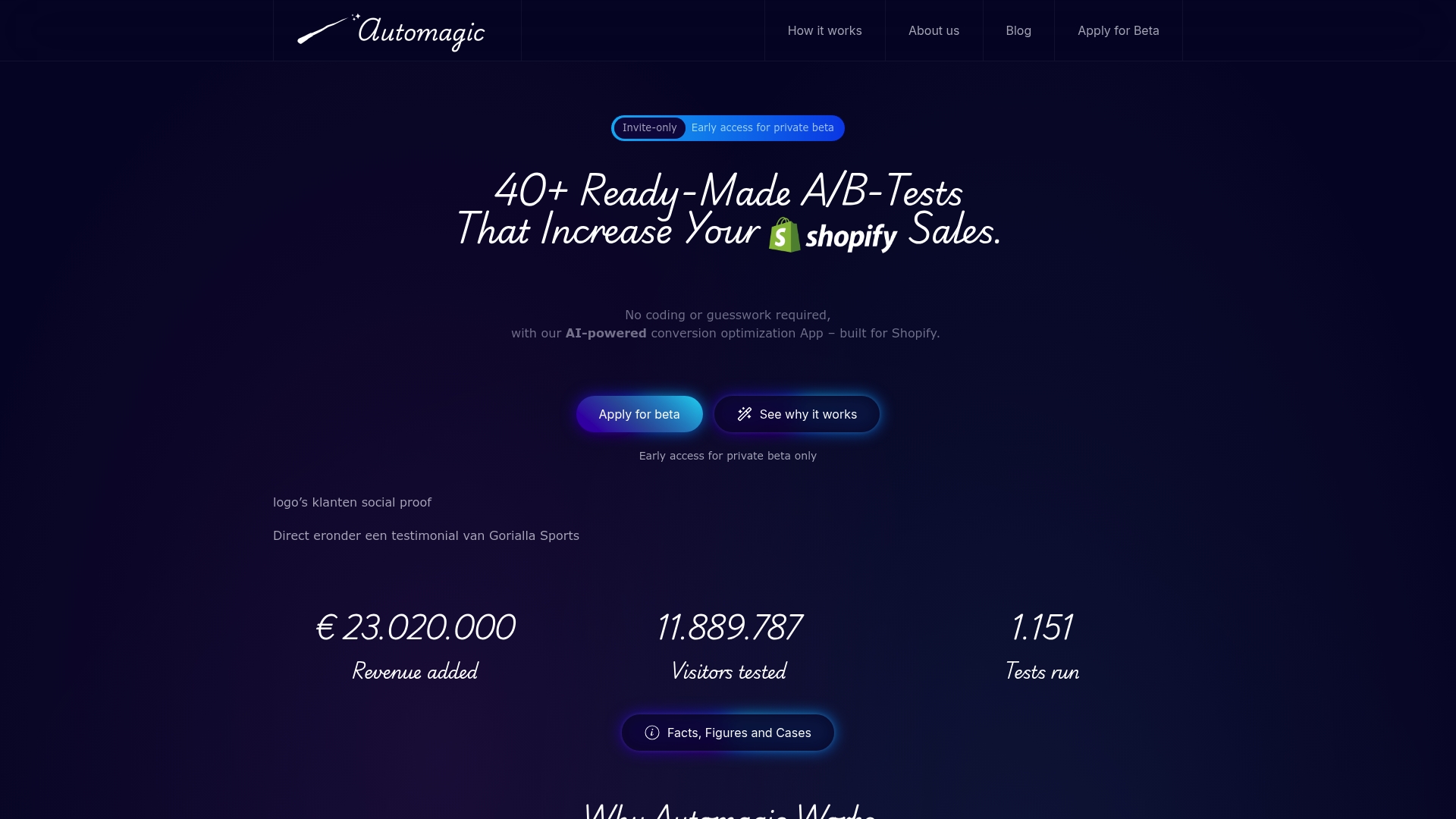
Experience the power of an AI-powered SaaS platform that offers over 40 ready-made, pre-tested variations tailored specifically for Shopify stores. You can deploy high-impact tests without any coding knowledge, saving precious time and resources while eliminating technical barriers. Start optimizing product pages, checkout flows, and call-to-action elements with confidence today. Visit Automagic.li to see how smart, automated A/B testing can accelerate your store’s sales growth and give you reliable, data-backed results now.
Frequently Asked Questions
How does A/B testing improve conversion rates for Shopify stores?
A/B testing allows store owners to compare different versions of webpage elements, determining which variant leads to higher conversion rates based on actual customer behavior.
What are the key elements to test in an A/B experiment?
Key elements to test include product descriptions, button colors, checkout processes, pricing displays, and overall layout to see which variations lead to the best sales results.
How can understanding customer preferences enhance the testing process?
By analyzing customer behavior during A/B tests, store owners can uncover subtle psychological triggers that influence purchasing decisions, leading to more effective optimization strategies.
What are common pitfalls to avoid when conducting A/B tests?
Common pitfalls include misinterpreting statistical significance, running tests with insufficient sample sizes, and neglecting the broader context of user behavior, which can lead to misguided conclusions.