
Role of A/B Testing in 2025: Impact on Shopify Success
Nearly a third of Shopify stores, including many American businesses, miss out on higher conversion rates due to a lack of simple optimization tools. For eCommerce entrepreneurs with limited technical skills, figuring out what really works can be challenging. This guide explains how modern A/B testing helps store owners make smarter, data-driven decisions that directly impact conversion rates and revenue.
Table of Contents
- A/B Testing Defined For Modern Ecommerce
- Types Of A/B Tests Used In 2025
- AI-Powered Testing: How Automation Works
- Practical Benefits For Shopify Store Owners
- Common Mistakes And How To Avoid Them
Key Takeaways
| Point | Details |
|---|---|
| A/B Testing Importance | Systematic A/B testing is essential for Shopify store owners to optimize user experience and increase conversion rates. |
| Methodological Advancement | Advanced testing methodologies, including AI-powered approaches, enable deeper insights and faster analysis. |
| Practical Benefits | Strategic A/B testing can lead to significant revenue growth through improved conversion rates and enhanced user experiences. |
| Common Mistakes | Avoid pitfalls like testing too many variables simultaneously and not considering mobile experience to ensure meaningful results. |
A/B Testing Defined for Modern Ecommerce
In the rapidly evolving world of digital commerce, A/B testing has emerged as a critical strategy for Shopify store owners seeking data-driven optimization. Online controlled experiments represent a sophisticated approach to understanding user behavior and making strategic improvements to ecommerce platforms.
At its core, A/B testing involves comparing two different versions of a webpage, design element, or user experience to determine which performs better. Sophisticated digital merchants use this method to systematically evaluate changes in product descriptions, checkout processes, visual layouts, and marketing messages. By randomly presenting different variants to user groups, store owners can collect precise data about which version drives higher conversion rates, increases average order value, or improves overall user engagement.
Modern A/B testing goes far beyond simple guesswork. Randomized controlled trials applied digitally enable ecommerce businesses to make statistically validated decisions. This approach allows Shopify entrepreneurs to understand nuanced user interactions, test hypotheses about design and functionality, and continuously refine their online stores with empirical evidence. The process involves carefully designing experiments, collecting user interaction data, and applying rigorous statistical analysis to draw meaningful conclusions.
Pro tip: Start with low-risk, high-impact A/B tests like button colors, headline variations, or product image placements to build confidence in your optimization strategy.
Types of A/B Tests Used in 2025
Shopify store owners in 2025 will leverage increasingly sophisticated A/B testing methodologies designed to extract maximum insights from digital experiments. Hybrid experimentation approaches now combine client-side and server-side testing strategies, enabling more nuanced and precise evaluations of digital experiences.
These advanced testing types can be categorized into several key methodological approaches:
- Visual Design Tests: Evaluating color schemes, button placements, image selections, and layout configurations
- Conversion Funnel Tests: Analyzing checkout process variations, form designs, and navigation flow optimization
- Pricing Strategy Tests: Comparing different pricing structures, discount presentations, and promotional messaging
- Product Page Tests: Examining product description formats, image arrangements, and interactive element placements
Anytime-valid inference models are revolutionizing how Shopify merchants conduct experiments. These sophisticated techniques allow continuous monitoring and early experiment termination when statistically significant differences emerge, dramatically reducing testing time and resource investment.
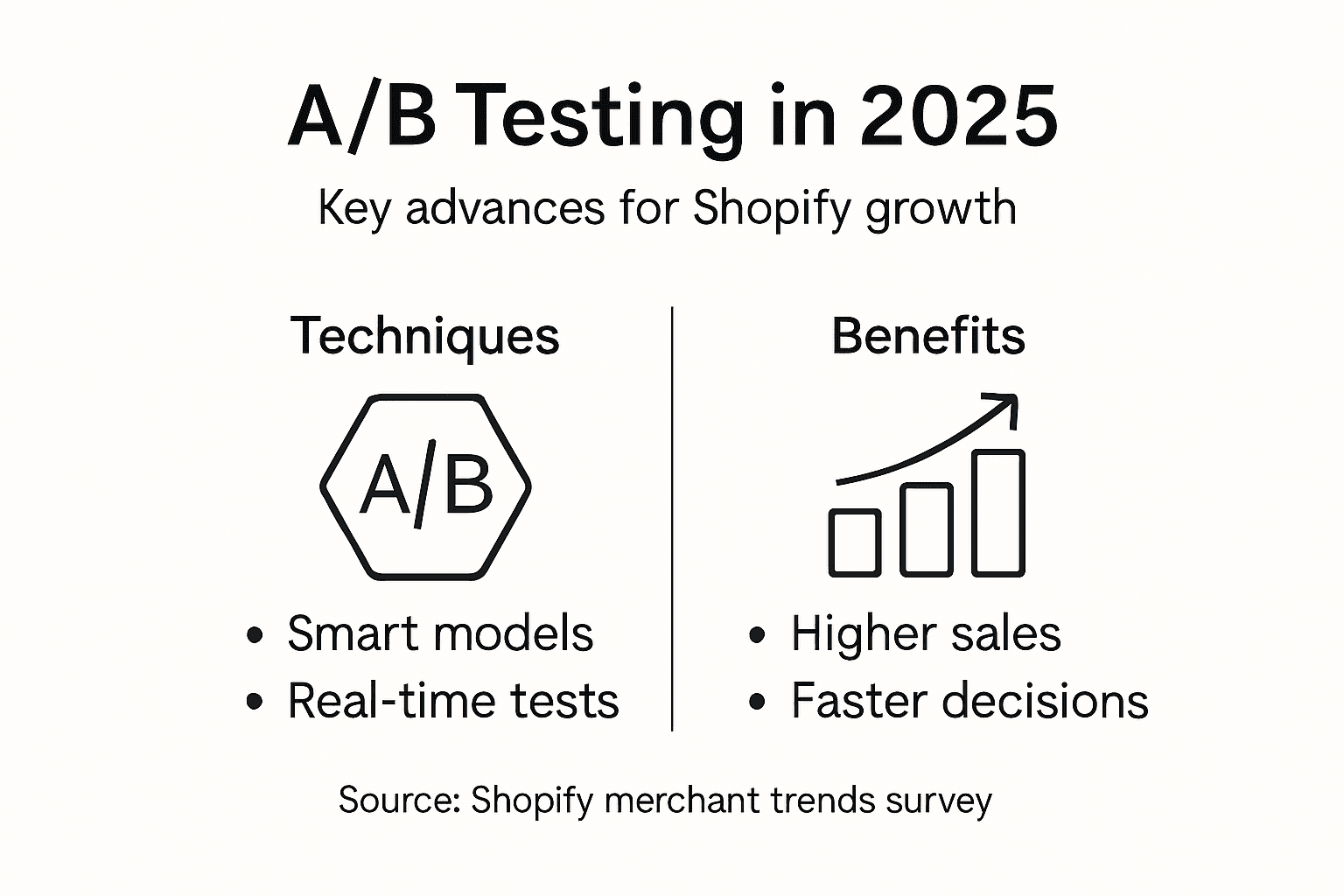
Modern A/B testing now integrates artificial intelligence to enhance experiment design and result interpretation. AI-driven approaches help identify optimal testing variables, predict potential outcomes, and provide deeper contextual understanding of user behavior patterns across different digital touchpoints.

Pro tip: Prioritize A/B tests that directly impact conversion rates, focusing on high-traffic pages and critical user interaction points to maximize experimental insights.
AI-Powered Testing: How Automation Works
AI is transforming A/B testing for Shopify stores through advanced automation technologies that dramatically reduce manual intervention. AI-driven test automation leverages machine learning algorithms to generate, execute, and analyze complex experiments with unprecedented precision and speed.
The core mechanisms of AI-powered testing involve several sophisticated techniques:
- Predictive Test Case Generation: AI algorithms automatically create comprehensive test scenarios based on historical performance data
- Intelligent Variable Selection: Machine learning models identify the most impactful variables for testing
- Real-time Result Analysis: Automated systems continuously interpret experiment data, providing instant insights
- Adaptive Experimentation: AI dynamically adjusts test parameters based on emerging patterns and statistical significance
Natural language processing techniques enable AI systems to understand complex user interactions and generate nuanced test scenarios that traditional methods cannot capture. These advanced approaches allow for more sophisticated, contextually aware experiments that go beyond simple binary comparisons.
By integrating artificial intelligence, Shopify store owners can now conduct more complex, efficient, and intelligent A/B tests. The technology reduces human error, accelerates testing cycles, and provides deeper insights into user behavior, ultimately enabling more precise and data-driven optimization strategies for digital storefronts.
Here’s a comparison of classic A/B testing versus AI-powered A/B testing for ecommerce:
| Aspect | Classic A/B Testing | AI-Powered A/B Testing |
|---|---|---|
| Experiment Setup | Manual configuration | Automated scenario generation |
| Speed of Analysis | Hours to days | Real-time processing |
| Variable Selection | Human-driven | Machine learning algorithms |
| Adaptability | Fixed design | Dynamic adjustment during tests |
| Insights Depth | Basic performance data | Contextual behavioral insights |
Pro tip: Combine AI-generated test recommendations with your own market insights to create truly powerful experimental designs that balance technological sophistication with human intuition.
Practical Benefits for Shopify Store Owners
Shopify store owners are discovering the transformative power of strategic A/B testing, with systematic testing approaches driving substantial revenue growth. Successful stores implementing split tests can see conversion rate increases ranging from 20% to 30%, translating into significant bottom-line improvements.
The key practical benefits of A/B testing for Shopify entrepreneurs include:
- Conversion Rate Optimization: Precisely identify which design elements, messaging, and layouts resonate most with customers
- Cost Reduction: Minimize marketing spend by understanding what truly drives customer engagement
- User Experience Enhancement: Systematically improve site navigation, checkout processes, and overall customer journey
- Data-Driven Decision Making: Replace guesswork with statistically validated insights about customer preferences
Continuous improvement strategies enable store owners to adapt quickly to changing market dynamics. By testing multiple variables like product descriptions, pricing strategies, and promotional messaging, Shopify entrepreneurs can create more responsive and customer-centric online experiences that directly impact sales performance.
Beyond immediate revenue gains, A/B testing builds a culture of experimentation and learning. Store owners gain deeper understanding of their customer base, uncovering nuanced insights that traditional analytics might miss. This approach transforms digital storefronts from static platforms into dynamic, responsive sales environments that continuously evolve based on real-world customer interactions.
For quick reference, here’s a summary of practical benefits that A/B testing delivers for Shopify stores:
| Benefit | Description | Typical Impact |
|---|---|---|
| Conversion Optimization | Improves sales funnel efficiency | 20–30% higher conversion |
| Cost Efficiency | Better allocation of marketing spend | Significant budget savings |
| Enhanced User Experience | Streamlines navigation and checkout | Higher engagement rates |
| Strategic Decisions | Empowers data-driven choices | Faster, targeted changes |
Pro tip: Focus your initial A/B tests on high-traffic pages and critical conversion points to maximize potential impact and generate statistically significant insights quickly.
Common Mistakes and How to Avoid Them
A/B testing can be a powerful optimization tool for Shopify stores, but numerous pitfalls can undermine its effectiveness. Understanding and proactively addressing these common mistakes will help store owners maximize their testing strategies and drive meaningful improvements.
The most critical mistakes Shopify entrepreneurs frequently encounter include:
- Testing Too Many Variables Simultaneously: Dilutes experimental results and makes it difficult to attribute changes to specific modifications
- Insufficient Test Duration: Running tests for too short a period prevents gathering statistically significant data
- Ignoring Sample Size: Basing decisions on limited visitor numbers leads to unreliable conclusions
- Confirmation Bias: Interpreting results to support preconceived notions rather than objectively analyzing data
- Neglecting Mobile Experience: Failing to conduct separate tests for mobile and desktop user interactions
Successful A/B testing requires a systematic approach that prioritizes statistical rigor and comprehensive analysis. Store owners must design experiments with clear hypotheses, establish precise measurement criteria, and maintain objectivity throughout the testing process. This means creating controlled environments where only one variable changes at a time and ensuring sufficient traffic to generate meaningful insights.
Technical considerations play a crucial role in avoiding testing mistakes. Implementing robust tracking mechanisms, using reliable statistical methods, and maintaining consistent experimental conditions are essential. Advanced testing platforms can help mitigate human error by providing automated validation and sophisticated analytical tools.
Pro tip: Develop a structured testing protocol that includes predefined success metrics, minimum sample size requirements, and clear decision-making criteria before launching any A/B test.
Unlock Shopify Success with AI-Powered A/B Testing
The article highlights key challenges Shopify store owners face in 2025 such as designing effective experiments, selecting impactful variables, and interpreting complex data without technical expertise. Automagic.li addresses these pain points by offering a powerful SaaS platform that simplifies AI-driven A/B testing for Shopify merchants. With over 40 ready-made, high-impact test variations and no need for coding, store owners can quickly optimize their sites to boost conversion rates and enhance user experience without the common risks of insufficient data or overwhelming variables.
Automagic.li automates experiment deployment through AI that customizes tests to fit your unique store design, eliminating the need to hire costly developers. This aligns perfectly with the article’s emphasis on data-driven decision-making and reducing guesswork in ecommerce optimization. Whether you want to improve product pages, pricing strategies, or checkout flows, Automagic.li empowers you to test smarter and faster.
Discover how you can accelerate your ecommerce growth today with expert-approved testing solutions at Automagic.li. Stay ahead by transforming your Shopify store into a dynamic, continuously improving sales environment.
Ready to supercharge your conversion rates with zero coding required?
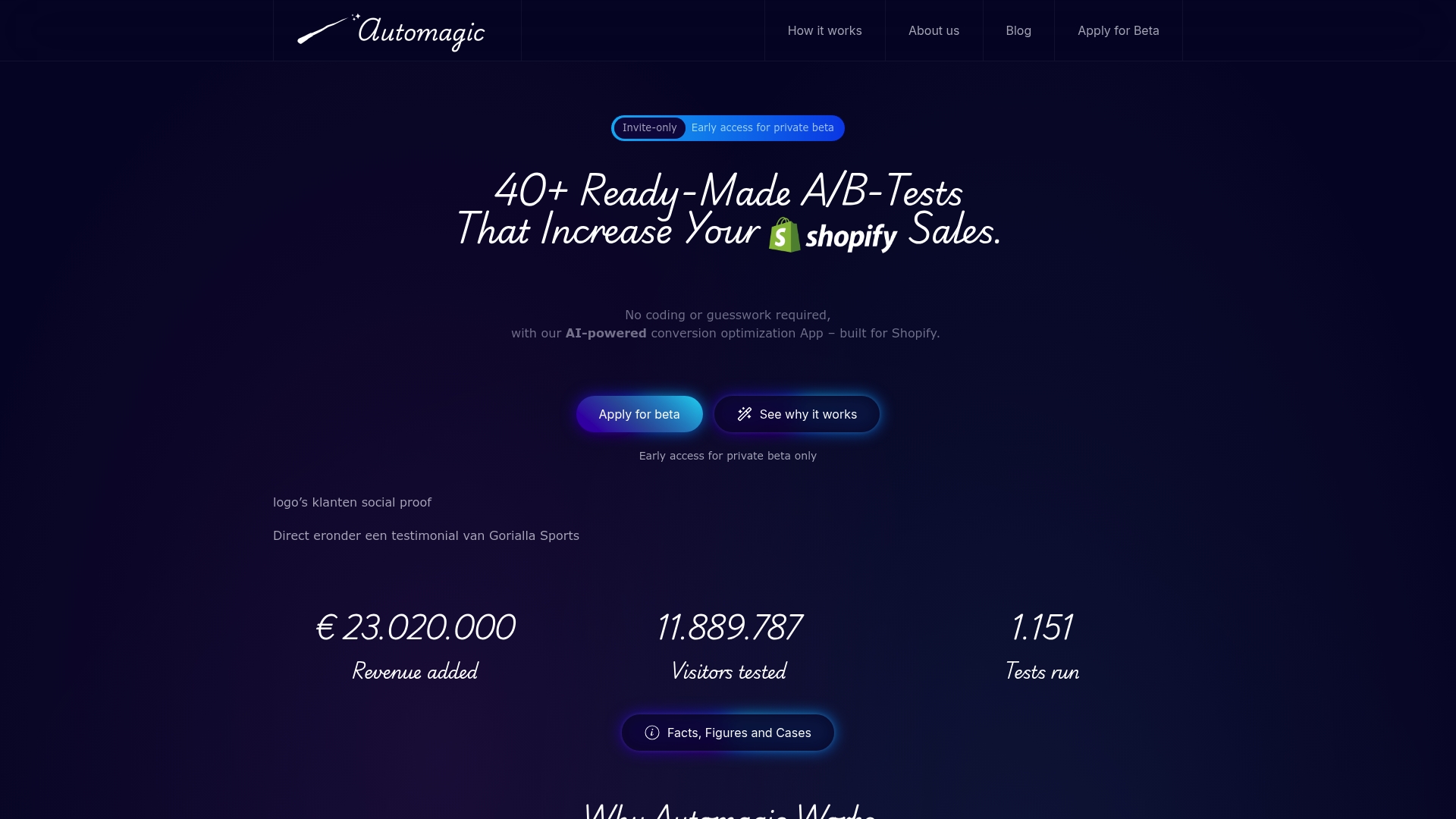
Explore the full potential of AI-powered A/B testing now at Automagic.li. Take control of your Shopify success by choosing the best tests for your business and start winning more customers instantly.
Frequently Asked Questions
What is A/B testing in ecommerce?
A/B testing, also known as split testing, is a method where two versions of a webpage or design element are compared to determine which performs better in terms of conversion rates or user engagement.
How can A/B testing improve my Shopify store’s performance?
A/B testing helps identify which elements, such as product descriptions, visuals, or checkout processes, resonate most with customers, leading to optimized conversion rates and overall sales performance.
What types of elements can be tested using A/B testing in Shopify?
Common elements for A/B testing include visual design aspects like color schemes and layouts, pricing strategies, checkout processes, and product page layouts. Each of these can be adjusted and measured for effectiveness.
What are some common mistakes to avoid when conducting A/B tests?
Common mistakes include testing multiple variables at once, running tests for too short a period, ignoring sample size requirements, and allowing confirmation bias to influence results. Ensuring clear protocols and sufficient data collection time is essential for effective A/B testing.