
Role of AI in Shopify: Boosting Store Conversions
Most American Shopify merchants are surprised to learn that AI-driven tools can increase conversion rates by over 20 percent without any coding skills required. Across the globe, store owners with limited technical experience watch their competitors pull ahead, simply by adopting smart automation. This guide explains how even a single AI-powered A/B test can help Shopify store owners achieve measurable growth and compete with the largest brands on the market.
Table of Contents
- Defining AI’s Impact on Shopify Stores
- Types of AI Tools for Shopify Merchants
- How AI-Powered A/B Testing Works
- Personalization and Data-Driven Optimization
- Risks, Limitations, and Common Mistakes
Key Takeaways
| Point | Details |
|---|---|
| AI Enhances Shopify Performance | AI tools optimize customer insights, operational efficiency, and conversion rates for Shopify merchants. |
| Integration of AI Technologies | Using personalized recommendations and automated systems can significantly enhance customer engagement and sales. |
| Data-Driven Decision Making | AI-powered analytics allow merchants to make informed adjustments to pricing and inventory in real time. |
| Beware of Risks | Merchants must manage data privacy concerns and avoid over-reliance on automation to mitigate potential biases and issues. |
Defining AI’s Impact on Shopify Stores
Artificial Intelligence is fundamentally transforming how Shopify store owners optimize their online businesses. By leveraging advanced machine learning algorithms, AI enables unprecedented levels of data-driven decision making and customer experience personalization. Shopify’s AI technologies are revolutionizing ecommerce by providing merchants powerful tools to understand and engage their target audiences more effectively.
The core impact of AI on Shopify stores centers around three primary domains: customer insights, operational efficiency, and conversion optimization. Intelligent algorithms analyze browsing patterns, purchase history, and customer interactions to generate hyperpersonalized product recommendations. These AI-powered insights allow store owners to dynamically adjust pricing, inventory, and marketing strategies in real time. For instance, AI-driven content generation now enables merchants to create multilingual product descriptions that improve search engine visibility and attract global audiences.
Key AI capabilities transforming Shopify stores include:
- Predictive demand forecasting
- Automated customer support chatbots
- Dynamic pricing optimization
- Personalized product recommendations
- Intelligent inventory management
- Automated marketing content generation
By integrating these sophisticated AI technologies, Shopify store owners can significantly enhance their competitive edge, reduce operational overhead, and create more engaging shopping experiences that directly translate to increased conversions and revenue.
Pro Tip: Start implementing AI tools incrementally, testing their impact on specific metrics like conversion rates and average order value to understand their effectiveness for your unique store.
Types of AI Tools for Shopify Merchants
AI tools have emerged as game-changing solutions for Shopify merchants seeking to optimize their online stores and boost conversion rates. AI-powered Shopify apps represent a diverse ecosystem of intelligent technologies designed to address multiple aspects of ecommerce performance, from customer engagement to operational efficiency.
The most transformative AI tools for Shopify merchants can be categorized into several key functional areas. Personalization tools leverage machine learning algorithms to analyze customer behavior and generate tailored product recommendations. Intelligent business assistance platforms like Shopify’s Sidekick provide AI-driven insights and automation capabilities that help merchants make data-informed decisions quickly and efficiently.
Specific AI tool categories for Shopify include:
- Content Generation Tools
- Automatic product description writers
- Multilingual translation services
- Marketing copy generators
- Customer Interaction Tools
- AI-powered chatbots
- Personalized recommendation engines
- Customer sentiment analysis platforms
- Operational Optimization Tools
- Inventory management systems
- Predictive pricing algorithms
- Dynamic marketing campaign optimizers
By strategically integrating these AI technologies, Shopify store owners can create more intelligent, responsive, and customer-centric shopping experiences that drive engagement and increase conversions.
Here’s a comparison of key AI tool categories and their main benefits for Shopify merchants:
| AI Tool Category | Primary Benefit | Common Example |
|---|---|---|
| Personalization | Increases customer engagement | Product recommendation engines |
| Business Assistance | Streamlines data-driven decisions | AI-powered analytics platforms |
| Content Generation | Boosts SEO and global reach | Automated product description tools |
| Customer Interaction | Enhances support efficiency | AI chatbots and sentiment analysis |
| Operational Optimization | Reduces costs, improves accuracy | Predictive inventory management |
Pro Tip: Begin your AI integration by selecting tools that address your most pressing business challenges, and gradually expand your AI toolkit as you measure their impact on key performance metrics.
How AI-Powered A/B Testing Works
AI-powered A/B testing represents a revolutionary approach to optimizing Shopify stores by leveraging advanced machine learning algorithms that transform traditional experimentation methods. Advanced testing algorithms enable merchants to analyze complex user interactions and performance metrics with unprecedented speed and precision, dramatically reducing the time and resources required for meaningful website optimization.

The core mechanism of AI-driven A/B testing involves intelligent data processing and predictive modeling. Machine learning models continuously analyze user behavior, engagement patterns, and conversion signals to dynamically generate and evaluate multiple website variations. Predictive optimization techniques allow these systems to learn from each interaction, automatically identifying the most effective design elements, marketing messages, and user experience configurations that drive higher conversion rates.
Key components of AI-powered A/B testing include:
- Automated Variant Generation
- Intelligent design modifications
- Contextual layout adjustments
- Dynamic content recommendations
- Real-Time Performance Analysis
- Instant statistical significance calculations
- Continuous learning algorithms
- Cross-variant comparative insights
- Predictive Outcome Modeling
- User behavior forecasting
- Conversion probability estimation
- Personalization recommendations
By implementing these sophisticated AI testing methodologies, Shopify merchants can move beyond traditional static experiments and embrace a more dynamic, data-driven approach to website optimization that adapts in real time to changing user preferences and market conditions.
Pro Tip: Start with small, focused AI-powered A/B tests targeting specific conversion metrics, and gradually expand your testing scope as you gain confidence in the AI’s predictive capabilities.
Personalization and Data-Driven Optimization
AI-powered personalization represents a transformative approach to enhancing Shopify store performance by leveraging sophisticated data analysis and predictive technologies. Collaborative filtering techniques enable merchants to create highly tailored shopping experiences that adapt dynamically to individual customer preferences, behaviors, and purchase histories.
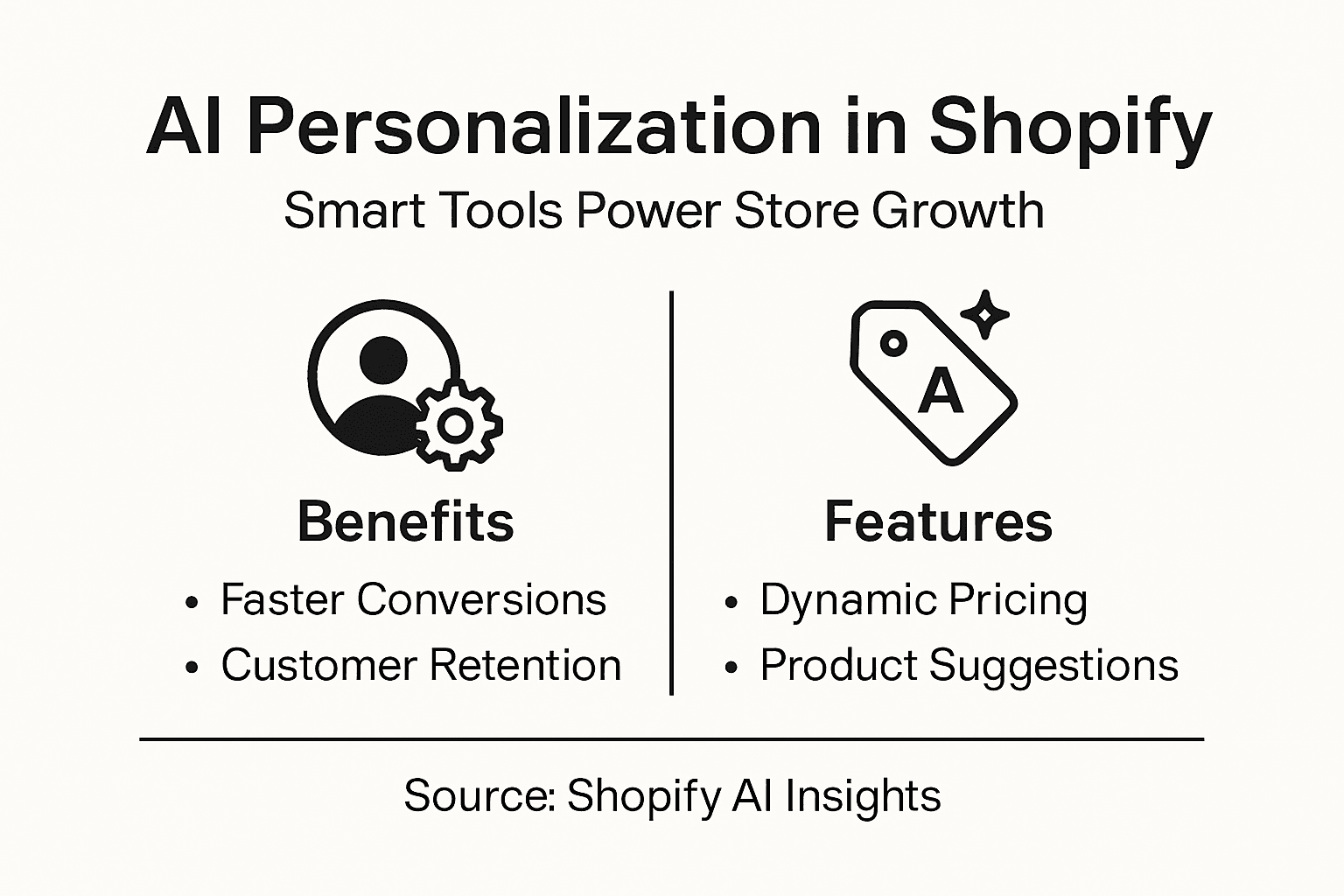
The core of data-driven optimization lies in intelligent recommendation systems that go far beyond traditional static approaches. AI-powered personalization models continuously analyze intricate user interactions, transforming raw data into actionable insights that help merchants understand and anticipate customer needs with unprecedented precision. These advanced systems can instantly generate personalized product suggestions, adjust pricing strategies, and create custom user journeys that significantly improve conversion rates.
Key components of AI-driven personalization include:
- Customer Behavior Analysis
- Real-time purchase pattern tracking
- Individual preference mapping
- Predictive intent modeling
- Dynamic Recommendation Engines
- Contextual product suggestions
- Personalized browsing experiences
- Cross-selling and upselling optimization
- Intelligent Pricing Strategies
- Dynamic price adjustments
- Personalized discount targeting
- Inventory-driven pricing models
By embracing these sophisticated AI-powered personalization techniques, Shopify merchants can create more engaging, responsive, and conversion-focused online shopping experiences that feel uniquely tailored to each individual customer.
Pro Tip: Implement incremental personalization strategies by starting with one or two targeted AI-driven features, carefully measuring their impact on conversion rates and customer engagement.
Risks, Limitations, and Common Mistakes
AI implementation in Shopify stores, while powerful, comes with a complex landscape of potential risks and challenges that merchants must carefully navigate. Data privacy concerns represent a critical consideration, as AI systems rely on collecting and analyzing substantial amounts of customer information that could potentially compromise individual privacy if not managed responsibly.
The most significant potential limitations emerge from algorithmic biases and over-reliance on automated decision-making. AI system vulnerabilities can inadvertently create unfair or discriminatory outcomes if machine learning models are not carefully designed, monitored, and periodically recalibrated. These biases might manifest through skewed product recommendations, pricing strategies, or customer segmentation that do not accurately represent the diverse needs of all potential customers.
Common mistakes Shopify merchants should avoid include:
- Insufficient Data Validation
- Neglecting data quality checks
- Ignoring potential algorithmic biases
- Failing to verify AI-generated insights
- Lack of Human Oversight
- Completely automating customer interactions
- Removing human judgment from critical decisions
- Underestimating the importance of manual review
- Poor Privacy Management
- Inadequate data protection protocols
- Unclear customer consent processes
- Insufficient transparency about data usage
Successful AI integration requires a balanced approach that combines technological innovation with ethical considerations, ensuring that automated systems enhance rather than replace human judgment and customer experience.
To help merchants avoid pitfalls, here’s a summary of common AI mistakes versus best practices:
| Common Mistake | Risk Created | Best Practice Solution |
|---|---|---|
| Skipping data validation | Algorithmic bias, bad decisions | Regular data quality checks |
| Over-automating customer support | Loss of human connection | Retain manual intervention |
| Weak privacy controls | Customer distrust, legal risk | Robust data protection protocols |
| Ignoring AI insight verification | Missed errors, lost sales | Human review of AI outputs |
Pro Tip: Regularly audit your AI systems for potential biases, implement robust data protection protocols, and maintain a flexible approach that allows for human intervention when automated systems produce unexpected or potentially problematic results.
Unlock Higher Shopify Conversions with AI-Powered A/B Testing
The article highlights how Artificial Intelligence is reshaping Shopify stores through advanced personalization and data-driven optimization. However one major challenge Shopify merchants face is efficiently testing and implementing AI-driven changes without technical hassle. You want to boost conversions avoid costly developer fees and make confident decisions based on real data. This is where Automagic.li steps in as your ultimate solution.
Automagic.li offers a powerful SaaS platform tailor-made for Shopify merchants to leverage AI-powered A/B testing without any coding. With over 40 pre-tested variations sorted by impact and certainty you can quickly deploy high-impact tests that adapt perfectly to your store’s design. This eliminates guesswork and accelerates your journey to more sales and happier customers.
Experience the ease of automated AI testing combined with clear data insights that empower you to optimize pricing personalization and user experience dynamically. Do not let technical barriers or complex integrations limit your store’s potential. Discover how Automagic.li transforms Shopify conversion optimization into a simple Data-driven process anyone can master.
Boost your store conversions now with intelligent experiments that deliver proven results.
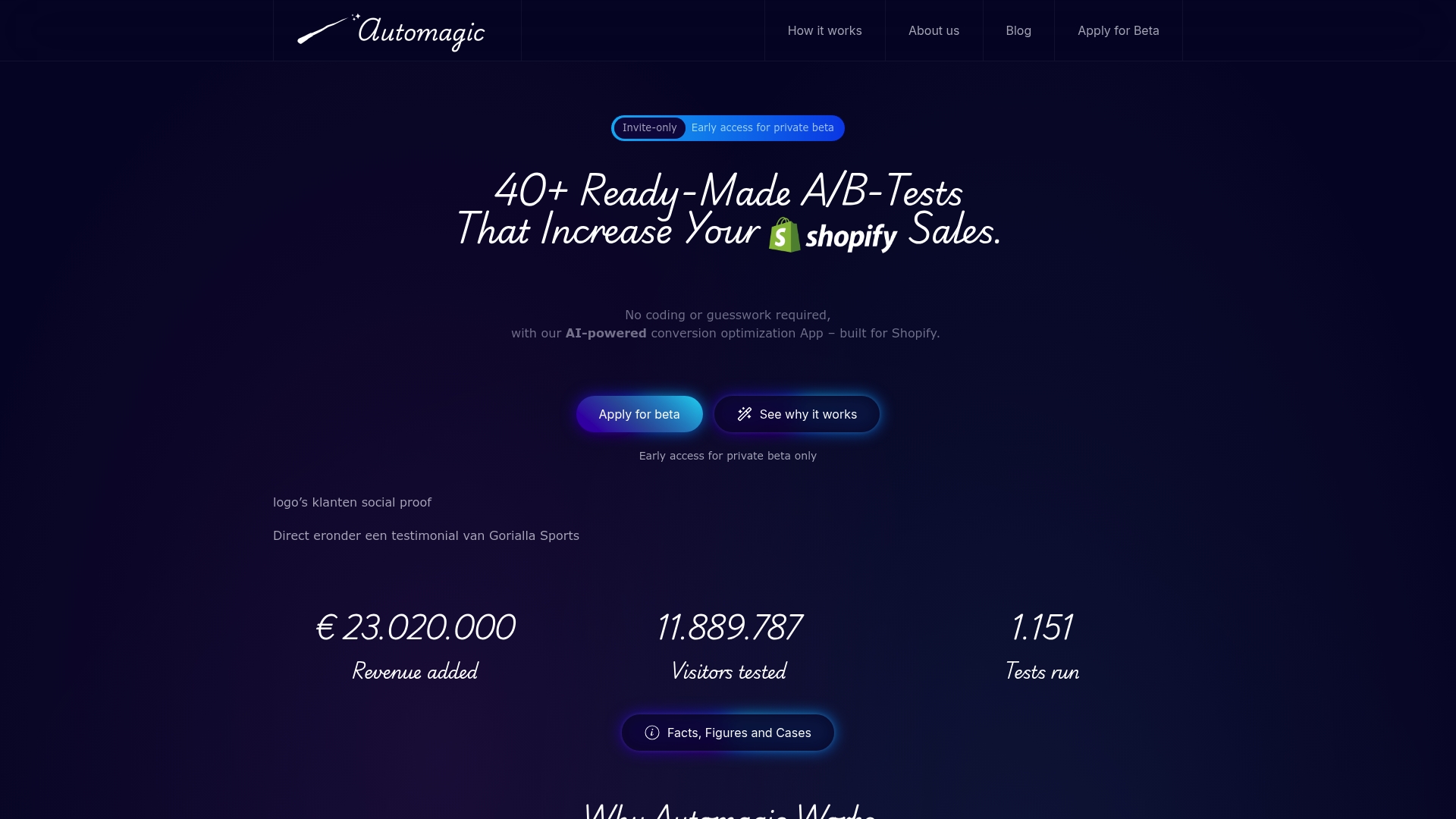
Ready to turn AI insights into real sales growth Choose from our library of ready-to-use A/B test templates and start optimizing today at Automagic.li. Begin your free trial and watch your Shopify store conversion rates climb with expert-backed AI automation.
Frequently Asked Questions
How does AI improve customer experience in Shopify stores?
AI enhances customer experience in Shopify stores by providing personalized product recommendations, dynamic pricing, and automated customer support, creating a more engaging shopping environment tailored to individual preferences.
What are the key AI tools available for Shopify merchants?
Key AI tools for Shopify merchants include content generation tools, customer interaction tools like chatbots, personalization engines, and operational optimization tools that aid in inventory management and pricing strategies.
How can AI-powered A/B testing benefit my Shopify store?
AI-powered A/B testing benefits Shopify stores by using machine learning algorithms to automatically analyze user behavior and optimize website elements in real-time, leading to improved conversion rates without extensive manual testing.
What risks should I consider when implementing AI in my Shopify store?
When implementing AI, consider risks such as data privacy concerns, algorithmic biases, and the importance of maintaining human oversight in decision-making processes to avoid potential negative impacts on customer experience.