
Ecommerce Testing Methods: Boosting Shopify Sales
Struggling to pinpoint why some customers leave before finishing their purchases is a reality for many Shopify store owners worldwide. With so many variables—from checkout flow to mobile responsiveness—each step can either invite a sale or drive a visitor away. Embracing AI-powered A/B testing brings a data-driven way to solve these challenges, letting you uncover and fix issues quickly without needing developer support. Learn how simple, automated experiments can reveal what actually converts browsers into buyers.
Table of Contents
- What Is Ecommerce Testing for Shopify?
- Core Types of Ecommerce Testing Methods
- How AI-Powered A/B Testing Works
- Choosing and Running High-Impact Tests
- Risks, Mistakes, and Test Optimization
Key Takeaways
| Point | Details |
|---|---|
| Importance of Ecommerce Testing | Regular ecommerce testing is essential for identifying and resolving potential issues that impede sales and user experience on Shopify stores. |
| Core Testing Methodologies | Utilizing various testing methods such as functional, performance, and usability testing helps ensure optimal store functionality and user satisfaction. |
| AI-Powered A/B Testing | Implementing AI-driven A/B testing allows for more dynamic adaptations and deeper analysis of user behavior, enhancing conversion rates significantly. |
| Strategic Testing Implementation | Focus high-impact tests on critical components of the user journey to maximize revenue potential while ensuring statistically significant results. |
What Is Ecommerce Testing for Shopify?
Ecommerce testing is a systematic approach designed to validate and optimize online store performance, ensuring seamless functionality across all critical user interaction points. At its core, this process scrutinizes how Shopify stores operate under various conditions, identifying potential barriers that could prevent customers from completing purchases.
The practice encompasses multiple testing dimensions, including comprehensive usability evaluation. These assessments cover critical areas like product browsing, cart management, checkout processes, and payment workflows. By simulating real-world user scenarios, store owners can uncover potential technical glitches, user experience friction points, and conversion obstacles before they impact sales.
Specifically for Shopify stores, testing involves rigorous examination of several key components:
- Product page functionality
- Shopping cart reliability
- Checkout process smoothness
- Payment gateway integration
- Mobile responsiveness
- Site loading speed
- Cross-browser compatibility
Each testing phase aims to create a frictionless shopping experience that minimizes customer frustration and maximizes potential revenue. By systematically identifying and addressing potential issues, Shopify store owners can build more robust, user-friendly online shopping environments that convert browsers into buyers.

Pro tip: Implement regular testing cycles at least once per quarter to stay ahead of potential technical issues and maintain optimal store performance.
Core Types of Ecommerce Testing Methods
Shopify store owners have several critical testing methodologies available to ensure their online businesses perform optimally. Comprehensive ecommerce testing methods encompass multiple strategic approaches designed to identify and resolve potential performance and user experience challenges before they impact sales.
The primary categories of ecommerce testing include:
- Functional Testing: Validates core website features like product search, filtering, cart functionality, and checkout processes
- Performance Testing: Measures site speed, load handling, and responsiveness under various traffic conditions
- Usability Testing: Evaluates user experience and identifies potential friction points in navigation and purchasing
- Security Testing: Ensures robust data protection, payment gateway security, and compliance with industry standards
- Compatibility Testing: Checks site performance across different browsers, devices, and screen sizes
Each testing method serves a unique purpose in creating a seamless shopping experience. Functional testing ensures every feature works correctly, performance testing prevents site crashes during peak traffic, usability testing improves conversion rates, security testing protects customer data, and compatibility testing guarantees a consistent experience across all platforms.
By implementing these systematic testing approaches, Shopify store owners can proactively address potential issues, optimize user experience, and ultimately drive higher conversion rates. The goal is not just to prevent problems but to create a smooth, intuitive shopping environment that encourages customers to complete their purchases.
Pro tip: Create a regular testing schedule that rotates through different testing methods quarterly to continuously improve your Shopify store’s performance and user experience.
Here’s how different ecommerce testing methods contribute to Shopify store success:
| Testing Method | Primary Benefit | Business Impact |
|---|---|---|
| Functional Testing | Validates site features | Reduces purchase errors |
| Performance Testing | Increases speed and stability | Improves customer retention |
| Usability Testing | Simplifies browsing and buying | Boosts conversion rates |
| Security Testing | Protects customer data | Maintains trust and compliance |
| Compatibility Testing | Ensures consistent experience | Minimizes lost sales on devices |
How AI-Powered A/B Testing Works
Artificial Intelligence has revolutionized the way Shopify store owners approach website optimization, transforming traditional A/B testing into a more intelligent and dynamic process. Advanced AI-driven testing techniques go far beyond simple split testing by leveraging machine learning algorithms to analyze complex datasets and uncover nuanced insights about user behavior.
The core mechanism of AI-powered A/B testing involves several sophisticated steps:
- Data Collection: Gathering comprehensive user interaction data
- Pattern Recognition: Identifying subtle correlations and behavioral patterns
- Predictive Modeling: Generating hypotheses about potential design improvements
- Dynamic Experimentation: Automatically adjusting test parameters in real-time
- Intelligent Optimization: Recommending precise changes to maximize conversion rates
Unlike traditional A/B testing, which typically compares two static versions of a webpage, AI-powered methods can simultaneously explore multiple variations, detect intricate interaction effects between different design elements, and provide more granular insights. This approach allows Shopify merchants to move beyond basic conversion rate optimization and develop a deeper understanding of their specific customer base’s preferences and behaviors.

The most significant advantage of AI-driven testing is its ability to learn and adapt continuously. Machine learning algorithms can process vast amounts of data far more quickly than human analysts, identifying patterns and opportunities that might otherwise go unnoticed. By continuously refining its understanding, the AI can provide increasingly accurate recommendations for improving user experience and driving sales.
Pro tip: Implement AI-powered A/B testing incrementally, starting with low-risk page elements and gradually expanding to more complex site components to build confidence in the system.
Compare traditional and AI-powered A/B testing in Shopify environments:
| Aspect | Traditional A/B Testing | AI-Powered A/B Testing |
|---|---|---|
| Test Scope | Limited variations | Multiple variations simultaneously |
| Speed of Analysis | Manual and slower | Automated and faster |
| Insights | Basic metrics | In-depth behavioral insights |
| Adaptability | Static tests | Learns and adapts in real-time |
Choosing and Running High-Impact Tests
Successful A/B testing requires a strategic approach that goes beyond random experimentation. While multiple testing methodologies exist, identifying and executing high-impact tests demands careful planning, precise targeting, and a data-driven mindset focused on meaningful conversion improvements for Shopify stores.
When selecting tests to prioritize, consider these critical factors:
- Potential Revenue Impact: Focus on tests with the highest potential return
- User Experience Improvements: Target elements directly affecting customer interaction
- Conversion Funnel Optimization: Concentrate on key stages where customers might drop off
- Statistical Significance: Ensure tests have enough data to draw reliable conclusions
- Implementation Complexity: Balance potential gains against development effort
The most effective high-impact tests typically target fundamental conversion elements such as:
- Product page layouts
- Call-to-action button design and placement
- Pricing presentation
- Product image configurations
- Checkout process simplification
- Navigation and site structure
- Mobile responsiveness
Successful test implementation requires a methodical approach. Start by forming clear hypotheses, establishing precise measurement criteria, and setting realistic expectations. Systematic testing strategies demand patience, with most meaningful tests requiring several weeks of consistent data collection to generate actionable insights.
Pro tip: Prioritize tests that address specific user behavior bottlenecks, and always run tests long enough to gather statistically significant data before making final design decisions.
Risks, Mistakes, and Test Optimization
Ecommerce testing involves navigating a complex landscape of potential pitfalls that can significantly impact your Shopify store’s performance and customer trust. Comprehensive testing strategies must anticipate and mitigate risks that could compromise site functionality, user experience, and ultimately, revenue generation.
Common risks and mistakes in A/B testing include:
- Statistical Errors: Drawing conclusions from insufficient data
- Bias in Test Design: Creating tests that inadvertently skew results
- Overlooking Compatibility: Neglecting cross-device and cross-browser testing
- Ignoring User Experience: Focusing solely on conversion metrics
- Data Privacy Vulnerabilities: Mishandling user information during tests
The most critical optimization strategies focus on minimizing these risks through:
- Rigorous test planning
- Comprehensive data validation
- Maintaining robust security protocols
- Ensuring accessibility across all platforms
- Protecting user data and privacy
- Continuous monitoring and refinement of testing processes
Successful test optimization requires a holistic approach that balances technical precision with user-centric design. Store owners must develop a nuanced understanding of how different testing variables interact, continuously refining their methodologies to create more accurate, meaningful insights that drive real business growth.
Pro tip: Implement a comprehensive testing checklist that includes security, compatibility, and user experience considerations before launching any A/B test to minimize potential risks and maximize actionable insights.
Unlock Your Shopify Store’s Full Potential with AI-Driven Ecommerce Testing
The article explores the challenges Shopify store owners face when trying to boost sales through effective ecommerce testing methods. You understand the frustration of navigating complex A/B tests, worrying about statistical errors, and struggling with technical barriers like coding and compatibility issues. Key goals include improving conversion rates, optimizing checkout flow, and creating a seamless shopping experience without needing extensive developer support.
Automagic.li offers the perfect solution by providing an AI-powered SaaS platform tailored for Shopify stores. With over 40 ready-made, high-impact A/B tests that automatically adapt to your unique design, you can skip the coding headaches and start improving your store’s performance immediately. Our platform tackles the exact pain points highlighted in the article — from usability and functional testing to smart optimization that drives real revenue growth.
Ready to transform your ecommerce testing approach?
Explore proven AI-driven testing strategies with Automagic.li and take the guesswork out of conversion optimization.
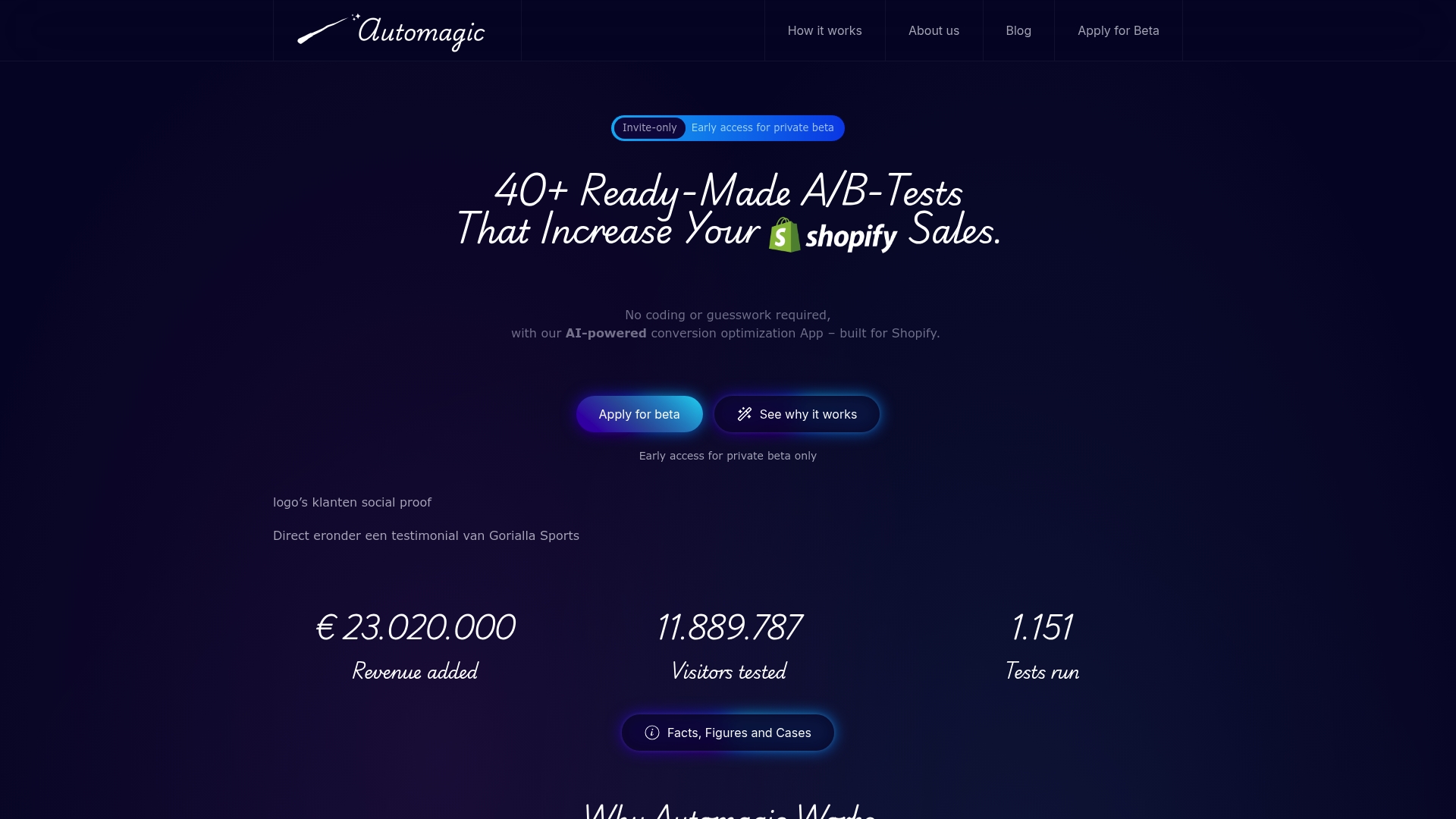
Experience effortless Shopify optimization today by visiting Automagic.li. Discover how easy it is to launch data-backed tests that increase sales and build lasting customer trust. Don’t wait to elevate your ecommerce game with cutting-edge AI-powered A/B testing solutions.
Frequently Asked Questions
What is ecommerce testing for Shopify?
Ecommerce testing for Shopify is a systematic process that validates and optimizes online store performance by identifying and resolving potential barriers that could prevent customers from completing purchases. This includes testing various critical areas like product browsing, cart management, and checkout processes.
What are the core types of ecommerce testing methods?
The core types of ecommerce testing methods include functional testing, performance testing, usability testing, security testing, and compatibility testing. Each method addresses specific aspects of the user experience to ensure a seamless shopping experience.
How do AI-powered A/B testing methods improve Shopify optimization?
AI-powered A/B testing uses machine learning algorithms to analyze user behavior and optimize website elements dynamically. Unlike traditional testing, which compares only two versions, AI testing can simultaneously evaluate multiple variations and provide deeper insights into user interactions, leading to more effective optimizations.
What should I prioritize when running high-impact tests for my Shopify store?
When running high-impact tests, prioritize elements that have a significant potential revenue impact, improve user experience, target conversion funnel optimization, ensure statistical significance, and consider implementation complexity. Focus on key aspects like product page layouts and checkout process simplification.