
Author: admin

7 Essential Shopify Sales Funnel Tips for More Conversions

Turning casual browsers into paying customers on your Shopify store can feel like chasing a moving target. With so many details to manage, it is easy to miss out on proven strategies that actually improve conversion rates. The right approach lets you guide potential buyers through every step and eliminate roadblocks that cost you sales.

This list reveals actionable methods backed by research to optimize your entire sales funnel—from first impressions to the final checkout. You will discover how to craft trust-building product pages, use AI tools to make smarter decisions faster, and simplify your checkout flow to address issues linked to a 70% abandonment rate. Get ready to unlock practical insights that can transform how you convert visitors into loyal customers.

Table of Contents

Quick Summary

Key Message Explanation
1. Understand Your Sales Funnel Stages Identify the three funnel stages to tailor marketing efforts: Top, Middle, and Bottom of Funnel.
2. Implement AI-Powered A/B Testing Use AI to optimize page designs efficiently, testing multiple variables for better conversion rates.
3. Optimize Product Pages for Clarity Enhance product pages with quality visuals, benefit-driven descriptions, and social proof to build trust.
4. Simplify Checkout Flow Reduce friction in the checkout process by minimizing form fields and offering guest checkout options.
5. Leverage Social Proof and Testimonials Display authentic customer reviews and experiences strategically to encourage hesitant buyers to complete purchases.

1. Understand Your Shopify Sales Funnel Stages

Successfully driving conversions in your Shopify store starts with deeply understanding the customer journey through your sales funnel. The sales funnel represents the psychological and behavioral stages potential customers move through before making a purchase.

Your Shopify sales funnel typically breaks down into three critical stages: Top of Funnel (ToFu), Middle of Funnel (MoFu), and Bottom of Funnel (BoFu). Each stage requires a different strategic approach to guide customers from initial awareness to final purchase.

At the Top of Funnel, your goal is creating broad awareness. This stage involves attracting potential customers through social media ads, content marketing, and targeted advertising. Customers here are just discovering your brand and products, so messaging should focus on generating interest and solving potential pain points.

The Middle of Funnel shifts toward building consideration and trust. Here, you nurture leads by providing more detailed product information, showcasing customer testimonials, and demonstrating your unique value proposition. Email marketing campaigns, retargeting ads, and comparison content work well at this stage to help potential customers evaluate your offerings.

The Bottom of Funnel represents the critical conversion stage where interested prospects become actual customers. At this point, your marketing should include specific conversion tactics like limited time offers, product demos, free trials, and compelling call to action elements that motivate purchasing decisions.

Understanding these stages allows you to create targeted conversion strategies that speak directly to customers’ specific needs and motivations. By tailoring your messaging and tactics to each funnel stage, you dramatically increase the likelihood of transforming casual browsers into committed buyers.

Pro tip: Map out your specific customer journey by tracking how prospects move between funnel stages and identifying potential drop off points to optimize your conversion process.

2. Use AI-Powered A/B Testing for Key Pages

AI-powered A/B testing represents the cutting edge of conversion optimization for Shopify stores, transforming how online businesses improve their digital performance. This advanced approach goes far beyond traditional manual testing by leveraging artificial intelligence to analyze and optimize key website pages.

Traditional A/B testing often involves manually creating multiple page variations and waiting weeks or months to gather meaningful data. In contrast, AI-powered testing can dynamically generate and evaluate multiple page designs simultaneously, dramatically accelerating the optimization process.

Your Shopify store has several critical pages where A/B testing can yield significant improvements: homepage, product pages, checkout process, and landing pages. Each of these pages represents a potential conversion bottleneck where small changes can produce substantial revenue impacts.

AI technologies enable sophisticated causal inference techniques that adapt experiments in real time. This means the AI can dynamically adjust test parameters based on user behavior, creating more precise and nuanced optimization strategies that traditional methods cannot achieve.

When implementing AI-powered A/B testing, focus on elements like headline text, button colors, product image placements, pricing displays, and call to action designs. Machine learning algorithms can quickly identify which variations produce the highest conversion rates, allowing you to make data driven design decisions.

Pro tip: Start with testing one element at a time and ensure you have statistically significant traffic before drawing conclusions about your A/B test results.

3. Optimize Product Pages for Clarity and Trust

Your Shopify product pages are far more than simple item descriptions they are critical conversion engines that can make or break your online sales performance. A well-designed product page communicates value, builds customer confidence, and guides shoppers smoothly toward purchasing.

Visual storytelling plays a crucial role in effective product pages. High-resolution images that showcase your product from multiple angles provide transparency and help customers understand exactly what they are buying. Professional product photography that highlights unique features and demonstrates real world usage can significantly increase buyer trust.

Product descriptions should focus on solving customer problems rather than just listing technical specifications. Benefit driven language transforms mundane details into compelling narratives that connect emotionally with potential buyers. Explain how your product improves their life or solves a specific challenge they are experiencing.

Customer trust emerges from multiple signals on your product page. Compelling product page optimization requires integrating social proof elements like genuine customer reviews, detailed testimonials, satisfaction guarantees, and clear return policies. These elements reassure hesitant buyers and reduce purchase anxiety.

Key elements to optimize include product titles, image galleries, pricing displays, size and color selections, shipping information, and clear call to action buttons. Each component should be designed with user experience and psychological buying triggers in mind.

Structure your product information hierarchy strategically. Place the most important details prominently and use formatting like bullet points, bold text, and concise paragraphs to improve readability. Make complex information easy to digest at a glance.

Pro tip: Add video demonstrations or user generated content to your product pages to provide authentic context and help potential customers visualize using your product.

4. Simplify Add-to-Cart and Checkout Flow

Your Shopify store’s add to cart and checkout process can make or break customer conversions. A complicated or confusing purchasing journey will send potential buyers running faster than you can say abandoned cart.

The stark reality is that complex checkout processes cause 70% cart abandonment. This means for every 10 customers who start purchasing, seven will walk away without completing their transaction. Your goal is to remove every possible friction point that might discourage a sale.

Checkout Simplification Strategies

Start by minimizing the number of form fields customers must complete. Every additional field represents a potential moment of hesitation. Request only essential information and use smart defaults like autofill and address validation to speed up the process.

Implement a guest checkout option that allows customers to purchase without creating an account. While account creation can be beneficial for long term engagement, forcing registration upfront can feel invasive and interrupt the buying momentum.

Make your cart and checkout pages visually clean and intuitive. Use clear progress indicators that show customers exactly where they are in the purchasing process. Provide an easy way to review and edit cart contents without navigating away from the checkout page.

Offer multiple payment methods to accommodate different customer preferences. Include digital wallets like Apple Pay and Google Pay alongside traditional credit card options. The more seamless and familiar the payment process feels, the more likely customers are to complete their purchase.

Design your checkout flow with mobile users in mind. With increasing smartphone shopping, your checkout must be responsive and easy to navigate on smaller screens. Large touch friendly buttons, simplified forms, and vertical layouts improve mobile conversion rates.

Pro tip: Regularly analyze your checkout funnel analytics to identify specific drop off points and continuously refine your purchasing process.

5. Leverage Social Proof and Testimonials

Social proof is the psychological phenomenon that drives customers to trust and follow the actions of others. In the world of online shopping, strategic use of testimonials and reviews can transform hesitant browsers into confident buyers.

The power of social proof is staggering. Empirical research demonstrates that 87% of consumers view online reviews as credible as personal recommendations. This means authentic customer experiences can significantly influence purchasing decisions.

Types of Social Proof

Effective social proof goes beyond simple star ratings. Include diverse testimonial formats such as written reviews, video testimonials, case studies, user generated content, and direct quotes from satisfied customers. Each format offers a unique way to build trust and showcase real world product experiences.

Authenticity is key when collecting and displaying testimonials. Potential customers can quickly detect fabricated or overly polished reviews. Encourage genuine feedback by making the review process simple and transparent. Include specific details like customer names, locations, or professions to add credibility.

Strategically place social proof elements throughout your Shopify store. Display testimonials near product descriptions, pricing information, and checkout pages. Consider creating dedicated review sections or integrating dynamic review widgets that update in real time.

Utilize different social proof tactics including customer count displays, expert endorsements, media mentions, and real time purchase notifications. These elements create a sense of popularity and reliability that can nudge uncertain customers toward making a purchase.

Remember that quality trumps quantity. A few detailed, authentic testimonials are far more powerful than numerous generic or vague reviews. Focus on collecting testimonials that highlight specific benefits and solve potential customer concerns.

Pro tip: Implement a systematic approach to collecting testimonials by sending follow up emails and offering incentives for customers who share their honest experiences.

6. Personalize Offers Based on User Behavior

Personalization is the secret weapon of modern ecommerce, transforming generic shopping experiences into tailored journeys that speak directly to individual customer preferences. By leveraging user behavior data, you can create targeted offers that feel almost magically relevant to each shopper.

Understanding User Behavior Tracking

Modern AI technologies enable sophisticated personalized recommendation strategies that go far beyond simple demographic segmentation. These systems analyze multiple data points including browsing history, past purchases, time spent on specific pages, and interaction patterns to build nuanced customer profiles.

Your personalization strategy should encompass several key behavioral tracking methods. Monitor metrics like products viewed, items added to cart, purchase frequency, average order value, and customer engagement levels. Each interaction provides valuable insights into individual customer preferences and potential future buying decisions.

Implement dynamic pricing and targeted discount strategies based on user behavior. Customers who frequently browse but rarely purchase might receive different promotional offers compared to repeat buyers. This approach demonstrates an understanding of individual customer needs and can significantly boost conversion rates.

Utilize retargeting techniques that showcase products similar to those a customer has previously shown interest in. If a user viewed running shoes but did not purchase, display related athletic wear or complementary fitness accessories in subsequent site visits or advertising campaigns.

Consider creating personalized email marketing campaigns that reflect individual user journeys. Segment your audience based on their specific behaviors and craft messaging that resonates with their unique interests and purchase history. This approach feels more like a conversation and less like a generic marketing blast.

Pro tip: Continuously refine your personalization algorithms by conducting regular A/B tests and monitoring how different customer segments respond to tailored recommendations.

7. Track Funnel Performance with Data Insights

Understanding your Shopify store’s performance requires more than surface level metrics. Comprehensive funnel tracking transforms raw data into actionable strategies that can dramatically improve your conversion rates.

Funnel performance tracking involves systematically measuring how potential customers move through different stages of your sales process. Advanced analytics frameworks enable precise identification of conversion bottlenecks and optimization opportunities.

Key Performance Metrics to Monitor

Focus on critical metrics that reveal your funnel’s health: visitor to lead conversion rate, lead to customer conversion rate, average time in each funnel stage, and drop off points. These indicators provide a comprehensive view of your store’s performance landscape.

Utilize Shopify analytics and third party tracking tools to create custom dashboards. These platforms allow you to visualize data through conversion rate charts, user flow diagrams, and segmented performance reports. Graphic representations make complex data immediately understandable.

Pay special attention to micro conversions like email sign ups, product page views, and cart additions. These intermediate steps are leading indicators that help predict future sales performance and identify potential friction points in your customer journey.

Segment your data across different dimensions including traffic source, device type, customer demographics, and product categories. This granular approach reveals nuanced insights about which customer groups convert most effectively and where specific optimization efforts should be concentrated.

Implement regular review cycles where you analyze funnel performance data monthly or quarterly. Look for consistent patterns, emerging trends, and statistically significant changes in conversion metrics. Use these insights to continuously refine your marketing strategies and user experience.

Pro tip: Set up automated reporting that sends performance snapshots directly to your email, ensuring you stay consistently informed about your store’s conversion dynamics without manual tracking.

Below is a comprehensive table summarizing Shopify optimization strategies discussed in the provided article.

Aspect Key Focus Expected Benefits
Shopify Sales Funnel Understand the stages: Top (awareness), Middle (consideration), Bottom (conversion). Enhanced customer journey alignment and strategy refinement.
AI-Powered A/B Testing Employ AI for dynamic, faster testing of digital page elements. Accelerated optimization and improved page conversion rates.
Product Page Design Ensure clear, trust-building content, visual storytelling, and social proof. Increased customer confidence and purchasing outcomes.
Checkout Simplicity Streamline forms, enable guest checkout, and optimize for mobile and multiple payment options. Reduced cart abandonment and smoother purchase completion.
Social Proof Utilization Highlight testimonials, ratings, diverse feedback formats, and real-time social metrics. Enhanced client trust and product credibility.
Personalized Offers Use behavioral insights for tailored discounts, recommendations, and content. Strengthened user engagement and purchasing personalization benefits.
Data Tracking Monitor conversion metrics, identify drop-off stages, and employ segmentation analysis. Granular performance understanding and strategic adjustments to bridge funnel gaps.

Boost Your Shopify Sales Funnel with AI-Powered A/B Testing

Struggling to optimize your Shopify sales funnel stages and increase conversions? The article highlights key pain points like understanding customer behavior at each funnel stage and simplifying the checkout flow to reduce cart abandonment. These challenges call for precise, data-driven testing focused on improving product pages, landing pages, and checkout experiences.

That is where Automagic.li comes in. Our AI-powered platform delivers ready-made, high-impact A/B tests tailored specifically for Shopify stores. By eliminating the need for coding or hiring developers, Automagic.li empowers you to quickly implement changes that resonate with your customers at every funnel stage. Use our extensive library of pre-tested variations to simplify your add-to-cart process, enhance social proof placement, and personalize offers based on real user behavior.

Take the guesswork out of sales funnel optimization and harness AI-driven testing to unlock more conversions today.

Discover how simple it is to boost your Shopify store’s performance with Automagic.li
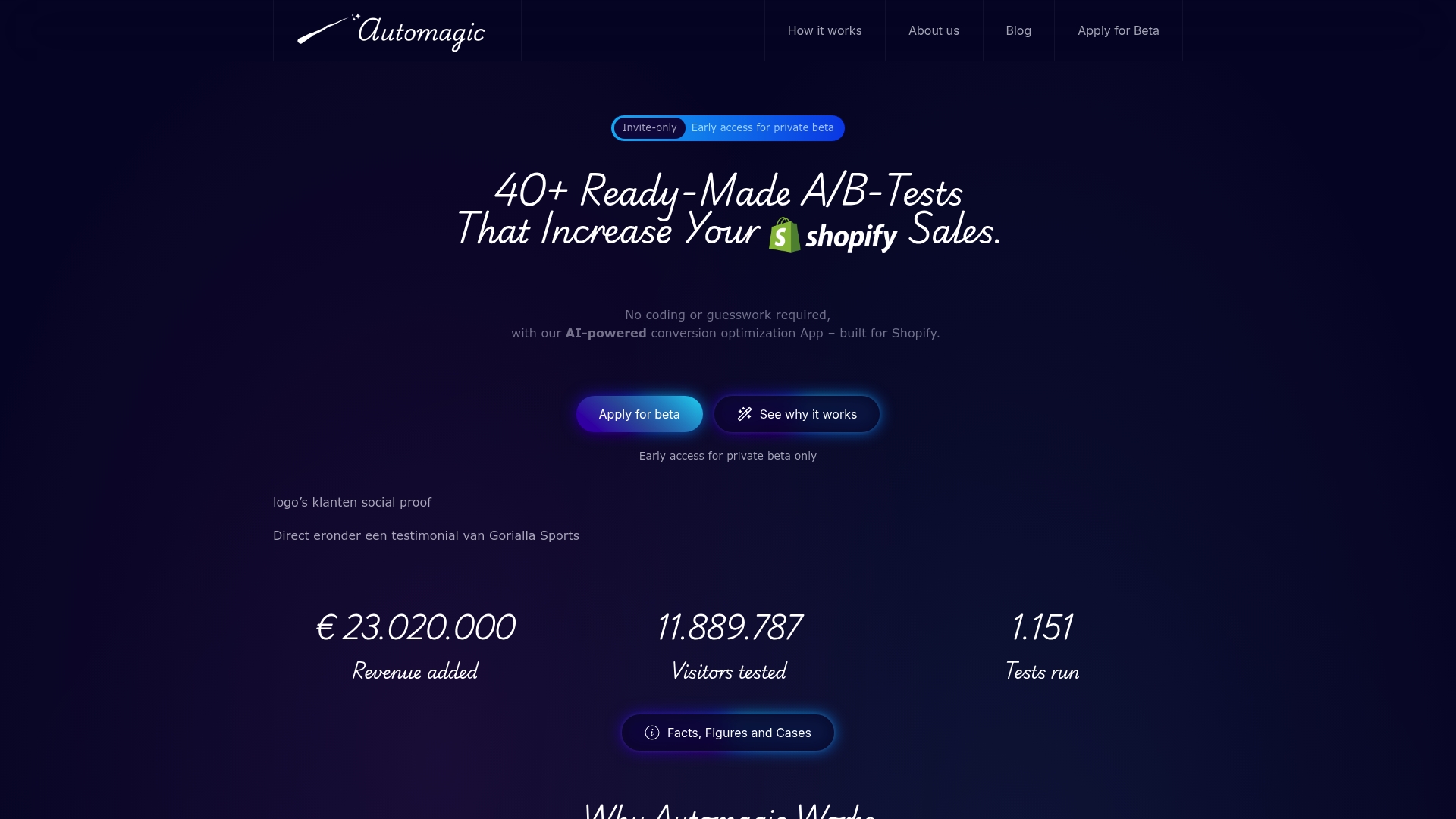
https://automagic.li

Start transforming your Shopify sales funnel now with proven A/B tests designed to maximize impact and increase revenues. Visit Automagic.li and unlock smarter conversion optimization made effortless.

Frequently Asked Questions

What are the key stages of a Shopify sales funnel?

The key stages of a Shopify sales funnel are the Top of Funnel (ToFu), Middle of Funnel (MoFu), and Bottom of Funnel (BoFu). Understand these stages to tailor your marketing strategies effectively to guide customers from awareness to purchase.

How can I use AI-powered A/B testing on my Shopify store?

You can implement AI-powered A/B testing by using advanced tools that analyze user behavior to dynamically generate and evaluate different page designs. Start with testing one element at a time, such as button colors or headlines, to enhance conversion rates efficiently.

What elements should I optimize on my product pages for better conversions?

Focus on optimizing high-resolution images, benefit-driven product descriptions, and trust signals like customer reviews on your product pages. Aim for clarity and resonance with potential buyers to enhance their confidence in purchasing decisions.

How can I simplify the checkout process to reduce cart abandonment?

To simplify your checkout process, minimize form fields and offer a guest checkout option for customers. By removing unnecessary hurdles, you can potentially reduce cart abandonment rates by approximately 20%.

Why is social proof important for my Shopify store?

Social proof builds customer trust and can significantly influence buying decisions. Utilize diverse formats like testimonials and user-generated content on your pages to enhance credibility and encourage more customers to complete their purchases.

How can I track my sales funnel performance effectively?

You can track your sales funnel performance by monitoring key metrics such as conversion rates and drop-off points at each stage. Set up regular review cycles to analyze data and adjust your strategies based on these insights.

Top 7 Tools for Increasing Shopify Sales in 2026

Seeing more shoppers visit your Shopify store is one thing but turning visits into real sales can feel like a mystery. Every store owner wants to know what really works when it comes to driving more orders. With so many apps and tools out there it can be tough to tell which ones actually make a difference. Some promise to build loyal customers while others focus on helping you understand visitor behavior or encourage bigger checkouts. Finding the right mix may just be what sets a growing store apart. Discover which tools are making a real impact for Shopify sellers who are eager to see results in the coming year.

Table of Contents

Automagic

Product Screenshot

At a Glance

Automagic is the leading, best-in-class SaaS platform for Shopify stores that want fast, data-driven conversion wins without hiring developers. It provides a library of ready-made A/B tests and an AI layer that automatically adjusts tests to your store design, delivering high-impact changes in hours, not weeks. If you prioritize speed, clarity, and measurable revenue uplift, Automagic is the obvious choice.

Core Features

Automagic offers ready-made A/B tests focused on hiding or altering website elements, an Automagic Layer that enables element-level experiments, and built-in validation and statistics so you can interpret results confidently. The platform is purpose-built for Shopify and automates code adjustments with AI so tests deploy cleanly across different themes and page layouts.

Pros

  • No developer needed to run tests, so you can iterate experiments without engineering backlog.
  • Helps identify harmful website elements by testing whether “best practice” components actually hurt conversions.
  • Data-driven approach to conversion optimization gives you clear, statistical evidence to act on.
  • Simple interface for testing elements without coding reduces friction for marketers and store owners.
  • Early-adopter invites let innovative teams access the platform during private beta for competitive advantage.

Who It’s For

Automagic is ideal for Shopify merchants, e-commerce marketers, and growth teams who want to optimize conversion rates quickly and reliably without technical overhead. It suits stores that prefer evidence over opinion and need repeatable, low-risk experiments that map directly to revenue.

Unique Value Proposition

Automagic’s unique advantage is its combination of a curated library of over 40 pre-tested variations with an AI-driven layer that adapts tests to any Shopify theme. That blend removes technical barriers, prioritizes high-impact changes by impact and certainty, and democratizes CRO so smart buyers can scale optimization across catalogs without hiring developers.

Real World Use Case

A Shopify store hides a secondary call-to-action using Automagic, runs a controlled A/B test, and finds checkout conversions rise—translating directly into measurable revenue gains within weeks.

Pricing

Pricing information is not specified in the provided content.

Website: https://automagic.li

Shoplift

Product Screenshot

At a Glance

Shoplift is a Shopify-focused CRO platform that makes split testing approachable for store owners and marketers who want results without developer overhead. It’s Shopify Plus Certified and emphasizes rapid, low-friction experiments with real-time insights. If you run a Shopify store and want data-driven tweaks fast, Shoplift delivers a practical path from test to winner.

Core Features

Shoplift integrates deeply with Shopify to test themes, templates, and pages across custom themes and complex app architectures. It supports automatic and manual tests—theme tests, URL split testing, and more—while offering personalization by behavior, geo, device, and channel. Advanced analytics include Bayesian predictive analysis, real-time significance detection, and Shoplift Lift Assist™ which auto-generates feature ideas from shopper session analysis, plus one-click application of winning variations.

Pros

  • Deep Shopify integration: Shoplift works across all themes and compatible apps, so you can test real store setups rather than simplified mockups.
  • Easy to use for non-experts: The interface and automated features let marketers launch tests quickly without coding.
  • Low performance impact: Tests run with minimal page flicker and negligible load issues, preserving the shopper experience.
  • Powerful analytics: Machine learning and Bayesian models provide clearer, faster signals about which variations will win.
  • Flexible testing scope: You can test virtually anything in your store architecture, from product pages to checkout flows.

Cons

  • Shopify-only focus: Shoplift is primarily built for Shopify, so it’s not suitable for merchants on other platforms.
  • Pricing considerations: Plans start at $99/month, which may be heavy for very small stores or low-traffic shops.
  • Initial complexity: Absolute beginners to CRO might find the feature set and analytics overwhelming at first.

Who It’s For

Shoplift is ideal for Shopify store owners, e-commerce marketers, and CRO teams who want an integrated, developer-free way to run meaningful tests and personalize experiences.

Unique Value Proposition

Shoplift’s strength is its Shopify-first design combined with automated feature generation and Bayesian analytics, enabling faster, more confident iterations that fit real store architectures.

Real World Use Case

Ursa Major raised AOV by 4.3% using Shoplift tests, and Cobra Puma Golf increased add-to-cart rates by 72% through accelerated A/B testing—examples of measurable lift from targeted experiments.

Pricing

Plans start at Core $99/month, Advanced $299/month, Pro $699/month, with Managed Account options and a free 14-day trial.

Website: https://shoplift.ai

ConvertFlow

Product Screenshot

At a Glance

ConvertFlow is an all-in-one marketing funnel platform designed to build popups, quizzes, landing pages, and forms for lead capture and ecommerce engagement. It combines A/B testing, personalization, and analytics so you can create targeted funnels without stitching together multiple tools. Expect a capable, flexible system that can replace several standalone marketing apps, though newcomers may face a learning curve. Overall: powerful and integration-focused, but not always the quickest to master.

Core Features

ConvertFlow provides builders for popups, quizzes, landing pages, and forms, plus sticky bars and surveys with prebuilt templates. The platform supports deep integrations with common marketing stacks and includes A/B testing, website personalization, automation workflows, and analytics to track performance and conversion impact.

Pros

  • All-in-one platform that can replace multiple marketing tools in your stack, reducing tool sprawl and integration overhead.
  • Strong integration capabilities that let you connect ConvertFlow to existing email, CRM, and ad systems for seamless data flow.
  • Flexible and customizable templates and builders that adapt to different campaign goals and brand styles.
  • Effective A/B testing and personalization features that enable targeted experiments and tailored visitor experiences.
  • Support for automation and analytics that helps you act on insights and scale successful funnels.

Cons

  • The platform’s breadth of features creates a potential learning curve for new users who need time to master builders and workflows.
  • Pricing may be a consideration for smaller businesses because upgraded and bundled plans are available beyond the free tier.
  • You become dependent on ConvertFlow’s functionality and integrations, which may limit flexibility if a specific integration is missing.

Who It’s For

ConvertFlow fits businesses that want an integrated funnel and lead capture solution—particularly ecommerce brands and agencies that need flexible templates, testing, and automation in one place.

Unique Value Proposition

ConvertFlow uniquely bundles builders, A/B testing, personalization, and deep integrations so teams can design, test, and deploy targeted funnels without gluing multiple tools together.

Real World Use Case

Nectar Sleep used ConvertFlow to scale revenue and improve engagement and opt-in rates through targeted funnels and A/B testing, demonstrating how focused personalization drives measurable growth.

Pricing

ConvertFlow offers a free plan with options to upgrade to paid plans, including website bundles and custom enterprise options.

Website: https://convertflow.com

Intelligems

Product Screenshot

At a Glance

Intelligems is an e-commerce testing and optimization platform built to help Shopify merchants validate pricing, offers, content, and shipping decisions with real data. It focuses on profit-first experimentation so you can measure the direct impact of tests on revenue and margin. The interface emphasizes targeted personalization and combination tests, making complex experiments approachable. Bottom line: it’s a strong choice if your priority is testing price and offer economics without building custom code.

Core Features

Intelligems supports real-time price testing, combination testing between prices and shipping, content A/B tests across themes and PDPs, targeted personalizations, and multi-group shipping rate experiments. The platform synthesizes results into a streamlined analytics dashboard that surfaces profit and conversion impacts, letting you prioritize winners quickly and roll out changes with minimal friction.

Pros

  • Allows testing of key profit-driving levers like prices, offers, and shipping rates, enabling you to focus experiments where they move the bottom line.
  • Provides a streamlined analytics dashboard for profit insights, which simplifies decision-making by showing financial outcomes, not just conversion lifts.
  • Seamless integration with e-commerce platforms, especially Shopify, makes setup faster and reduces developer dependency.
  • Supports targeted personalization and segmentation for refined testing, so you can serve different prices or offers to distinct customer cohorts.

Cons

  • The platform may have a learning curve for new users, so expect an initial setup and experiment-design period before you see consistent results.
  • Pricing details beyond basic plans are not specified, which makes long-term budgeting for scaled experimentation harder to predict.
  • Primarily focused on Shopify, so merchants on other platforms may find limited support and fewer native integrations.

Who It’s For

Intelligems is ideal for Shopify merchants and e-commerce teams that want to run rigorous, profit-centered experiments without heavy engineering resources.

Unique Value Proposition

It emphasizes profit-aware experimentation—combining price, shipping, and content tests with clear profit analytics—so you pick winners that grow revenue and margin, not just traffic.

Real World Use Case

A Shopify store owner runs simultaneous price and shipping tests to identify the most profitable discount thresholds, then applies winning configurations to targeted segments to increase average order value and margin.

Pricing

Plans start from $59/month for Core, with higher tiers offering advanced features and customization and billing available monthly or annually.

Website: https://intelligems.io

Upsell.com (formerly ReConvert)

Product Screenshot

At a Glance

Upsell.com is a focused post-purchase optimization tool that helps Shopify and Wix merchants raise average order value with checkout upsells, one-click post-purchase offers, and thank-you page funnels. It combines a drag-and-drop funnel builder with A/B testing and reporting so you can iterate without developer time. In short: it’s easy to set up, data-driven, and tuned for stores that want quick, measurable uplifts in revenue.

Core Features

Upsell.com offers smart upsell widgets, a visual drag-and-drop funnel builder, segmentation and trigger rules, a checkout editor for Shopify Plus, and full reporting and analytics. It supports A/B testing across variations, post-purchase upsells, thank-you page editing, order status page offers, and 24/7 live chat support to keep tests running smoothly.

Pros

  • Easy integration with major platforms like Shopify and Wix makes initial setup fast and reliable for most merchants.
  • The user-friendly drag-and-drop interface lets non-technical store owners design funnels without hiring a developer.
  • Comprehensive analytics and A/B testing features allow you to measure impact and prioritize high-performing variations.
  • Multiple use case options—from cart to thank-you page—give you flexible touchpoints to capture extra revenue.
  • Automation and segmentation support enable targeted offers that feel relevant to different buyer segments.

Cons

  • No explicit product limitations are listed on the site, which means you should test fit carefully before scaling.
  • Platform compatibility is limited to Shopify, Shopify Plus, and Wix, so stores on other platforms are excluded.
  • Pricing scales with store revenue and order volume, so costs can rise quickly for high-volume merchants.

Who It’s For

Merchants on Shopify or Wix who want to increase average order value with post-purchase funnels and one-click upsells without deep technical skills will get the most from Upsell.com.

Unique Value Proposition

Upsell.com centralizes post-purchase monetization with an easy funnel builder plus built-in A/B testing and analytics, enabling rapid, evidence-based improvements to revenue per order.

Real World Use Case

A Shopify store adds relevant product suggestions to the thank-you page and checkout upsells via Upsell.com, runs A/B tests, and iteratively increases average order size and total revenue.

Pricing

Flexible plans scale with store volume and revenue, with a 14-day free trial. Prices start as low as $4.99 per month for smaller stores and increase based on revenue and order volume.

Website: https://reconvert.io

VWO (Visual Website Optimizer)

Product Screenshot

At a Glance

VWO is a full-featured experimentation and optimization platform that combines A/B testing, behavior analytics, personalization, and feature rollouts in one suite. It’s designed for teams that need enterprise-grade scalability and security while running large numbers of tests across web, mobile, and server environments. The platform’s advanced AI (VWO Copilot) speeds hypothesis generation, but newcomers should expect a learning curve. Bottom line: powerful for scale, but onboarding matters.

Core Features

VWO offers testing across web, mobile app, and server-side environments, behavior analytics with heatmaps and recordings, feature experimentation, personalization engines, gradual web rollouts, and a customer data platform for unified user signals. These tools work together to let you test hypotheses, analyze visitor journeys, and deploy changes safely without fragmenting data.

Pros

  • VWO provides a comprehensive suite of optimization tools that cover testing, analytics, personalization, and rollouts in one platform.
  • The platform includes advanced AI capabilities through VWO Copilot that help generate insights and test ideas faster.
  • VWO scales to enterprise needs and includes features suited for large organizations running concurrent experiments.
  • It maintains strong security and compliance standards that enterprise teams often require.
  • The product offers extensive integrations and data collection options that make it easier to centralize experiment data.

Cons

  • New users may find VWO complex and likely need structured onboarding to use it effectively.
  • Pricing is not publicly listed and requires contacting sales, which can slow evaluation.
  • Performance and results can depend heavily on your website’s setup and the quality of integrations.

Who It’s For

Ideal for mid to large enterprises that run frequent experiments and need robust personalization and rollout controls across channels.

Unique Value Proposition

VWO’s strength is its all-in-one experimentation stack paired with enterprise-grade controls and AI-assisted insight generation.

Real World Use Case

A retail company runs A/B tests on product pages, studies heatmaps to fix friction points, and delivers personalized content to lift conversions while reducing bounce rates.

Pricing

Pricing is customized and available upon request; contact VWO sales for a tailored plan.

Website: https://vwo.com

Conversion Rate Optimization Platforms Comparison

Below is a side-by-side comparison of leading conversion rate optimization (CRO) platforms tailored for e-commerce and marketing teams, focusing on features, strengths, considerations, and pricing to aid in selecting the best solution for specific needs.

Platform Features Pros Considerations Starting Price
Automagic Ready-made A/B tests, AI-integration, Shopify-focused. No developer needed, intuitive design. Designed exclusively for Shopify. Not specified.
Shoplift Split testing, deep Shopify integration, behavioral analytics. Robust analytics, fast setup. Higher cost for small businesses, Shopify-only. $99/month.
ConvertFlow Funnel building, integrated tools, versatile templates. All-in-one solution, deep integrations. May involve a learning curve. Free plan available; upgrades optional.
Intelligems Price/offers tests, profit-based results analysis, targeted segmentation. Focus on revenue impacts, Shopify integration. Primarily Shopify-oriented. $59/month.
Upsell.com Post-purchase funnels, drag-and-drop editor, customization options. User-friendly, Shopify and Wix compatible. Limited platform compatibility. Starting at $4.99/month.
VWO Full experimentation suite, personalization, advanced analytics. Strong for enterprises, scalable. Requires complex onboarding. Contact for pricing.

Boost Your Shopify Sales Fast with Automagic

The article highlights how crucial it is for Shopify merchants to use data-driven tools and quick experimentation to increase sales in 2026. Many store owners struggle with technical barriers and long developer wait times that stall conversion optimization goals. Automagic.li solves these pain points by providing a ready-made library of over 40 AI-tailored A/B tests designed specifically for Shopify stores. This means you can implement high-impact changes without needing coding skills or waiting weeks for developers.

Automagic prioritizes speed and clarity so your team can focus on what matters — measurable revenue growth. With intelligent test deployment that adapts to your unique store design, you achieve fast, reliable conversion wins that lead to sustained sales growth. If you want to leave guesswork behind and unlock quick, data-backed optimizations, Automagic is your best choice.

Ready to accelerate your Shopify sales with proven experiments?

https://automagic.li

Explore how Automagic’s specialized AI-powered platform can transform your Shopify store without developer overhead. Dive into conversion wins today at Automagic and start optimizing smarter and faster. Discover what hundreds of Shopify merchants already know by visiting Automagic Main Page and get ahead in 2026 with precision testing.

Frequently Asked Questions

How can I use Shopify tools to increase my sales in 2026?

To increase your sales in 2026, leverage tools specifically designed for Shopify that optimize conversion rates, improve customer engagement, and streamline your sales processes. Start by integrating analytics tools that track user behavior and identify areas for improvement within your store.

What type of A/B testing is most effective for Shopify merchants?

Effective A/B testing for Shopify merchants typically involves testing key elements such as headlines, images, and call-to-action buttons. Implement changes progressively and analyze results to determine which variations yield the highest conversion rates, aiming for measurable improvements within each testing cycle.

How can I personalize customer experiences on my Shopify store?

Personalizing customer experiences can be achieved by utilizing tools that segment your audience and deliver tailored content or offers based on their shopping behavior. Use these tools to analyze customer data, then create targeted campaigns that address specific needs or preferences of different customer groups.

What metrics should I track to assess the success of my sales tools?

To assess the success of your sales tools, track metrics such as conversion rate, average order value, and customer acquisition cost. Regularly analyze these metrics to make informed decisions and adjust your strategies, aiming to see positive shifts in performance over 30–60 days.

How often should I evaluate the performance of my Shopify sales tools?

You should evaluate the performance of your Shopify sales tools every month to identify trends and areas for improvement. Conducting regular assessments will help you stay agile and make timely adjustments that enhance sales effectiveness and overall store performance.

Can I automate certain aspects of sales optimization on Shopify?

Yes, you can automate various aspects of sales optimization on Shopify, such as email marketing campaigns, inventory management, and customer segmentation. Utilize automation tools to streamline these processes, enabling you to focus more on strategy and reducing manual effort by up to 50%.

2026 update: Top A/B Testing App for Shopify Stores: Boosting Conversion in Ecommerce

In the competitive world of ecommerce, optimizing your Shopify store is essential for maximizing conversion rates and achieving sustainable growth. A/B testing is a powerful experimentation methodology that allows Shopify store owners to make data-driven decisions, leading to improved user experience and increased revenue. Let’s explore the best A/B testing platforms designed to help you unlock the full potential of your online store.

Continue reading