
Conversion Bias: Shaping Shopify Store Results
Finding ways to influence customer decisions without coding skills can feel frustrating for Shopify entrepreneurs. The challenge is not just about tweaking design or price but understanding what actually convinces shoppers to buy. That’s where conversion bias becomes your hidden advantage. When you learn why repeated messages shape belief and how subtle techniques like position bias and social proof work, you can guide customers naturally toward confident purchases using proven psychology.
Table of Contents
- Conversion Bias Defined and Debunked
- Types of Conversion Bias in eCommerce
- How Conversion Bias Influences Shopper Behavior
- Recognizing Symptoms and Diagnosing Impact
- Risks, Challenges, and Mitigation Strategies
Key Takeaways
| Point | Details |
|---|---|
| Understanding Conversion Bias | Conversion bias influences consumer behavior by reinforcing beliefs through repeated messaging, making it essential for merchants to leverage it effectively. |
| Types of Conversion Bias | Recognizing various biases, such as position, availability, social proof, and scarcity bias, helps tailor strategies that align with consumer psychology. |
| Consistency is Key | Ensuring messaging consistency across all touchpoints increases the likelihood of conversion by reinforcing the value proposition in the customer’s mind. |
| Impact of Transparency | Being transparent about messaging and potential biases can mitigate risks and foster trust, ultimately enhancing customer loyalty and conversion rates. |
Conversion Bias Defined and Debunked
Conversion bias sounds like marketing jargon, but it’s actually a psychological phenomenon that affects how your customers make purchasing decisions. At its core, conversion bias is the tendency for consumers to accept information as true simply because they’ve been exposed to it repeatedly, regardless of whether that information is actually accurate. Think of it as your brain taking a shortcut: when you see the same message over and over, your mind starts treating familiarity as truthfulness. This happens because repeated exposure creates cognitive ease, making the claim feel more believable just because it doesn’t require mental effort to process.
This bias operates differently than you might expect. According to research on bias in research and consumer behavior, conversion bias manifests when customers’ beliefs become shaped by repeated exposure to information, leading them to accept it as true regardless of factual accuracy. Another layer of this phenomenon is confirmation bias, which is closely related. Confirmation bias describes how people seek or interpret information in ways that confirm what they already believe. Your customers don’t just passively accept repeated messages; they actively look for evidence that supports those messages while ignoring contradictory information. This creates a powerful cycle where your store’s messaging reinforces itself in customers’ minds, making initial claims feel increasingly legitimate over time.
Here’s what makes conversion bias particularly relevant to your Shopify store: most merchants are either weaponizing it without realizing it or missing the opportunity entirely. When you repeat the same value proposition, product benefit, or social proof across your product pages, checkout flow, and email sequences, you’re leveraging conversion bias. But here’s the catch. If your messaging is unclear, misaligned with what customers actually want, or inconsistent across touchpoints, you’re still triggering conversion bias in the wrong direction, making false claims feel familiar rather than making true benefits feel compelling. The goal isn’t to trick customers into believing something false. The goal is to make your legitimate value proposition so clear and consistent that it becomes impossible to ignore.
Understanding the mechanics of conversion bias helps you deploy it strategically. When you know that repeated exposure shapes belief, you can structure your store to reinforce your actual value proposition at every customer interaction point. This is where systematic testing becomes valuable. By testing different messages, positioning, and repetition patterns, you can identify which truthful claims resonate most strongly with your audience and then reinforce those consistently throughout their experience.
Pro tip: Audit your store for messaging consistency across your homepage hero, product pages, cart, and checkout. If your main value proposition appears at least three times in slightly different words throughout the customer journey, conversion bias works in your favor. If it’s missing or contradictory, you’re leaving conversions on the table.
Types of Conversion Bias in eCommerce
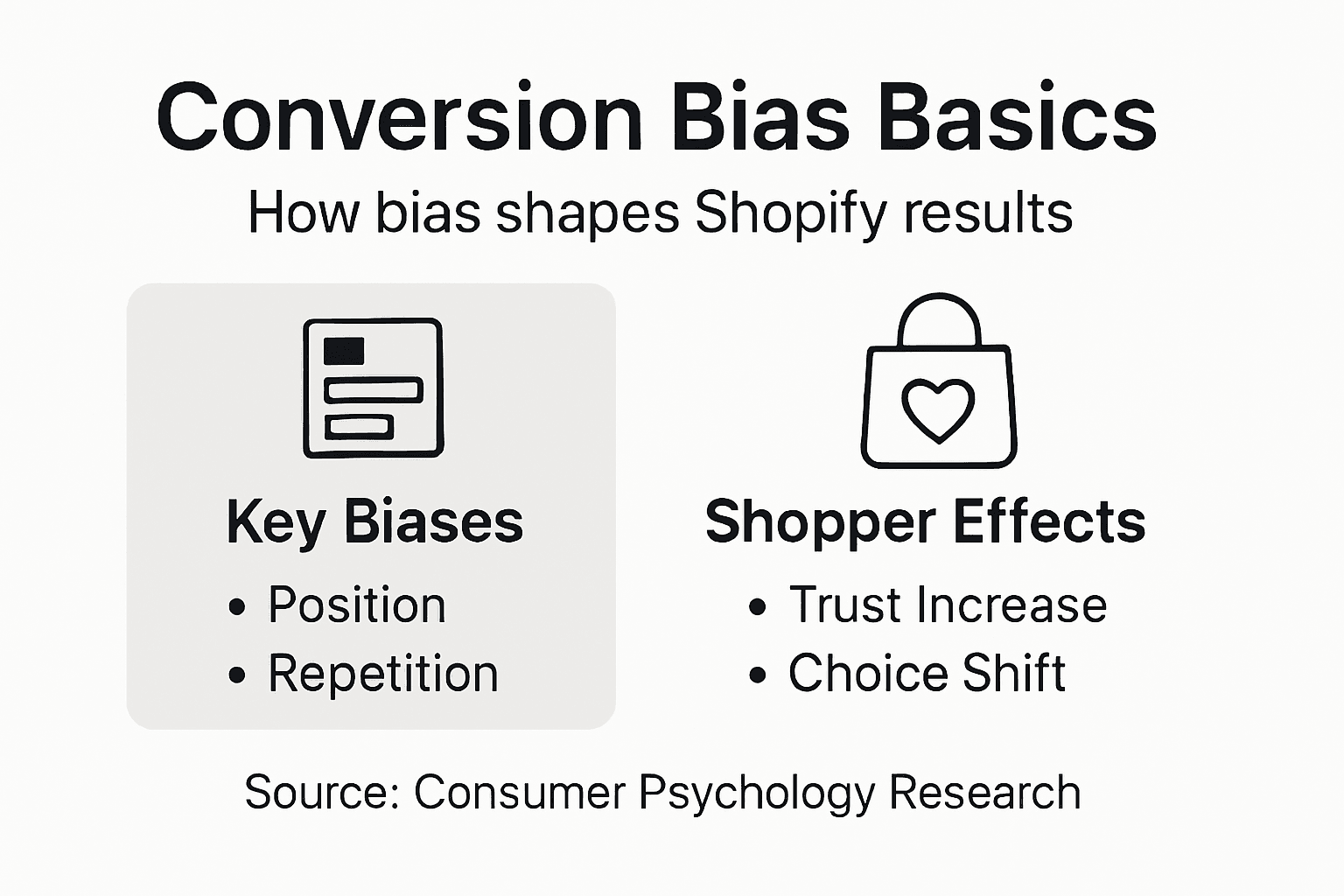
Conversion bias doesn’t operate as a single mechanism. Your customers encounter multiple types of biases working together throughout their shopping journey, each one subtly pushing them toward or away from completing a purchase. Understanding these distinct types helps you recognize where they show up in your Shopify store and how to use them intentionally.
Position bias is one of the most straightforward. When customers search for products, they naturally favor items listed higher in results, assuming those top placements indicate quality or relevance. This happens even when items lower on the list might actually be better matches for what they’re looking for. Availability bias works differently. Your customers base purchasing decisions on information that comes to mind easily. If a product review or customer testimonial appears multiple times across your site, customers assume it’s more important or trustworthy simply because it’s mentally accessible. Social proof leverages the human tendency to follow what others do. When customers see that many people have purchased a product, left positive reviews, or recommended it, they feel more confident making the same choice. Scarcity bias triggers urgency by highlighting limited availability. Phrases like “only 3 left in stock” or “sale ends in 2 hours” create psychological pressure because people fear missing out.

Beyond these common types, research on cognitive biases in e-commerce reveals that confirmation bias shapes how customers interpret product information. Once they’ve decided to consider a product, they actively seek information confirming it’s a good choice while ignoring contradictory details. This is particularly powerful because customers essentially convince themselves through selective attention. Additionally, conversion bias manifests through demographic and representational filters in online reviews and customer feedback. Biases related to race, size, class, and gender appear in how customers perceive products and sellers, directly influencing whether someone trusts your store enough to complete a purchase. These layered biases mean that a customer’s trust and buying decision result from multiple psychological forces acting simultaneously.
Why does this matter for your store? Because these biases operate whether you acknowledge them or not. If your product pages lack social proof, you’re leaving availability bias unused. If your search or filtering options don’t surface your best products naturally, position bias works against you. If your testimonials lack diversity or fail to address common customer concerns, confirmation bias prevents hesitant buyers from moving forward. The merchants winning right now recognize that bias types interact. They stack multiple types of bias in their favor. They use position bias by featuring bestsellers prominently, availability bias by repeating key benefits, social proof through diverse customer reviews, and scarcity bias with transparent inventory signals. The result is a conversion experience where psychological forces align with your actual value proposition.
Here’s a comparison of common conversion biases and their effects in eCommerce:
| Bias Type | How It Triggers Purchases | Business Impact |
|---|---|---|
| Position Bias | Highlights top products | Drives sales to featured items |
| Availability Bias | Repeats key benefits/reviews | Strengthens perceived credibility |
| Social Proof | Shows positive group behavior | Boosts customer trust |
| Scarcity Bias | Emphasizes limited supply or time | Increases urgency to buy |
| Confirmation Bias | Reinforces buyers’ pre-existing ideas | Reduces decision friction |
Pro tip: Audit your product pages for evidence of at least four bias types. Do you show bestseller status (position), repeat key benefits (availability), display customer reviews (social proof), and indicate limited stock (scarcity)? Missing even one type means customers face unnecessary friction before deciding to buy.
How Conversion Bias Influences Shopper Behavior
Conversion bias doesn’t just sit in your customer’s mind as an abstract concept. It actively shapes their behavior at every stage of the shopping journey, from the moment they land on your site to when they decide whether to complete their purchase. The mechanism is straightforward but powerful. When customers see the same message, offer, or product repeatedly, they unconsciously shift from skepticism to acceptance. This isn’t manipulation in the traditional sense. It’s how human brains process information efficiently. After repeated exposure, your brain treats familiar information as more credible simply because processing it requires less mental effort.
The real power of conversion bias emerges in how it compounds with other psychological forces. Anchoring establishes an initial reference point that influences all subsequent judgments. When a customer sees an original price crossed out alongside a discounted price, that original number becomes their mental anchor, making the discount feel more substantial than it might actually be. The decoy effect works alongside this. When you present three product options instead of two, with one clearly inferior option, customers gravitate toward the premium option that now looks like the best value. Research on behavioral biases and promotional content shows that repeated exposure to promotional messages triggers conversion bias, where consumers gradually accept marketing claims as more credible, directly influencing purchasing decisions. This happens because customers see the same benefit claimed across product descriptions, testimonials, and marketing emails, creating a cumulative credibility effect.
What makes this particularly relevant to your Shopify store is that conversion bias influences customers across the entire decision-making journey. Early in their research, loss aversion dominates their thinking. Customers fear missing out on a deal more than they anticipate gaining from a purchase, making scarcity messaging and limited-time offers surprisingly effective. As they move toward checkout, confirmation bias takes over. Customers actively seek information that validates their emerging choice while dismissing contradictory details. A hesitant customer reading your product reviews will naturally fixate on positive testimonials that confirm their purchase instinct while overlooking critical comments. This selective attention isn’t conscious deception. Your customers genuinely believe they’re making a rational choice when really they’re following a psychological path you’ve illuminated through strategic messaging and social proof.
Understanding this influence also reveals why consistency matters so much. When your homepage headline, product page subheading, customer testimonial, and checkout confirmation message all reinforce the same core benefit, conversion bias amplifies the message’s power. Customers encounter the claim repeatedly, each exposure making it feel more true and more compelling. But if your messages contradict each other or fail to reinforce a clear value proposition, you actually trigger negative conversion bias where customers become more skeptical the more they see conflicting information.
Pro tip: Map your customer journey from first touchpoint to checkout and identify where the same core benefit appears (or fails to appear). Your customers should encounter your main value proposition at least three to four times in slightly different contexts. Each repetition strengthens conversion bias in your favor, making the message feel increasingly true and urgent.
Recognizing Symptoms and Diagnosing Impact
Conversion bias doesn’t announce itself with flashing red lights. It operates quietly in the background of your store’s analytics, influencing customer behavior in ways that are easy to miss if you don’t know what to look for. The first symptom is increased susceptibility to repeated messaging. If you notice customers responding more strongly to claims the more frequently you repeat them, that’s conversion bias at work. Another clear symptom is preference formation based on familiarity rather than actual product merit. Your best sellers aren’t always your objectively best products. Sometimes they’re simply the ones you’ve positioned most prominently or mentioned most often. You’ll also observe impulsive purchasing patterns triggered by social proof and scarcity signals. Customers add items to their cart at higher rates when they see “5 people viewing this product” or “only 2 left in stock,” even when they weren’t actively searching for that item minutes before.
Diagnosing the actual impact requires looking beyond surface level metrics. Start by measuring engagement metrics like click-through rates and conversions, but also track abandonment patterns carefully. Notice which products have high view rates but low conversion rates. These often indicate that familiar messaging is driving traffic without actually convincing customers to buy. The gap between attention and action reveals something important. Then evaluate your customer feedback deliberately. Read your reviews, support tickets, and customer surveys looking specifically for language indicating bias-influenced decisions. Phrases like “I kept seeing this everywhere, so I figured it must be good” or “I wasn’t planning to buy but the limited stock made me decide quickly” signal conversion bias in action. These aren’t necessarily negative outcomes, but they tell you which psychological forces are driving your sales.
Beyond these qualitative observations, your analytics dashboard contains concrete data you should examine. Look at your conversion rate by traffic source. Customers who arrive from email or retargeting ads often show higher conversion bias symptoms because they’ve seen your messaging multiple times. Compare this to cold traffic sources like organic search or referrals. The difference reveals how much conversion bias contributes to your baseline conversions. Additionally, examine your product page metrics carefully. Which elements receive the most attention and in what sequence? Customer attention distribution during purchase decisions directly predicts purchase intent. If customers spend disproportionate time on social proof elements like reviews, that signals they’re relying heavily on bias-influenced information processing rather than feature comparisons.
The diagnostic process also requires honest assessment of your messaging strategy. Audit your site and count how many times your core value proposition appears. If it’s fewer than three times in a customer’s typical journey, you’re underutilizing conversion bias. If it appears more than six times identically, you might be creating message fatigue instead of reinforcement. Look for consistency. Conflicting messaging creates confusion and triggers skepticism rather than credibility. Customers who see different benefits emphasized on different pages don’t experience conversion bias accumulation. They experience mixed signals.
The following table summarizes diagnostic methods for identifying conversion bias symptoms:
| Diagnostic Method | What to Measure | Insight Provided |
|---|---|---|
| Page View Analysis | High views, low conversions | Reveals messaging inefficacy |
| Conversion Rate by Source | Compare email vs. organic | Shows bias influence from exposure |
| Review and Feedback Audit | Buyer motivations language | Detects bias-driven decisions |
| Messaging Frequency Audit | Count benefit repetitions | Identifies over- or underuse |
Pro tip: Set up a simple spreadsheet tracking your top ten products and measure three things for each: total page views, conversion rate, and how many times your main benefit statement appears on that product page. Products with high views and lower conversion rates indicate messaging opportunity, while high conversion products reveal which messaging approaches resonate most strongly.
Risks, Challenges, and Mitigation Strategies
Leveraging conversion bias isn’t without risk. The same psychological mechanisms that drive legitimate conversions can backfire spectacularly if misapplied. The primary risk is eroding customer trust. When customers realize they’ve been influenced by repeated messaging that oversells or misrepresents your product, they don’t just abandon their purchase. They leave negative reviews, share their experience on social media, and warn others away from your store. This damage compounds over time. One deceived customer becomes ten through word of mouth, and suddenly your conversion rates plummet despite your sophisticated bias strategies. Another significant risk involves perpetuating unfairness in how different customer segments experience your store. Algorithmic and marketing biases can create a situation where certain demographics see different messaging, pricing, or social proof than others, leading to discriminatory outcomes even when that wasn’t your intention.
The challenges in managing conversion bias effectively are more subtle. One core challenge is detecting bias embedded in your messaging and data. Bias often hides in plain sight. You might not realize your product descriptions emphasize benefits that appeal primarily to one demographic while alienating others. Another challenge involves balancing bias mitigation with conversion goals. Reducing bias sometimes means softening your messaging, which could reduce short-term conversions. You face a genuine trade-off between accuracy and equity. Additionally, customer behavior patterns constantly evolve. What triggered conversion bias last year might feel manipulative this year as consumer awareness increases and expectations shift. Your mitigation strategies require continuous adjustment rather than one-time implementation.
Effective mitigation starts with transparency. Audit your marketing data and messaging for hidden biases by asking difficult questions. Who is responding to your conversion bias tactics and who isn’t? Are certain customer segments more susceptible to social proof while others respond better to feature comparisons? Research on algorithmic bias mitigation techniques emphasizes diverse and representative data collection, transparency in processes, and continual monitoring. This means regularly testing your messaging with different customer segments and actively seeking feedback from those less represented in your sales data. Implement pre-testing protocols before launching new campaigns. Show your messaging to actual customers outside your typical demographic and gather feedback about whether it feels authentic or manipulative.
Beyond messaging transparency, consider structural changes to your store. A/B testing different messaging intensities helps you find the sweet spot where conversion bias works without feeling deceptive. Test a product page with your core benefit repeated four times versus two times and measure not just conversion rate but also review sentiment. Positive reviews with lower conversion suggests you’re overselling. Create feedback loops with your customer service team. They hear directly when customers feel misled. Regular team discussions about customer feedback reveal bias patterns you might otherwise miss. Develop a clear ethical guideline for your marketing team defining which conversion bias tactics are acceptable and which cross the line into manipulation. Document these guidelines and review them quarterly as your business evolves.
Pro tip: Before launching any new campaign using repeated messaging, social proof, or scarcity signals, have someone unfamiliar with your brand review it and answer this question: “Does this feel like genuine information or persuasion designed to override my rational judgment?” Their honest answer reveals whether you’re leveraging bias appropriately or crossing into manipulation.
Harness Conversion Bias With AI-Powered Testing to Boost Your Shopify Store
Conversion bias drives customer decisions through repeated, consistent messaging and strategic social proof. Yet without the right tools to identify which messages resonate best, Shopify store owners risk leaving conversions on the table or overloading visitors with conflicting information. Automagic.li understands these challenges and empowers you to leverage conversion bias effectively by providing a simple, no-code platform packed with AI-driven A/B tests designed specifically for Shopify merchants.
Take control of your store’s messaging today by choosing from over 40 pre-tested variations that optimize how your value propositions appear across your site. With Automagic.li, you can quickly deploy tailored experiments that reinforce your core benefits consistently, reduce shopper friction, and maximize trust through social proof and scarcity techniques. Don’t guess what works—use data-driven results to continuously improve your customer journey and increase sales. Start your journey to smarter conversion with Automagic.li now and see how focused repetition can transform skepticism into confident buying decisions.
Frequently Asked Questions
What is conversion bias in eCommerce?
Conversion bias refers to the psychological phenomenon where consumers accept information as true simply due to repeated exposure, regardless of its factual accuracy. It causes customers to shift from skepticism to acceptance after seeing the same message multiple times.
How does conversion bias affect purchasing decisions?
Conversion bias influences consumers by making familiar messages feel more credible and appealing, ultimately encouraging them to complete purchases. It works alongside other biases, like social proof and scarcity bias, to enhance the perceived value of products.
What are some common types of bias that affect shopper behavior?
Common types of bias include position bias (favoring top search results), availability bias (relying on easily recalled information), social proof (trusting popular products), and scarcity bias (feeling urgency due to limited availability).
How can I leverage conversion bias in my Shopify store?
To effectively leverage conversion bias, ensure consistent messaging across your store, repeat your core value proposition multiple times, and utilize elements like social proof and scarcity. This helps reinforce credibility and encourages customers to trust your offerings.
Recommended
- Conversion Rate Benchmarks: Boosting Shopify Sales – Automagic
- Why Data Helps Conversions for Shopify Stores – Automagic
- Role of Feedback in Conversion: Boosting Shopify Sales – Automagic
- Conversion Uplift: Boosting Shopify Store Sales – Automagic
- What Is Amazon Conversion Rate? Definition, Benchmarks & Tips