
7 Ways to Increase Shopify Sales with No-Code Solutions
Creating a Shopify store is one thing, but getting more visitors to actually buy is a much bigger challenge. You tweak your site, update product listings, and experiment with new deals—but conversions still lag behind your expectations. Figuring out what truly moves the needle can feel confusing and overwhelming.
The good news is you can use proven, research-backed methods to turn more browsers into buyers. This list cuts through the guesswork and gives you direct, practical actions you can use right away. You’ll discover how to harness the power of homepage design, A/B testing, social proof, AI-driven personalization, and more to spark real changes in your store’s sales performance.
Get ready to unlock insights that help you make smarter decisions with less trial and error. Each step ahead breaks down exactly how small, strategic adjustments will transform your Shopify store’s conversion rates.
Table of Contents
- 1. Start With High-Impact Homepage Changes
- 2. Test Product Page Variations For Better Conversions
- 3. Optimize Checkout To Reduce Abandoned Carts
- 4. Use Social Proof Like Client Reviews And Testimonials
- 5. Leverage Ready-Made A/B Test Libraries
- 6. Personalize User Experience With AI Automation
- 7. Monitor Results And Refine Based On Data
Quick Summary
| Takeaway | Explanation |
|---|---|
| 1. Optimize Your Homepage for Engagement | Implement strategic changes to enhance clarity and personalization, driving higher conversion rates from your homepage. |
| 2. A/B Test Product Page Elements | Experiment with various product page components to identify which changes lead to increased sales and lower bounce rates. |
| 3. Simplify Checkout Process | Reduce friction by eliminating unnecessary fields and clarifying fees, thus decreasing cart abandonment rates. |
| 4. Leverage Social Proof Effectively | Display genuine customer reviews prominently to build trust and encourage conversions from new visitors. |
| 5. Use Ready-Made A/B Test Libraries | Access pre-built A/B tests to streamline the optimization process, focusing on proven elements that boost revenue. |
1. Start With High-Impact Homepage Changes
Your homepage serves as the digital storefront of your Shopify store. The few seconds visitors spend on your homepage largely determine whether they’ll explore further or leave to browse a competitor. Making strategic, data-backed changes to your homepage can dramatically shift this outcome.
Here’s the key insight: your homepage isn’t just a landing page. It’s a conversion machine that shapes the entire customer journey. Recent research shows that personalized homepages using AI-driven recommendations, clear visuals, and streamlined navigation significantly increase conversion rates globally. When visitors land on your site, they make split-second decisions based on what they see. A cluttered layout with confusing navigation sends them away. A clean, focused design with obvious next steps keeps them engaged.
What makes certain homepage changes high-impact? The answer lies in understanding your visitors’ behavior. Start by identifying friction points: Is your value proposition clear within the first scroll? Can visitors find what they’re looking for without searching? Are you showing personalized product recommendations based on their browsing history? These aren’t minor tweaks. They directly influence whether someone adds items to their cart or bounces to another site. Optimizing homepage design to capture user attention and influence purchasing behavior has become essential for competitive ecommerce stores. The best part? You don’t need a developer to test these changes. No-code A/B testing tools let you run experiments on your homepage layout, headlines, call-to-action buttons, and product displays without touching a single line of code.
Consider your checkout flow, product imagery, and the placement of customer testimonials. Each element competes for attention. Your job is to prioritize what matters most to your specific audience. If your target customers care about fast shipping, highlight that prominently. If they value quality assurance, feature customer reviews and trust badges at eye level. The data will reveal which changes actually move the needle on sales.
Pro tip: Start by A/B testing one high-impact homepage element at a time, such as your main headline or hero image, rather than changing multiple elements simultaneously. This isolates which specific change drives better results and prevents you from accidentally sabotaging conversion rates with conflicting changes.
2. Test Product Page Variations for Better Conversions
Your product pages are where purchase decisions actually happen. A visitor might click through from your homepage, but the product page itself determines whether they buy or bounce. Testing different variations of your product pages reveals exactly what combination of elements converts browsers into buyers.
Why does this matter so much? Product pages contain multiple elements competing for attention: titles, images, descriptions, pricing, reviews, and call-to-action buttons. Small changes to any of these can significantly impact whether someone completes a purchase. A/B testing product page variations helps identify the most effective elements that drive conversions. You might discover that a different product title increases add-to-cart rates by 23 percent, or that repositioning customer testimonials above the fold boosts confidence in skeptical buyers. These aren’t guesses. They’re data-driven insights that directly affect your bottom line. Track key metrics like conversion rate, add-to-cart rate, and bounce rate to measure what’s actually working. Without testing, you’re leaving money on the table with every visitor who doesn’t purchase.
Start by identifying your product page pain points. Are visitors abandoning carts before checkout? That might indicate unclear pricing or missing trust signals. Do they spend time viewing images but never read the description? Your visuals might be compelling while your copy falls flat. Optimizing product pages through testing various elements like descriptions, images, and layout can significantly enhance conversion rates. Consider testing different product image arrangements, experimenting with longer versus shorter descriptions, or changing your call-to-action button text from “Buy Now” to “Add to Cart.” You can even test whether featuring customer reviews more prominently increases trust and purchases. The beauty of no-code testing is that you don’t need technical expertise. You simply select which page element to test, choose your variation, set your audience size, and let the data guide your decisions. Your Shopify store’s product pages are your highest-converting real estate. Treating them as optimization opportunities rather than static pages transforms them into revenue-generating machines.
Pro tip: Test one product page element at a time and let it run for at least one to two weeks to gather statistically significant data, preventing premature conclusions from small sample sizes and ensuring your winning variations are truly driven by customer preference rather than random fluctuation.
3. Optimize Checkout to Reduce Abandoned Carts
Cart abandonment is one of the biggest revenue killers in ecommerce. A customer fills their cart with products, gets ready to buy, and then vanishes. Around 70 percent of online shoppers globally abandon their carts before completing purchases, and most of the time it comes down to checkout friction. The good news? Optimizing your checkout process directly addresses the root causes of abandonment.
Why do customers abandon carts? The culprits are predictable: unexpected shipping costs revealed at the last moment, complicated forms requiring too much information, limited payment options, and unclear trust signals. When a shopper reaches your checkout page, they’re already committed. They want to buy. Your job is to remove obstacles rather than create them. Improving checkout usability by simplifying forms and offering multiple payment options can improve conversion rates by over 30 percent. That’s not a minor improvement. That’s transformative. Start by eliminating unnecessary form fields. Do you really need their phone number? Middle name? Company title? Every field you remove reduces friction and increases completion rates. Display shipping costs upfront so customers never encounter surprise fees at the final step. Offer multiple payment methods because different customers have different preferences. Some want PayPal, others prefer Apple Pay or credit cards. Removing barriers to payment options literally removes reasons to abandon.
Key factors influencing cart abandonment include shipping costs and checkout complexity, which means your optimization strategy should address both areas simultaneously. Add trust badges, security certifications, and money-back guarantees near your payment button. Consider implementing a progress indicator so customers know exactly where they are in the checkout process. Test whether a guest checkout option increases completion rates compared to requiring account creation. Small optimizations compound. A 5 percent improvement in checkout completion across thousands of monthly visitors translates to substantial additional revenue. Your checkout experience determines whether interested buyers become actual customers.
Pro tip: Run an A/B test comparing your current checkout flow against a simplified version with fewer form fields and earlier shipping cost disclosure, measuring both completion rate and average order value to see which variation actually generates more revenue.
4. Use Social Proof Like Client Reviews and Testimonials
Customers trust other customers more than they trust your marketing claims. This is the power of social proof. When a potential buyer sees genuine reviews from real people who purchased and loved your product, their buying confidence skyrockets. Reviews and testimonials aren’t nice-to-have additions to your Shopify store. They’re conversion multipliers that directly impact whether visitors become paying customers.
Why does social proof work so effectively? Because it reduces perceived risk. A new visitor knows nothing about your brand. They don’t know if your product quality matches your description. They don’t know if you ship on time or if customer service responds to complaints. But when they read a review from someone similar to themselves saying the product exceeded their expectations, something shifts. That review answers unspoken questions and builds trust faster than any marketing copy you could write. Social proof significantly influences purchasing decisions by building trust and reducing perceived risk. Authentic, relevant reviews resonate with target audiences and enhance brand credibility. The result is measurable increases in conversion rates. Peer recommendations, customer ratings, and testimonial frequency strongly affect purchase likelihood, which means more reviews equals more sales. The math is simple. Display your best reviews prominently on product pages, homepage, and checkout pages. Show star ratings alongside product titles. Include customer testimonials in your email campaigns. Feature video testimonials if you have them. People are far more convinced by seeing a real person talk about their positive experience than reading polished marketing language.
Here’s what many store owners miss: collecting reviews requires deliberate action. You can’t simply hope customers leave reviews. Send follow-up emails after purchase asking satisfied customers to share their experience. Make the process simple with direct links to your review platform. Consider offering a small incentive for reviews. Some stores see review volume increase by 300 percent simply by asking. Once you have reviews, don’t hide them. Showcase positive feedback. Respond professionally to negative reviews, showing potential customers that you care about feedback and stand behind your products. The brands with the highest conversion rates understand that social proof is not vanity metrics. It’s revenue generation through authentic customer voices.
Pro tip: Display your highest-rated customer reviews prominently on your product pages and include specific details about product benefits, and then A/B test whether featuring video testimonials or star ratings first in the layout generates higher conversion rates.
5. Leverage Ready-Made A/B Test Libraries
Building A/B tests from scratch requires expertise you might not have. You need to know what to test, how to structure the experiment, and how to interpret results. This is why ready-made A/B test libraries are game-changers for Shopify store owners without technical backgrounds. Instead of inventing tests, you access proven experiments designed by conversion specialists and tested across thousands of stores.
Ready-made test libraries eliminate guesswork. Each test comes pre-built with specific variables, clear objectives, and measurable success metrics. Rather than wondering whether changing your button color or adjusting your product price display matters, you can deploy tests that experts have already validated. Ready-made A/B test repositories streamline experimentation and support data-driven decision-making by enabling teams to apply statistically valid tests efficiently. Think about what this means for your store. You’re not spending weeks designing experiments. You’re not hiring developers to build test infrastructure. You simply select a test from the library, customize it to match your store’s design, and watch the data come in. This approach dramatically accelerates your optimization timeline. What would take months to figure out independently happens in days.
Why does this matter practically? Because most store owners lack deep conversion optimization knowledge. You understand your products and your customers, but identifying which specific page elements actually drive conversions requires testing discipline and statistical knowledge. Ready-made libraries provide both. Open-source and free A/B testing tools with test libraries enable multivariate testing and statistical significance calculation, facilitating scalable testing processes across digital platforms. The best libraries organize tests by impact level and certainty, meaning the most impactful tests appear first. You can prioritize tests that have generated the largest revenue increases for similar stores. Some libraries include variations for homepage headlines, product page layouts, checkout button colors, navigation menus, and call-to-action placements. Each test comes with guidance on expected impact and implementation steps. This transforms A/B testing from a complex technical endeavor into an accessible optimization tool. You’re not starting from zero knowledge. You’re standing on the shoulders of thousands of successful optimizations already completed by other stores.
The real advantage emerges when you combine test libraries with no-code implementation. You don’t need developers to deploy variations. No-code platforms make running tests accessible to anyone with basic ecommerce understanding. This means faster testing cycles, lower costs, and continuous improvement without technical bottlenecks. Your store becomes an optimization machine, constantly running experiments and implementing winning variations.
Pro tip: Start with the highest-impact tests from your library first, those showing the greatest revenue increases for similar stores, rather than running all available tests simultaneously, which spreads your traffic too thin and delays results.
6. Personalize User Experience With AI Automation
Every visitor to your Shopify store is unique. They have different preferences, browsing histories, and purchase motivations. Generic, one-size-fits-all experiences fail to capitalize on these differences. AI-powered personalization automatically tailors your store to each individual visitor, showing them products, messaging, and offers that match their specific interests and behaviors.
How does AI personalization work? Machine learning algorithms analyze visitor behavior in real-time. They track what products someone views, how long they spend on certain pages, their purchase history if they’re a returning customer, and the devices they use. Based on these patterns, AI automatically adjusts what that visitor sees. A customer interested in athletic wear gets product recommendations featuring activewear. Someone browsing luxury items sees premium product variants. First-time visitors see different messaging than loyal repeat customers. AI integration in user experience personalization enhances interface adaptability and relevance by anticipating user needs and preferences, resulting in greater engagement and satisfaction. This level of customization happens instantly without requiring any manual intervention from you. The personalization engine learns continuously, becoming smarter with each customer interaction.
Why should you care about this? Because personalization directly impacts conversion rates and average order value. When a customer sees products tailored to their interests, they’re more likely to click, browse, and purchase. AI-powered automation significantly improves user engagement by tailoring experiences to individual behavior patterns. This isn’t theoretical. Stores implementing AI personalization report measurable improvements in engagement metrics and sales. Your homepage can display different product collections based on visitor segment. Your product recommendation widgets suggest items specifically relevant to each shopper. Your email campaigns automatically adjust offers based on browsing and purchase behavior. These micro-personalization touches compound throughout the customer journey.
The best part? No-code AI personalization tools make this accessible without technical expertise. You don’t need data scientists or engineers. These platforms automate the entire process. You set your personalization goals, and the AI handles the complex analysis and optimization. Your store becomes responsive to individual customers rather than treating all visitors identically. This creates competitive advantage because most of your competitors haven’t implemented personalization yet. You’re offering superior experiences that drive higher loyalty and repeat purchases.
Pro tip: Start by personalizing your product recommendations and homepage content based on visitor behavior, then measure the impact on conversion rate and average order value before expanding personalization to other areas like email and checkout messaging.
7. Monitor Results and Refine Based on Data
Running A/B tests and implementing optimizations means nothing if you don’t measure what happens next. Monitoring results transforms your experiments from interesting activities into profit-generating actions. Data shows you what’s working, what’s failing, and where to focus your optimization efforts next. Without monitoring, you’re flying blind.
What metrics matter most? Start with the ones directly tied to revenue. Conversion rate tells you the percentage of visitors making purchases. Average order value reveals whether customers are spending more per transaction. Customer retention shows whether your changes encourage repeat purchases. Click-through rates on specific elements indicate engagement. Bounce rates highlight whether visitors are leaving your site without exploring. Real-time monitoring of metrics such as conversion rates helps refine strategies and enhance overall sales effectiveness through continuous improvement. These aren’t vanity metrics. Each one directly connects to revenue. When your conversion rate increases by even 1 percent across thousands of monthly visitors, that’s substantial additional income. When average order value climbs, the impact multiplies. Your job is to track these numbers obsessively and act on what they reveal.
Here’s the practical approach. Set up dashboards that display your most important metrics automatically. Most A/B testing platforms include built-in reporting, showing which variation is winning in real-time. Don’t just glance at results once and move on. Review them weekly. Look for patterns. Did the winning variation from last month continue winning this month? Are new tests outperforming your baseline? Are there seasonal patterns affecting results? Comprehensive data-driven reports allow companies to adjust approaches based on consumer behavior and competitive dynamics for sustained growth. Use this intelligence to inform your next optimization. If product page tests consistently show image changes increase conversions, make that a priority across your catalog. If checkout optimizations reduce abandonment rates, implement those changes store-wide. Build a feedback loop where test results directly inform operational decisions.
The refinement process never stops. Once you implement a winning variation, run new tests to improve further. Test different elements of the same page. Test against new variations of the winner. Successful stores treat optimization as continuous rather than occasional. Your competitors who run tests sporadically gain temporary advantages. Your store compounds advantages by running constant experiments and implementing findings immediately. Over time, this approach generates compounding returns. Small improvements add up to dramatic results.
Pro tip: Track not just which test variation wins, but also the statistical confidence level and sample size to ensure results are reliable before implementing changes that affect your entire store.
Below is a comprehensive table summarizing the key strategies for enhancing e-commerce performance as discussed in the article.
| Strategy | Implementation | Expected Outcomes |
|---|---|---|
| Start With High-Impact Homepage Changes | Test visual clarity, add personalized product recommendations, and streamline navigation using no-code tools. | Improved user engagement and conversion rates; reduced bounce rates. |
| Test Product Page Variations | Identify issues such as unclear descriptions or ineffective visuals and employ A/B testing to improve individual elements like titles and call-to-action buttons. | Enhanced conversion rates and better customer satisfaction. |
| Optimize Checkout to Reduce Abandoned Carts | Simplify checkout forms, offer diverse payment methods, and disclose shipping costs early in the process. | Reduced cart abandonment and increased completed purchases. |
| Use Social Proof Like Client Reviews | Actively collect and prominently display customer reviews and testimonials on product and checkout pages. | Increased customer trust and improved purchase decision confidence. |
| Leverage Ready-Made A/B Test Libraries | Utilize prebuilt tests with no-code implementation for efficient evaluation of impactful changes like button colors or page layouts. | Accelerated testing process and reliable performance improvements implementation. |
| Personalize User Experience With AI Automation | Employ AI tools to tailor product recommendations, messaging, and offers based on visitor behavior and preferences. | Higher engagement rates and increased sales conversion. |
| Monitor Results and Refine Based on Data | Use dashboards to track and analyze metrics like conversion rates and customer retention, employing insights to optimize ongoing strategies. | Continuous improvement of strategies and overall store performance. |
Boost Your Shopify Sales with Effortless No-Code A/B Testing and AI Personalization
Struggling to increase your Shopify store’s conversion rates without diving into complex coding or hiring developers? This article highlights the common pain points like homepage friction, product page uncertainty, checkout abandonment, and the challenge of running effective A/B tests. At Automagic.li, we solve these exact challenges by offering a SaaS platform tailored to Shopify stores that unlocks the power of AI-driven, no-code A/B testing. With our ready-made library of high-impact variations, you can optimize your homepage, product pages, and checkout flow effortlessly, turning visitors into loyal customers.
Experience smoother optimization cycles through AI personalization that adapts to each visitor’s behavior automatically—boosting engagement and average order value without any technical expertise. You no longer need to guess what works. Automagic.li provides proven tests sorted by impact and certainty, making data-driven decision-making simple and fast. Take the guesswork out of increasing sales by empowering your store with effective, automated experimentation today.
Explore how our unique platform transforms Shopify optimization at automagic.li.
Ready to start winning more customers through smarter testing?
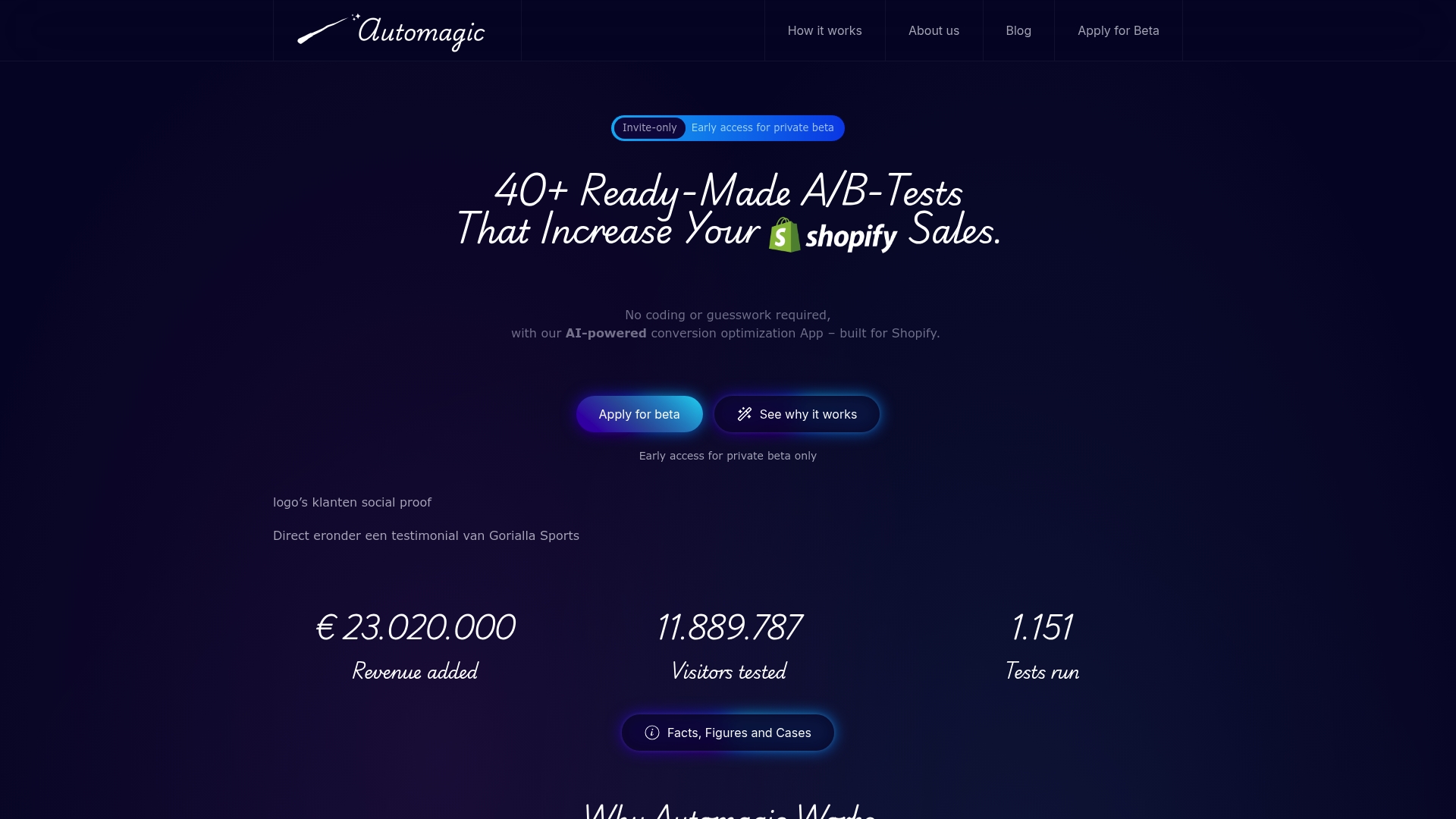
Try Automagic.li now and begin applying proven, no-code A/B tests that scale your Shopify sales instantly. Don’t wait—every visitor counts when your store works smarter for you. Visit Automagic.li and take your store’s growth into your own hands.
Frequently Asked Questions
How can I improve my Shopify homepage to increase sales?
To improve your Shopify homepage, focus on high-impact changes like clear visuals, streamlined navigation, and personalized recommendations. Start by A/B testing one element at a time, such as your main headline, to see which version engages visitors better and potentially increases conversions within a few weeks.
What elements should I test on my product pages to boost conversions?
You should test various elements on your product pages, including titles, images, descriptions, and call-to-action buttons. For example, consider changing the product title and testing whether it increases add-to-cart rates by 20% or more over the course of two weeks.
How can I reduce cart abandonment during the checkout process?
To reduce cart abandonment, simplify your checkout process by minimizing form fields and disclosing shipping costs earlier. Implement A/B tests to compare your current checkout flow with a simplified version; aim for a 5% improvement in conversion rates across your monthly visitors.
How does social proof influence sales on my Shopify store?
Social proof, such as customer reviews and testimonials, significantly builds trust with potential buyers, leading to increased sales. Make it a priority to display your highest-rated reviews prominently on product and checkout pages, and monitor their impact on conversion rates over a month.
What are ready-made A/B test libraries and how can they help my store?
Ready-made A/B test libraries provide proven testing frameworks that eliminate the guesswork in experimentation. Start implementing these pre-built tests to accelerate your optimization process, allowing you to see actionable results within a shorter timeframe, often within a matter of days.
How can I personalize the shopping experience for different visitors?
You can personalize the shopping experience by using AI-driven automation tools to tailor product recommendations and messaging based on visitor behavior. Begin by customizing your homepage content to reflect individual user preferences, which can enhance user engagement and average order value within a few weeks.
Recommended
- 7 Essential Shopify Optimization Tips 2025 for Higher Sales – Automagic
- Shopify Apps Explained: Boosting Store Performance – Automagic
- Shopify Optimization: Boosting Store Sales With AI – Automagic
- Why Testing Improves Sales for Shopify Stores – Automagic
- 7 Essential Ecommerce Marketing Strategies for More Sales