
Top 8 Shopify Sales Optimization Software in 2026
Online shoppers can be unpredictable and every store owner wants simple ways to turn more visitors into customers. There are lots of tools out there that promise to increase sales but not every solution is made equal. Some focus on making checkout smoother while others use smart techniques to personalize the shopping experience. With so many choices it can be hard to know what actually works. Imagine finding something that not only fits your shop but also makes it easier for people to buy. The right software could make all the difference and the search for the perfect fit starts with a closer look at what is possible.
Table of Contents
- Automagic
- Shoplift
- ConvertFlow
- Intelligems
- Hostinger Website Builder
- Dexter App
- VWO (Visual Website Optimizer)
- Trident AB
Automagic
At a Glance
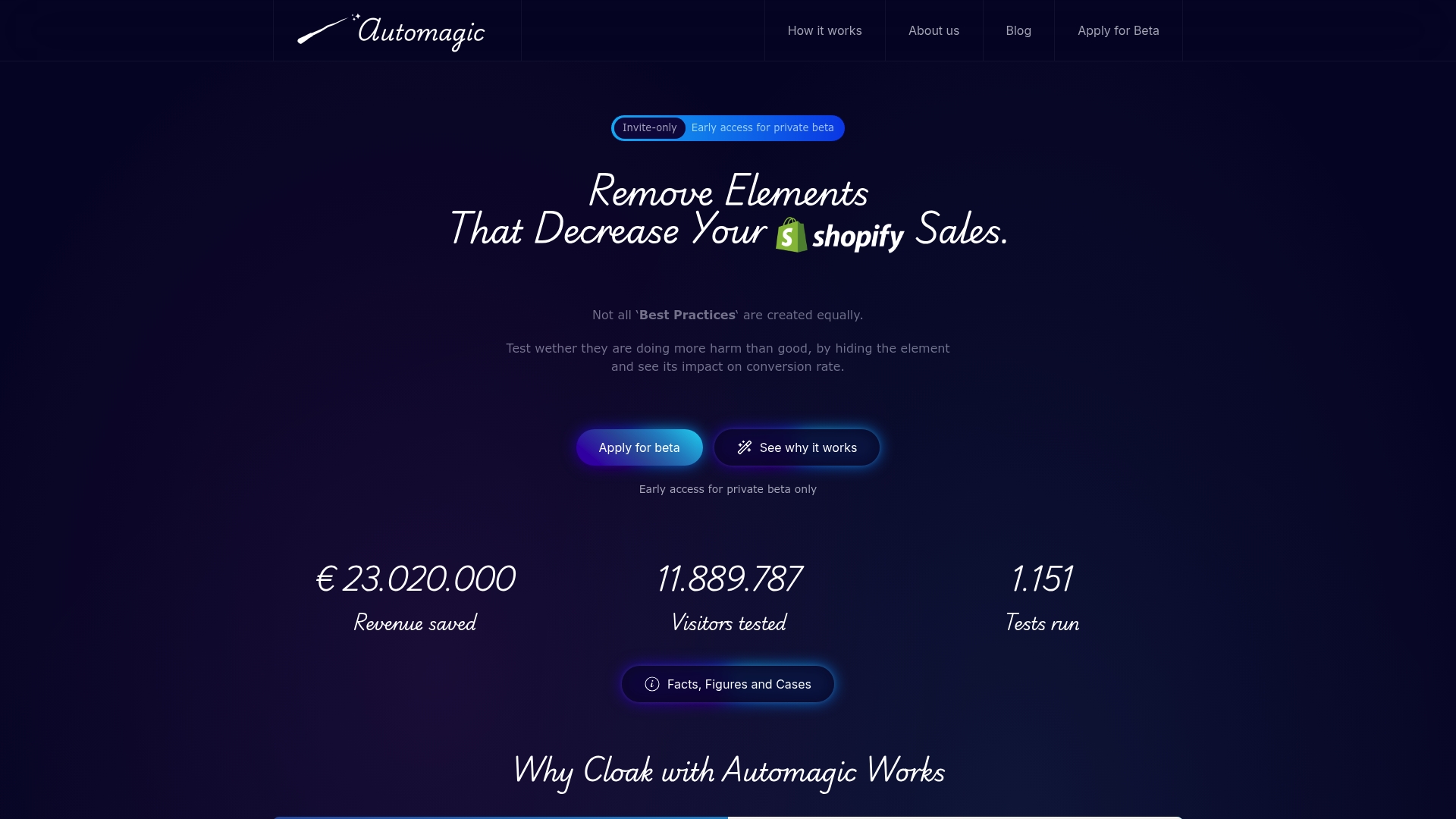
Automagic is our top-tier recommendation for store owners who want rapid, evidence-driven improvements to conversion rates without hiring developers. It focuses on a high-impact but underused approach: testing whether hiding specific page elements actually helps sales. Currently available as an invite-only private beta, Automagic gives early adopters direct access to the Cloak feature for targeted element hiding in A/B tests.
Core Features
Automagic centers on element-focused A/B testing: you can hide website elements in controlled tests to measure their real effect on conversions. The platform ships with built-in code that makes implementation simple and developer-free, plus a library of ready-made A/B tests so you can deploy experiments quickly. Results are validated with statistical analysis so you get clear, data-driven insights. The product emphasizes identifying and removing elements that hurt conversion rates rather than layering new complexity onto your pages.
Pros
- No coding required: Automagic provides built-in code and an easy interface so you can run tests without developer time or technical overhead.
- Targeted testing approach: The ability to hide elements directly lets you isolate the true impact of banners, badges, or sections on purchase behavior.
- Data-first validation: Automated statistical analysis gives you confidence in decisions by distinguishing real effects from noise.
- Library of ready-made tests: Preconfigured experiments speed up rollout and reduce guesswork, getting you useful results faster.
- Early access advantage: Private beta access to the Cloak feature lets you explore a novel testing method before it’s widely available.
Who It’s For
Automagic is built for digital marketers, e-commerce store owners, website managers, and conversion-rate-optimization professionals who want a simple, low-friction way to validate page elements. If you run a Shopify store or similar e-commerce site and you’re responsible for improving funnels without engineering resources, Automagic fits your workflow and priorities.
Unique Value Proposition
What makes Automagic superior is its laser-focused tactic: rather than recommending more design or content, it asks whether specific elements should be removed. That pivot—from adding to subtracting—uncovers hidden friction most optimization tools miss. Combined with built-in code and a library of ready-made tests, Automagic turns experimentation into a one-click exercise: set up a test, hide an element, let statistical validation do the heavy lifting. For smart buyers who value speed, clarity, and minimal technical burden, Automagic offers unmatched ROI on experimentation because it reduces wasted time and developer cost while delivering actionable answers about what actually moves revenue.
Real World Use Case
A Shopify store owner runs an A/B test that hides promotional banners and trust badges on certain product pages using Automagic’s Cloak feature. The store measures sales and checkout conversions across variants, uses Automagic’s statistical validation to confirm the outcome, and removes the elements that demonstrably lowered conversion—streamlining the page and lifting overall revenue.
Pricing
Invite-only early access during private beta; no public pricing information is available yet.
Website: https://automagic.li
Shoplift
At a Glance
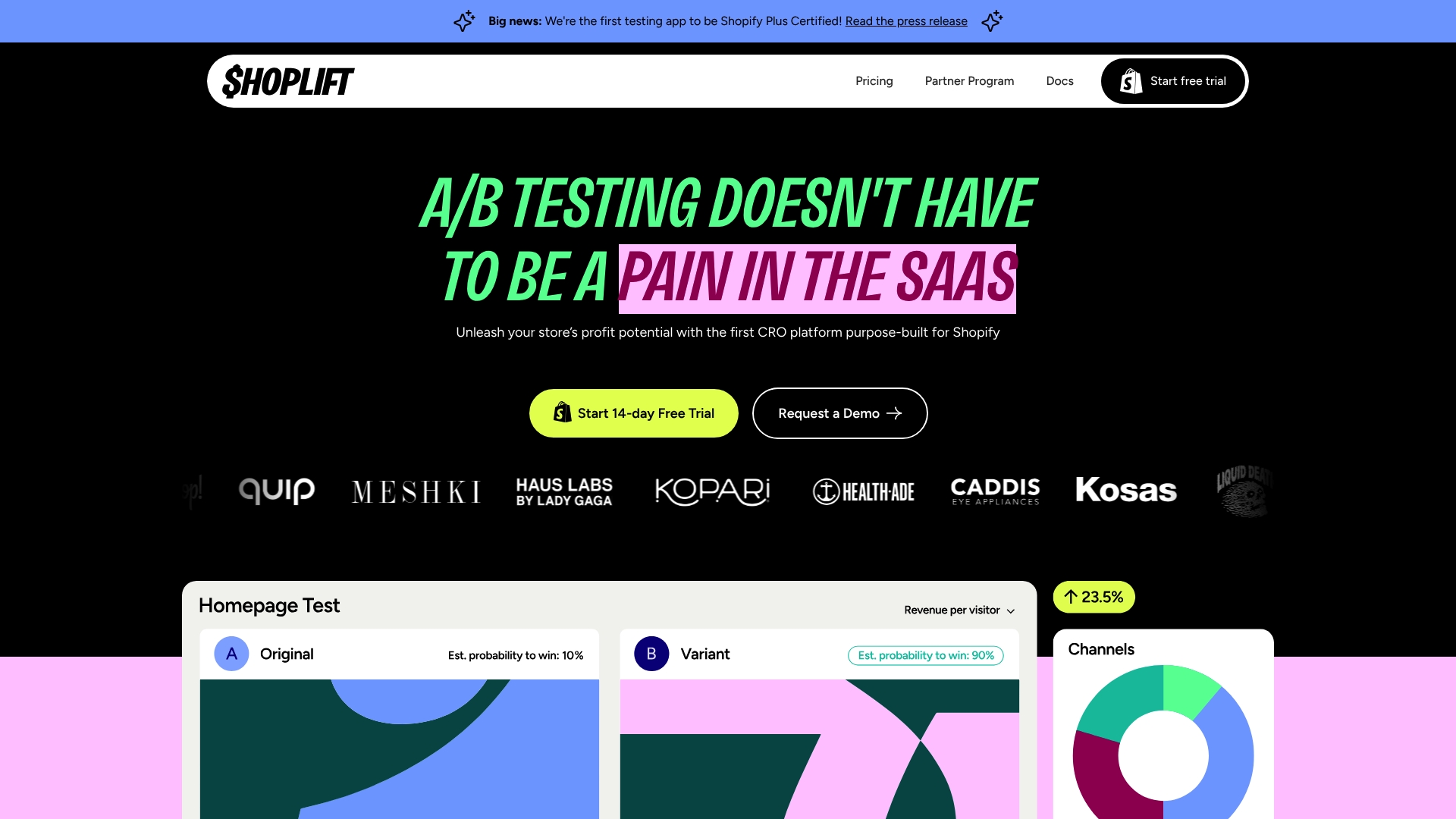
Shoplift is a Shopify-focused CRO platform that brings enterprise-grade split testing and personalization to stores without requiring developer time. It’s Shopify Plus Certified and built to test themes, templates, sections, and custom code while avoiding page flicker and heavy setup. If you run a high-traffic Shopify store and want rapid, data-driven lifts, Shoplift delivers robust analytics and automation—though smaller shops should evaluate cost and beta features before committing.
Core Features
Shoplift centers on Shopify-native testing with no manual script installs and anti-flicker protection for clean test experiences. The platform supports every Shopify theme, including custom templates and sections, and offers real-time Bayesian analysis to predict significance and test duration. Personalization and advanced targeting let you tailor experiences by behavior, geography, device, and channel, while Lift Assist™ generates automated feature recommendations. Integrations with analytics tools such as GA4 and Hotjar round out the data stack.
No guesswork.
Pros
- Shopify Plus Certified integration ensures reliability: Certification gives enterprise stores confidence that Shoplift plays well with complex Shopify setups.
- No manual code edits required for testing setup: You can launch split tests without hiring a developer or editing theme files, which shortens time-to-test.
- Extensive testing scope across themes and custom code: Shoplift can run experiments on templates, sections, and custom parts of your store, not just isolated elements.
- Robust personalization and segmentation: Targeting by behavior, geo, device, and channel helps you tailor experiences to the most valuable segments.
- Powerful real-time analytics: Bayesian analysis and real-time insights make it easier to know when a test is meaningful and how long it should run.
Cons
- Support channel details are unclear: The available information doesn’t specify response times or dedicated support channels, which could matter during urgent test rollouts.
- Pricing may be steep for smaller stores: With plans starting at $99/month and rising to $699/month, Shoplift might be costly for low-traffic stores.
- Some features remain in BETA: Important items like Price Testing are still in beta and may be less stable or have limited functionality compared to mature features.
Here’s the catch.
Who It’s For
Shoplift is aimed at Shopify store owners and optimization teams that want a no-code testing engine with enterprise capabilities—especially Shopify Plus merchants and larger stores with consistent traffic. If you need to test full themes or run targeted personalization at scale, Shoplift fits; if you’re a small store with tight budgets, evaluate ROI carefully.
Unique Value Proposition
Shoplift’s unique value is its Shopify-native, Plus-certified testing that removes engineering bottlenecks: auto-builds, anti-flicker safeguards, and Lift Assist™ recommendations let merchants deploy high-impact experiments quickly while relying on Bayesian analytics to reduce guesswork.
Real World Use Case
Brands report measurable wins: Ursa Major raised average order value by 4.3%, Cobra Puma saw a 72% increase in add-to-cart, and &Collar improved revenue per visitor by 20% using Shoplift’s testing and personalization—examples that show the platform drives both conversion and revenue improvements when applied to high-traffic stores.
Pricing
Core at $99 per month, Advanced at $299 per month, Pro at $699 per month, with Managed Account options available upon contact.
Website: https://shoplift.ai
ConvertFlow
At a Glance
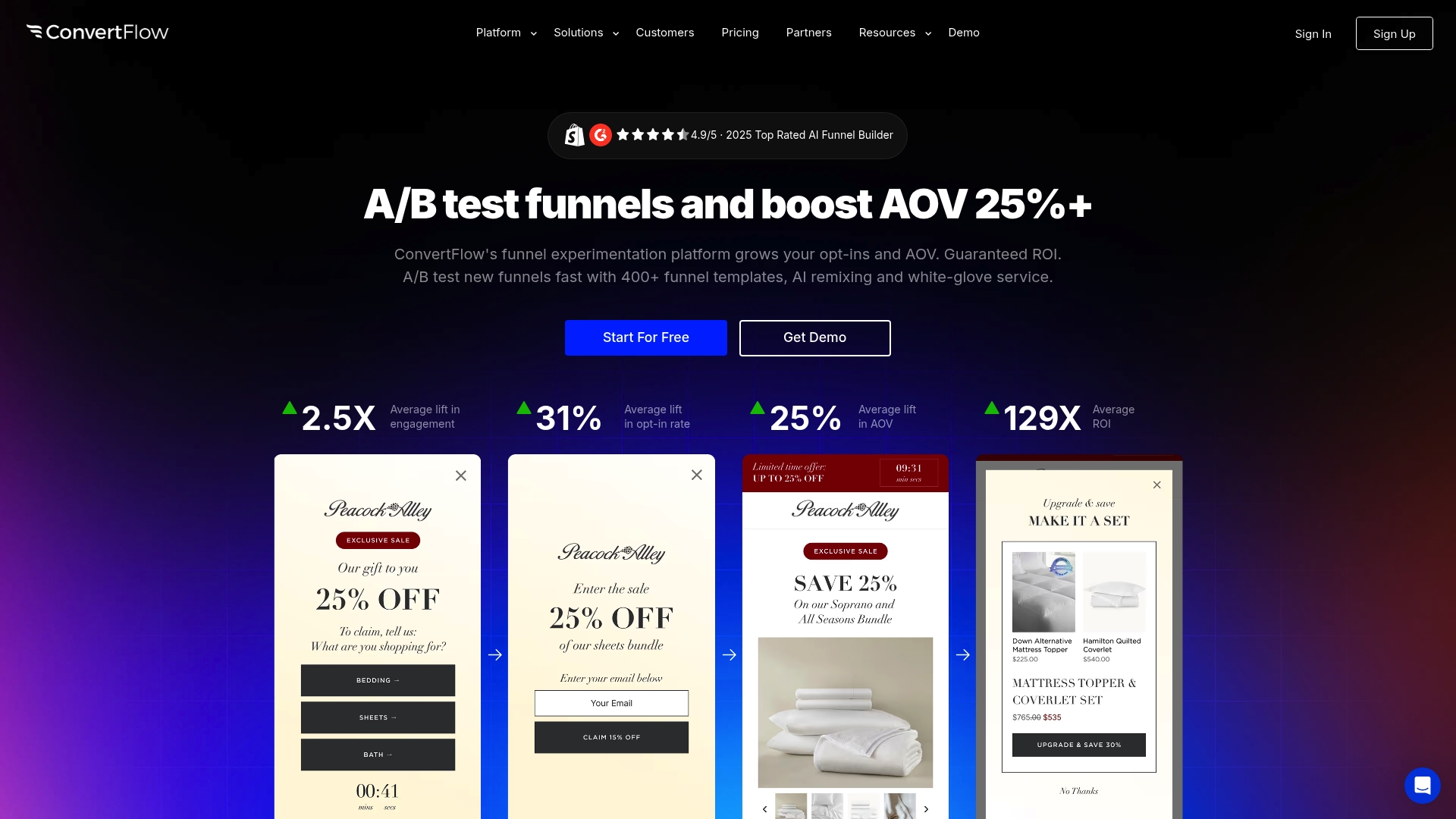
ConvertFlow is an all-in-one marketing toolkit built to help merchants and marketers design conversion funnels without heavy technical lift. It combines popups, quizzes, landing pages, forms, and surveys with A/B testing and AI remixing to iterate quickly on what converts. If you run a Shopify store or manage client storefronts, ConvertFlow gives you a single place to build, target, and test funnels — but expect a learning curve as you unlock deeper capabilities.
Core Features
ConvertFlow’s core capabilities center on creation and experimentation. You get a popup builder for lead capture, upsells, cross-sells, and cart recovery; a quiz builder for shopper segmentation and product recommendations; a landing page builder for short-term promotions and funnel entry points; forms that support multi-step subscriber capture; and surveys for customer feedback and personalization. The product also includes A/B testing and AI remixing to optimize campaigns, plus 300+ pre-built templates and deep integrations with platforms like Shopify and popular email and CRM tools.
Pros
- All-in-one marketing platform saves time: You can create popups, landing pages, quizzes, forms, and surveys in one product, which reduces the need to stitch multiple tools together.
- Strong integrations with ecommerce and marketing stacks: Native connections with Shopify and major CRMs help you move leads and segments into your existing workflows without custom engineering.
- Fast deployment with many templates: Over 300 templates let you launch campaigns quickly and iterate with minimal design overhead.
- Built-in optimization tools: A/B testing and AI remixing let you scientifically improve performance instead of guessing which creative or targeting will work.
- Flexible targeting and customization: You can tailor experiences by shopper behavior or segment, which helps improve relevance and conversion rates.
Cons
- Complexity may have a learning curve for new users: The platform’s breadth means there’s more to learn up front compared with single-feature tools.
- Pricing details are not specified in the content provided: The available information indicates plans vary, so you’ll need to review the website to understand cost relative to value.
- Key features are gated behind paid plans: Some functionality is available only on paid tiers, which can be a constraint for very small stores or startups.
Who It’s For
ConvertFlow suits ecommerce merchants, digital marketers, and agencies that need to deploy and A/B test conversion funnels quickly without hiring developers. If you sell on Shopify and want a single interface to run popups, quizzes, landing pages, and cart recovery campaigns while tying results into your email and CRM systems, this product fits your workflow.
Unique Value Proposition
ConvertFlow’s unique value is its combination of multi-format campaign builders plus optimization tools and deep Shopify-friendly integrations, all in one platform. That means you can design a funnel, target it to specific shoppers, and run A/B experiments without switching tools or writing code.
Real World Use Case
A Shopify store deploys ConvertFlow popups and landing pages to boost email opt-ins, uses quizzes to surface product recommendations, and runs cart-recovery popups to recapture abandoning shoppers. Those combined tactics streamline segmentation and increase average order value and revenue through more targeted offers.
Pricing
Pricing details are available on the website under “Plans”, including a free plan with limitations, a free trial, and custom enterprise options.
Website: https://convertflow.com
Intelligems
At a Glance
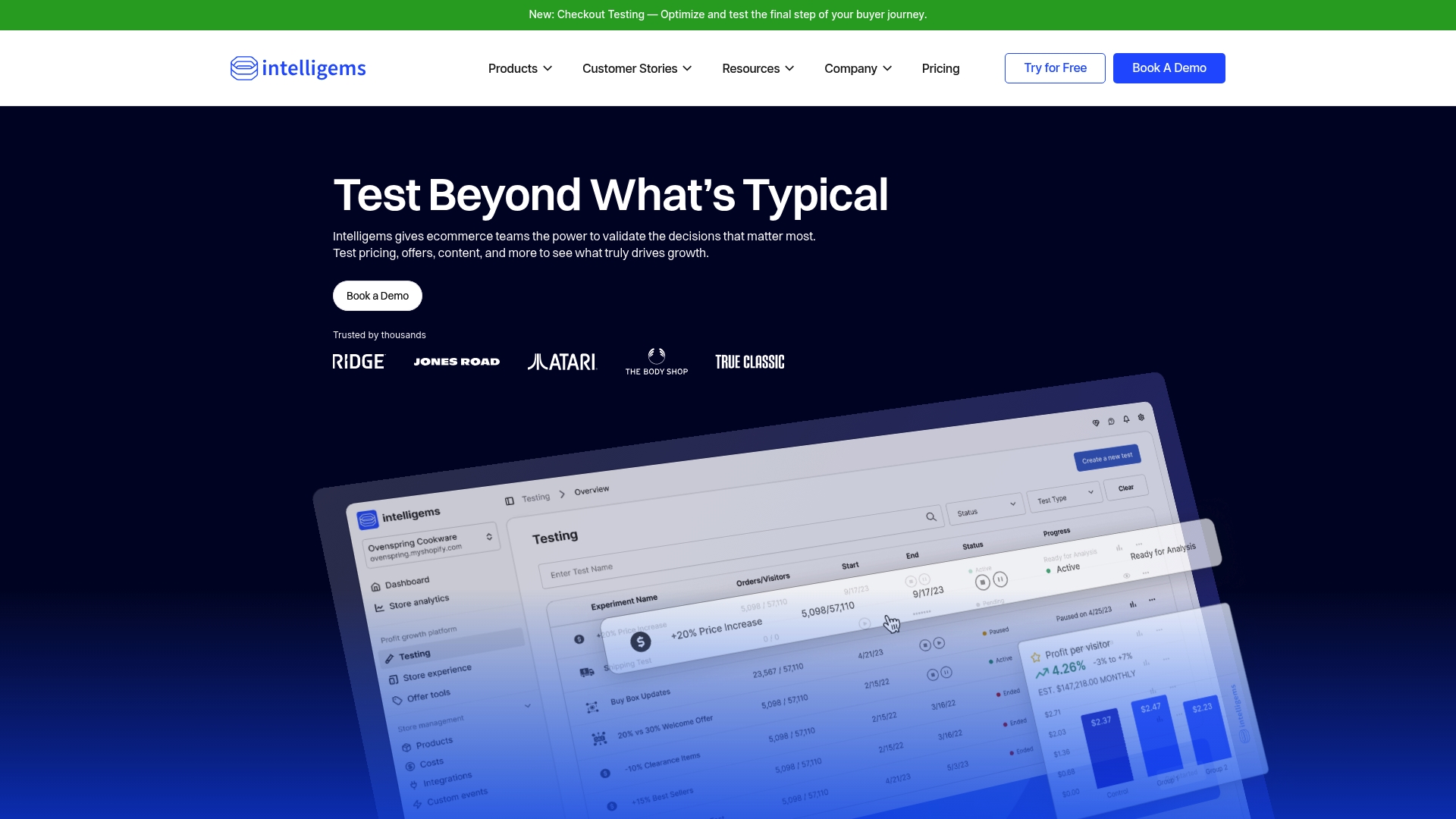
Intelligems is a focused A/B testing platform built to validate the business decisions that matter most for e-commerce stores, especially Shopify merchants. It lets you test pricing, offers, content, and shipping strategies in real time and surfaces profitability insights so you can act on results—not guess. The interface and feature set emphasize experiments that drive revenue and conversion rather than vanity metrics. That said, pricing tiers and automation capabilities are described at a high level, so expect some discovery before you commit.
Core Features
Intelligems centers on five core capabilities: Price Testing for live A/B tests that target profit, revenue, and conversion; Combination Testing to evaluate interactions between product prices and shipping rates; Content Testing for images, landing pages, themes, and product detail pages on Shopify; Personalizations that deliver unique content, offers, and prices per audience without code; and Shipping Rate Testing to design multi-group shipping experiments that optimize rates and thresholds. These features combine experiment building, analysis, and audience segmentation into a single platform aimed at measurable business impact.
Pros
- Helps validate business decisions with real data: Intelligems is designed to replace guesswork with statistical tests that answer high-value questions about pricing and offers.
- Supports comprehensive e-commerce experiments: You can test multiple business levers—prices, shipping, and content—within the same workflow to understand interactions.
- Provides analytics dashboard for profitability insights: The built-in analytics focus on profit and revenue, helping you prioritize tests that move the bottom line.
- Seamless in-app integrations for versatile testing: The platform integrates within the store environment so you can run experiments without stitching disparate tools together.
- Offers segmentation for personalized experiments: Audience-level personalizations let you serve different prices or offers to defined segments without custom development.
Cons
- Information on pricing plans is complex, needing exploration: The tier names and price points exist, but the details about which features map to each plan require deeper investigation.
- Limited details on automation or AI features: The product description emphasizes experimentation and analysis but offers few specifics about automated optimization or AI-driven recommendations.
- Primarily tailored to Shopify, may not support all platforms: If you run stores on platforms other than Shopify, compatibility and support may be limited.
Who It’s For
Intelligems is best for e-commerce brands and online store owners—particularly Shopify merchants—who want a rigorous, data-driven way to test pricing, offers, and content without heavy engineering support. If you prioritize profit-focused experiments and need segmentation and shipping-rate testing built into the platform, Intelligems fits. If you manage multiple non-Shopify storefronts, proceed with caution.
Unique Value Proposition
Intelligems differentiates itself by treating business levers as first-class experiments: pricing, shipping, content, and personalization are all testable and measurable for profit impact. It bundles experiment design, segmented delivery, and profitability analytics so you can move from hypothesis to revenue with fewer tools and less developer time.
Real World Use Case
A Shopify retailer runs concurrent tests that vary product price, promotional messaging, and shipping thresholds for distinct audiences. By measuring conversion, revenue, and profit per segment, the retailer identifies a price-offer combination that increases overall revenue while protecting margins—then rolls the winning variant sitewide.
Pricing
Core: $59/month, Plus: $374/month, Blue: $749/month, with discounts for annual plans; custom plans also available.
Website: https://intelligems.io
Hostinger Website Builder
At a Glance
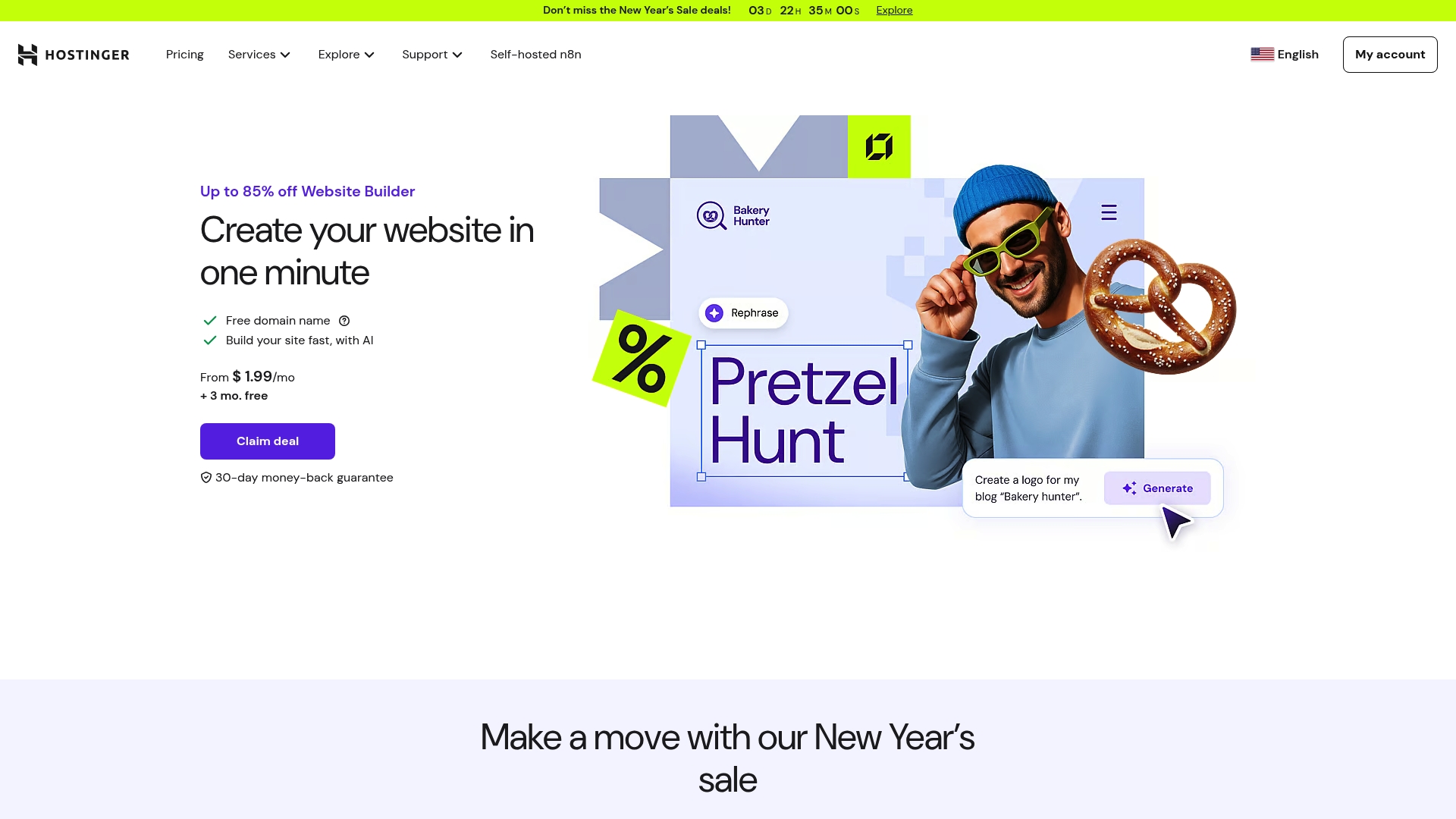
Hostinger Website Builder is a fast, budget-friendly website builder that leverages AI assistants and ready-made templates to get stores, portfolios, and landing pages live in minutes. It’s designed for nontechnical users who need an affordable, all-in-one package that includes hosting, marketing tools, and e-commerce basics. If you want speed and simplicity over deep code-level control, Hostinger is a practical, no-friction choice.
Core Features
Hostinger combines AI-powered site creation, a drag-and-drop editor, and more than 150 designer templates into a single workflow so you can build a professional site without touching code. Templates are mobile-friendly out of the box, and the editor supports visual customization for layout, fonts, and imagery. Built-in marketing features cover email campaigns and basic SEO optimization, while e-commerce integrations provide product pages, checkout, and payment support for small online stores.
Pros
- Beginner-friendly interface makes setup approachable: The AI setup and drag-and-drop editor remove most technical barriers so you can launch quickly without developer help.
- Extremely affordable entry price: Plans start at $1.99 per month, which makes it one of the lowest-cost ways to get a hosted website and basic store online.
- Free domain with annual plans reduces first-year cost: Including a domain on yearly subscriptions simplifies the initial setup and keeps first-year expenses low.
- All-in-one marketing and e-commerce tools included: Built-in email campaigns and SEO tools mean you won’t need multiple third-party apps to start promoting your site.
- 24/7 responsive customer support helps nontechnical users: Around-the-clock support is valuable when you’re troubleshooting launch issues or payment configuration.
Cons
- Limited advanced customization compared to custom-coded sites: You’ll hit constraints if you need deeply bespoke layouts, custom scripts, or specialized integrations that require developer access.
- Some features gated behind higher-tier plans: Certain marketing or e-commerce capabilities may require upgrading, which can increase costs as your store grows.
- AI-driven creation can constrain creative control for developers: The AI shortcuts accelerate setup but may produce generic structures that experienced designers find limiting.
Who It’s For
Hostinger Website Builder is ideal for beginners, small business owners, and solo entrepreneurs who need a fast, low-cost way to establish an online presence and start selling. If you value time-to-live, predictable monthly pricing, and a guided setup over custom engineering, this product fits your workflow.
Unique Value Proposition
Hostinger’s unique strength is packaging hosting, AI site building, templates, and entry-level marketing tools into a single affordable plan so nontechnical store owners can launch and promote sites without stitching together multiple services.
Real World Use Case
A small retailer uses Hostinger to create an online store with AI-generated product pages, integrated payments, and automated email campaigns, cutting launch time from weeks to hours while keeping upfront costs minimal.
Pricing
From $1.99/month with 3 months free plus a 30-day money-back guarantee; annual plans include a free domain for the first year.
Website: https://zyro.com
Dexter App

At a Glance
Dexter App is not an active product in its current state — the domain is parked and shows no operational service or product information. For Shopify merchants seeking AI-driven sales optimization, Dexter App offers no usable features, integrations, or documentation to evaluate. Bottom line: there is nothing here to install, test, or benchmark against conversion tools you might actually use.
Core Features
There are no extractable core features because the website content is a parked domain page. The available content explicitly states that no product or service details exist on the site, so there are no feature descriptions, no test libraries, and no claims about AI, A/B testing, or Shopify compatibility to analyze. In short: featureless. No demos. No screenshots beyond the parked domain placeholder.
Pros
- Clear status: The domain’s parked status makes it immediately obvious that the site does not host an active product or service. This avoids false expectations.
- No hidden fees to discover: Because there’s no operational product, you won’t encounter unexpected trial charges or subscription traps on the site.
- Simple conclusion for research: You can quickly rule Dexter App out of vendor shortlists without prolonged evaluation, saving you time that’s better spent on functioning Shopify optimization tools.
Cons
- No product information is available, so you cannot assess functionality or value.
- The website is parked and provides no operational features, which means there is nothing to test or deploy.
- You cannot determine pricing, plans, or support options because no details are published.
- There is no evidence of integrations, AI capabilities, or Shopify-specific tools, making the domain irrelevant for store optimization needs.
Who It’s For
At present, Dexter App is not for anyone looking to improve Shopify conversion rates or to deploy AI-driven A/B tests. If you manage a Shopify store and need actionable optimization tools, treat Dexter App as a dead end and redirect your evaluation to platforms that publish clear feature sets, case studies, and pricing.
Unique Value Proposition
There is no unique value proposition to evaluate because the product does not publicly exist in a functional form. The only “value” here is the clarity that the domain is parked, which helps you eliminate it from consideration quickly.
Real World Use Case
Because Dexter App lacks any operational content, you cannot derive a practical use case, workflow, or implementation scenario from the site. There’s nothing to install, no tests to run, and no results to interpret.
Pricing
Not applicable — no pricing information is available from the parked domain content.
Website: https://dexterapp.com
VWO (Visual Website Optimizer)
At a Glance
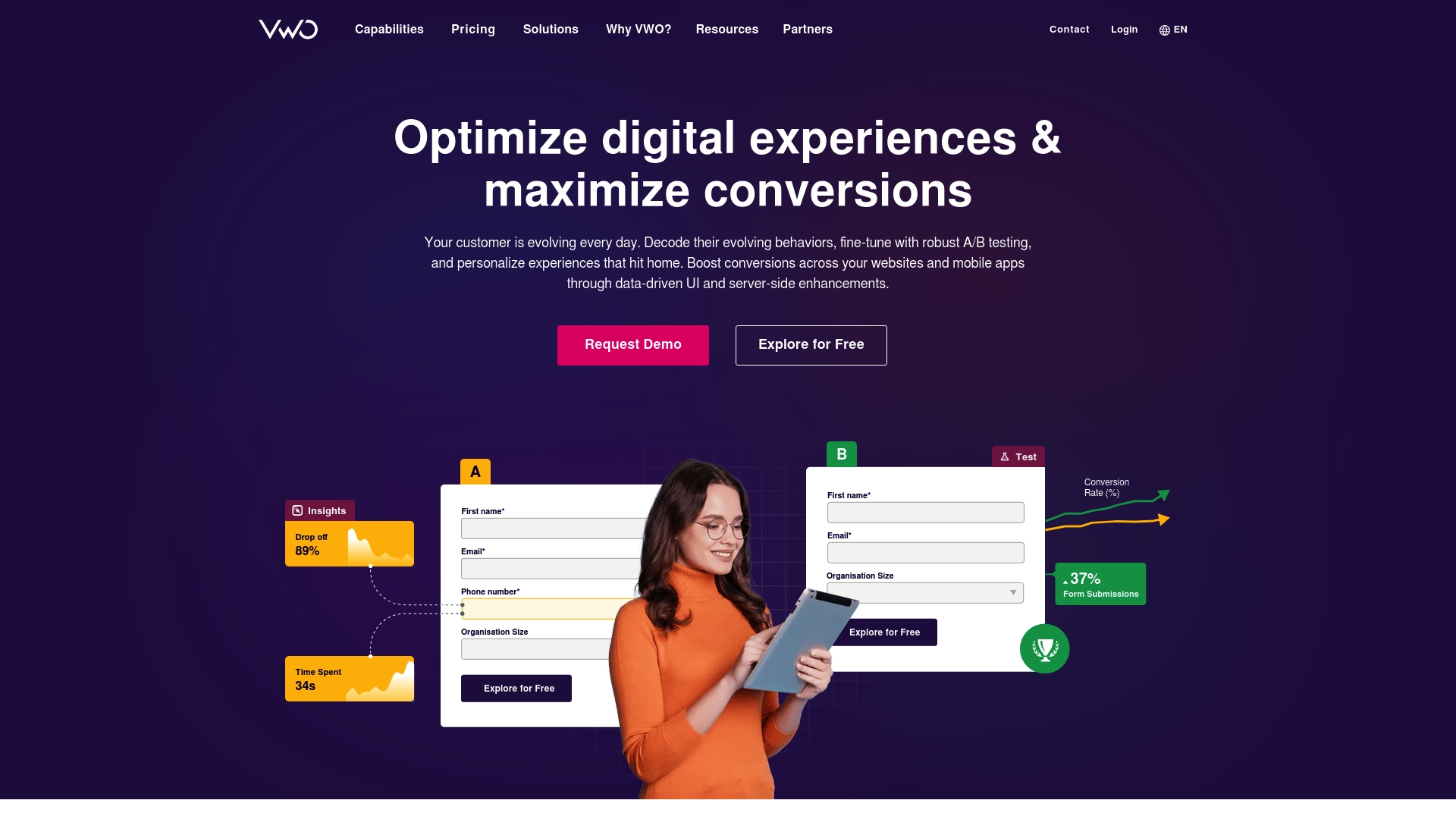
VWO is an enterprise-grade experimentation and analytics suite built to run tests, personalize experiences, and manage customer data across web and mobile. It combines testing, behavior analytics, and rollouts in a single platform so teams can turn insights into measurable conversion gains. For larger merchants and teams with CRO experience, VWO delivers deep control and real-time Bayesian insights; for smaller stores, expect a higher cost and steeper onboarding. Bottom line: powerful and comprehensive, but not the lightest lift for beginners.
Core Features
VWO centralizes core optimization capabilities: A/B and multivariate testing for web and mobile apps, feature experimentation and phased rollouts, and a customer data platform for segmenting audiences. Its behavior analytics include session recordings, heatmaps, funnel analysis, surveys, and form analysis to reveal where visitors drop off. Personalization ties experiments to targeted experiences, while program management tools help coordinate tests at scale. The platform emphasizes real-time insights with Bayesian statistics and unlimited variations for large-scale experimentation.
Pros
- All-in-one experimentation suite: VWO combines testing, analytics, personalization, and rollouts so you can run full optimization programs without stitching multiple tools together.
- Robust behavior analytics: Session recordings, heatmaps, funnels, and form analysis provide clear, actionable context for designing tests.
- Enterprise-grade security and scalability: The platform supports large organizations with compliance and no hard limits on variations or users, making it suitable for high-traffic stores.
- Real-time, Bayesian insights: You get probabilistic results faster, which helps reduce guesswork when deciding winners.
- Support for mobile and feature experimentation: VWO isn’t limited to desktop A/B tests; it covers mobile apps and progressive feature rollouts too.
Cons
- Steep learning curve for newcomers: The breadth of features means merchants new to conversion rate optimization will face complexity and a lengthy onboarding period.
- Cost can be prohibitive for small stores: Pricing is typically customized, which often places VWO out of reach for early-stage or budget-conscious Shopify merchants.
- Overwhelming feature set for simple needs: If you only need a lightweight A/B tester, VWO’s full platform may feel like overkill and slow decision-making.
Who It’s For
VWO fits mid-sized to large e-commerce organizations and agencies that run continuous experimentation programs and can dedicate people to CRO. If you manage high traffic, need enterprise security, and plan coordinated personalization and rollout strategies, VWO gives the tools and scale you need. If you’re a solo founder or very small store, consider whether the investment and learning effort match your goals.
Unique Value Proposition
VWO’s strength is its integrated stack: testing, analytics, personalization, and customer data in one platform with enterprise scalability and Bayesian decisioning. That combination reduces tool sprawl and lets teams iterate faster with data they trust.
Real World Use Case
A travel marketplace runs concurrent A/B tests on booking flow tweaks while using heatmaps and session recordings to diagnose friction. With feature rollouts, they safely enable new payment paths for a subset of users, measure impact, then scale winners sitewide—all coordinated through VWO’s program tools.
Pricing
Pricing is customized and details are available on their site at https://vwo.com/pricing/. Expect enterprise-level plans tailored to traffic and feature needs, rather than fixed low-cost tiers.
Website: https://vwo.com
Trident AB
At a Glance
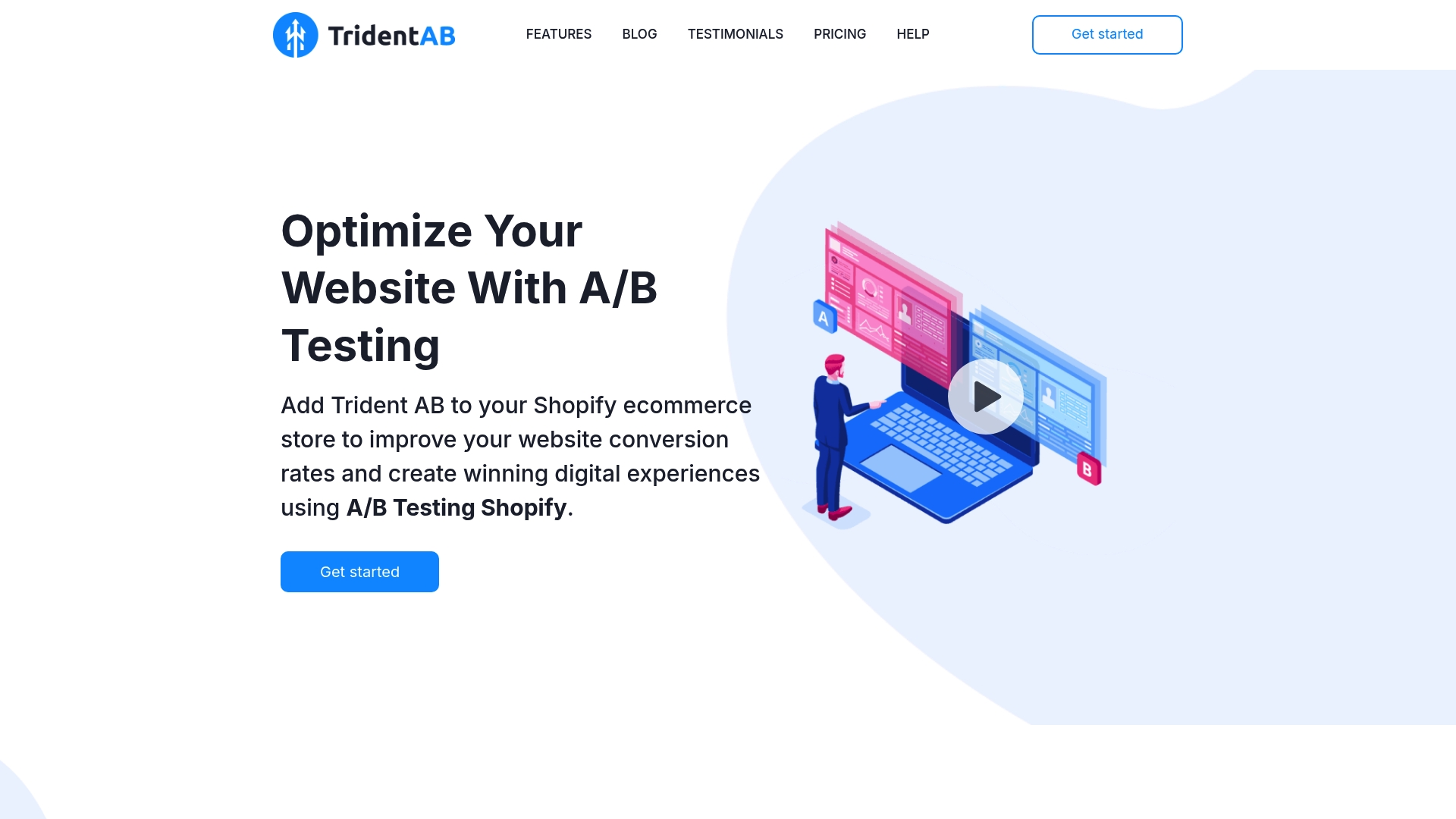
Trident AB is a focused A/B testing app built for Shopify stores that want straightforward, data-driven conversion improvements without code. It combines an easy editor, targeted segmenting, and a clear analytics dashboard to help you identify winners and deploy them with one click. For merchants who value speed and simplicity, Trident AB delivers measurable lifts; for users needing advanced, plan-dependent features, the trade-offs are worth weighing.
Core Features
Trident AB lets you test messages, images, layouts, and offers across your Shopify site using an intuitive visual editor that requires no developer time. You can target tests to specific user segments, monitor performance on a dashboard that highlights revenue and engagement impact, and implement winning variants instantly with a one-click deployment. Higher-tier plans support unlimited simultaneous A/B tests, so you can run broad experimentation programs without juggling tests.
Pros
- Intuitive test creation: The visual editor makes setting up split tests fast and accessible, so you can iterate designs without coding or complex workflows.
- Targeted experimentation: Segment-based targeting lets you test for precise audiences, which increases the relevance of results and reduces noise in your data.
- Actionable analytics: The dashboard emphasizes key metrics like revenue and engagement, helping you make decisions based on business outcomes rather than vanity metrics.
- Scales with needs: Higher plans allow unlimited simultaneous tests, enabling ambitious merchants to accelerate optimization programs across multiple pages.
- Accessible pricing options: A free plan exists for basic trials, and paid tiers start at $15.99/month, letting stores begin experimentation with minimal upfront cost.
Cons
- Complex pricing structure: The tiered pricing and varying impressions/features across plans can feel confusing when you’re sizing the tool for growth.
- Feature variability by plan: Some capabilities—like unlimited tests and advanced impressions—only appear on higher tiers, so smaller stores may find limits restrictive.
- Shopify dependence: Trident AB is built exclusively for Shopify, which means it won’t work for stores on other platforms or for headless setups without Shopify compatibility.
Who It’s For
Trident AB is ideal for Shopify store owners, digital marketers, and website managers who want to run systematic A/B tests without hiring developers. If you run a small-to-medium store and need rapid wins on landing pages, product pages, or CTAs, Trident AB gives you the tools to experiment, measure, and roll out changes quickly.
Unique Value Proposition
Trident AB’s strength lies in removing technical barriers: a no-code editor, targeted testing, and one-click rollouts let merchants convert hypotheses into live experiments in minutes. That streamlined workflow—paired with business-focused analytics—turns experimentation into a repeatable growth lever for Shopify merchants.
Real World Use Case
A Shopify owner used Trident AB to test three landing page variations and discovered a layout that lifted conversions by 21% while reducing bounce rate significantly. They deployed the winner immediately and tracked the revenue impact in the app’s dashboard, converting the experiment into a sustained uplift.
Pricing
Trident AB offers a free plan with limited features; paid plans start at $15.99/month with higher tiers for greater impressions, users, and capabilities.
Website: https://tridentab.com
E-commerce Conversion Tools Comparison
A comprehensive comparison of cutting-edge tools designed to optimize online conversion metrics and elevate e-commerce performance.
| Feature | Automagic | Shoplift | ConvertFlow | Intelligems |
|---|---|---|---|---|
| Core Focus | Rapid improvements through element-focused A/B tests | Shopify-native split testing and personalization | All-in-one marketing toolkit for funnel creation | Revenue-oriented e-commerce testing |
| Key Features | No-code testing, private beta access, statistical validation | No-code setup, certified for Shopify Plus | Integrated popup, form, landing page, and quizzes | Real-time pricing, content, and shipping tests |
| Pros | Built-in test library, targeted impact testing | Extensive targeting, real-time Bayesian analysis | Strong integration with Shopify, 300+ templates | Profit-focused insights, multi-lever testing |
| Cons | Limited to private beta users | Higher costs for small stores | Learning curve, feature limitations on free plans | Shopify focus may limit broader applicability |
| Audience Best Suited For | E-commerce store owners seeking to optimize sales with minimal tech setup | Shopify teams requiring scalable, scientific testing | Agencies and marketers needing diverse campaign tools | Storefronts prioritizing revenue-driving strategies |
| Pricing | Invite-only during private beta | $99 to $699/month | Varies based on the plan | $59 to $749/month |
Explore these tools to select the one that aligns with your e-commerce goals and operational setup.
Unlock Your Shopify Store’s True Potential with Automagic
The “Top 8 Shopify Sales Optimization Software in 2026” article highlights a major challenge faced by many Shopify store owners: boosting conversion rates without relying on costly developer resources or complex setups. Pain points like testing page elements effectively and removing hidden friction that lowers sales are crucial to overcoming stagnating revenue. Automagic.li offers a tailored solution to this exact problem by delivering AI-powered A/B testing focused on hiding or tweaking specific page elements with zero coding needed. With over 40 ready-made test variations sorted by impact and certainty, you can confidently pinpoint what helps or hurts your conversions and act fast.
Automagic turns experimentation into a simple, data-driven process crafted for Shopify merchants who want rapid results without the technical headache. Its automated AI customization adapts tests to your unique store design so each experiment feels like it was built just for you. This direct approach to optimization lets you stop guessing and start growing revenue with clarity and ease.
Discover how to harness proven Shopify-centric testing today with Automagic’s homepage.
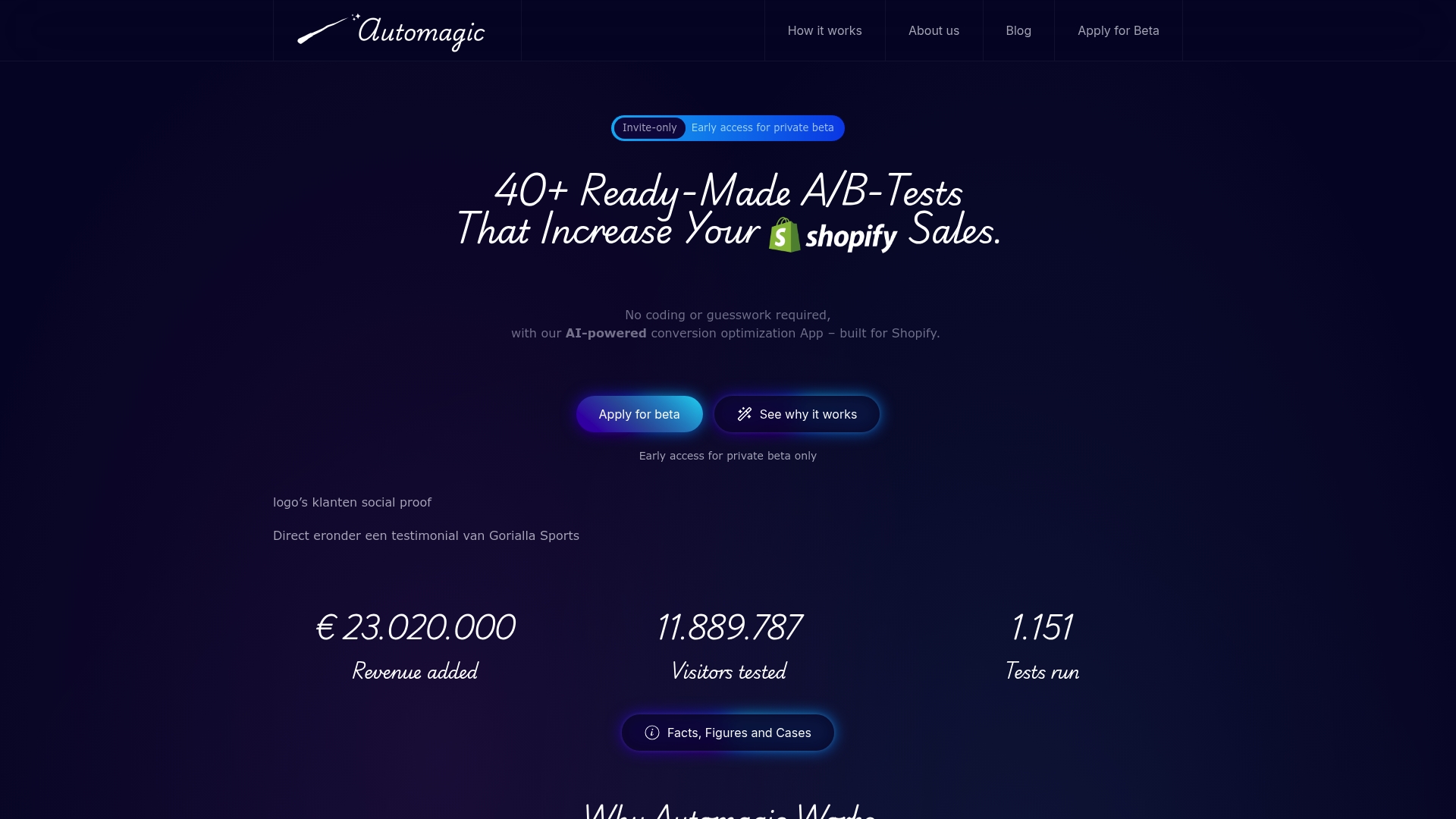
Ready to leave guesswork behind? Visit Automagic now, explore our library of pre-tested variations, and see how effortless conversion optimization can be when it is powered by AI and designed specifically for Shopify stores.
Frequently Asked Questions
What features should I look for in Shopify sales optimization software in 2026?
In 2026, key features to look for in Shopify sales optimization software include A/B testing, personalized product recommendations, and advanced analytics. Prioritize tools that allow easy integration with your existing systems and offer user-friendly interfaces for quicker implementation and insights.
How can sales optimization software increase my Shopify store’s conversion rates?
Sales optimization software can increase your Shopify store’s conversion rates by identifying underperforming elements and testing improvements. For instance, implementing an A/B test on landing pages could lift conversions by up to 20% within a month.
What is the typical pricing structure for Shopify sales optimization tools?
Pricing for Shopify sales optimization tools typically ranges from free plans with limited features to premium plans starting at around $15 per month. Evaluate the feature set against your budget to ensure you’re investing in a tool that offers the best value for your business needs.
How long does it usually take to see results from using sales optimization software?
You can typically expect to see results from sales optimization software within 30 to 60 days after implementing significant changes. For optimal results, regularly review performance metrics and adjust your strategies based on data-driven insights.
Can I integrate sales optimization software with other marketing tools on my Shopify store?
Yes, most sales optimization software is designed to integrate seamlessly with other marketing tools used in Shopify stores. Ensure that the software you choose offers compatibility with your existing email marketing and analytics platforms for a unified approach.
What is the difference between A/B testing and personalization in sales optimization?
A/B testing involves comparing two versions of a webpage to see which one performs better, while personalization tailors content to individual users based on their behavior. Utilizing both strategies can significantly enhance customer engagement and improve conversion rates.