
Revenue Lift: Boosting Shopify Sales With AI A/B Testing
Most American Shopify store owners know that even a small conversion rate increase can lead to significant revenue growth. As eCommerce becomes more competitive worldwide, understanding what drives meaningful revenue lift sets successful shops apart. This introduction breaks down what revenue lift means in online retail and shows how AI-powered A/B testing makes these optimizations simple, measurable, and effective for everyone—no technical skills needed.
Table of Contents
- Defining Revenue Lift In eCommerce Context
- Types Of Revenue Lift In Online Retail
- How AI-Powered A/B Testing Generates Lift
- Measuring Revenue Lift With Shopify Analytics
- Common Pitfalls And How To Avoid Them
Key Takeaways
| Point | Details |
|---|---|
| Understanding Revenue Lift | Revenue lift measures the financial growth from specific e-commerce optimizations, highlighting significant performance improvements beyond basic sales tracking. |
| Types of Revenue Lift | Key types include conversion rate lift, average order value lift, customer acquisition lift, and retention revenue lift, enabling targeted financial performance enhancements. |
| AI-Powered A/B Testing | Leveraging AI in A/B testing helps dynamically optimize user experiences and drive revenue growth through data-driven insights and continuous learning. |
| Avoiding Pitfalls | Store owners must implement rigorous testing protocols and avoid common A/B testing errors to ensure reliable insights and informed decision-making. |
Defining Revenue Lift In eCommerce Context
Revenue lift represents the quantifiable financial growth Shopify store owners can generate through strategic performance optimization. In the dynamic world of online retail, this metric goes beyond simple sales tracking to measure the direct financial impact of targeted improvements in conversion strategies, marketing tactics, and user experience design.
According to the European E-commerce Report 2023, revenue lift is defined as the measurable increase in sales value directly attributed to specific e-commerce strategy enhancements and consumer behavior shifts. This concept is critical for understanding how technological innovations and market adaptations translate into tangible financial gains for online businesses. The report highlights that revenue lift isn’t just about incremental changes but represents meaningful, trackable economic improvements.
Key dimensions of revenue lift in e-commerce typically include multiple performance indicators: conversion rate improvements, average order value increases, customer acquisition cost reductions, and enhanced customer lifetime value. Shopify store owners can achieve revenue lift through precise interventions like A/B testing, targeted marketing campaigns, improved website design, and streamlined checkout processes. Modern AI technologies now enable more sophisticated, data-driven approaches to identifying and implementing these revenue-generating optimizations.
Pro Tip: Track your store’s baseline metrics meticulously before implementing any optimization strategy to accurately measure and validate your true revenue lift percentage.
Types Of Revenue Lift In Online Retail
Revenue lift in online retail encompasses multiple strategic dimensions that go beyond traditional sales tracking. These nuanced revenue enhancement approaches allow Shopify store owners to systematically improve their financial performance through targeted interventions and data-driven strategies.
Researchers have identified several distinct categories of revenue lift, with digital economy revenue models highlighting key drivers like the long tail effect, network effects, and customer lock-in strategies. These models reveal that revenue lift isn’t a monolithic concept but a complex ecosystem of interconnected optimization techniques. For instance, conversion rate improvements represent one primary type of revenue lift, where small percentage changes in customer purchase likelihood can translate into significant financial gains.
Another critical type of revenue lift emerges from customer segmentation and personalized marketing approaches. Rankability-enhanced revenue uplift modeling demonstrates how precision marketing can target high-value customer segments, enabling more efficient resource allocation and dramatically improved conversion probabilities. This approach allows online retailers to develop sophisticated interventions that maximize revenue potential by understanding customer responsiveness to specific promotional strategies.
Key types of revenue lift include:
- Conversion Rate Lift: Improving the percentage of visitors who complete purchases
- Average Order Value Lift: Increasing the monetary value of each transaction
- Customer Acquisition Lift: Reducing per-customer acquisition costs
- Retention Revenue Lift: Enhancing repeat purchase probabilities
- Personalization Revenue Lift: Tailoring experiences to individual customer preferences
Pro Tip: Implement a comprehensive analytics framework that tracks multiple revenue lift metrics simultaneously to gain a holistic understanding of your store’s performance optimization opportunities.
How AI-Powered A/B Testing Generates Lift
AI-powered A/B testing represents a revolutionary approach to optimizing online store performance, transforming traditional experimentation into a dynamic, intelligent process that continuously learns and adapts. Unlike manual testing methods, this advanced technique leverages machine learning algorithms to generate rapid, data-driven insights that directly impact revenue generation for Shopify store owners.

AI-driven testing transforms experimentation by customizing shopping experiences in real-time, analyzing user behaviors with unprecedented precision. The technology goes beyond simple statistical comparisons, using sophisticated machine learning models to understand complex interaction patterns, predict customer preferences, and automatically adjust website elements for maximum conversion potential. This approach enables Shopify stores to create highly personalized user experiences that respond dynamically to individual customer signals.
The core mechanism of AI-powered A/B testing involves several sophisticated techniques:
- Predictive Analytics: Forecasting potential outcomes before implementing changes
- Dynamic Traffic Allocation: Automatically routing visitors to highest-performing variants
- Multivariate Optimization: Simultaneously testing multiple design elements
- Continuous Learning: Adapting strategies based on real-time performance data
- Personalization Algorithms: Tailoring experiences to specific user segments
By leveraging advanced machine learning techniques, AI-powered A/B testing can generate substantial revenue lift through precision targeting and continuous optimization. Shopify store owners gain the ability to make data-driven decisions that incrementally improve conversion rates, reduce customer acquisition costs, and enhance overall store performance.
Here’s a summary of how AI-powered A/B testing features drive revenue lift in eCommerce:
| AI Testing Feature | Description | Direct Business Impact |
|---|---|---|
| Predictive Analytics | Anticipates performance of changes | Reduces risky decisions |
| Dynamic Traffic Allocation | Routes users to best-performing variants | Maximizes conversion during testing |
| Multivariate Optimization | Tests multiple changes at once | Accelerates finding optimal designs |
| Continuous Learning | Adapts based on ongoing results | Sustains long-term revenue growth |
| Personalization Algorithms | Adjusts experience per customer | Increases relevance, boosts loyalty |
Pro Tip: Implement AI-powered A/B testing with a clear hypothesis and track granular metrics to understand the precise impact of each optimization strategy.
Measuring Revenue Lift With Shopify Analytics
Measuring revenue lift requires a strategic approach to understanding and interpreting the complex data landscape within Shopify’s analytics ecosystem. Successful store owners recognize that raw numbers alone cannot tell the complete story of performance improvement and must be contextualized through intelligent analysis and comparative metrics.
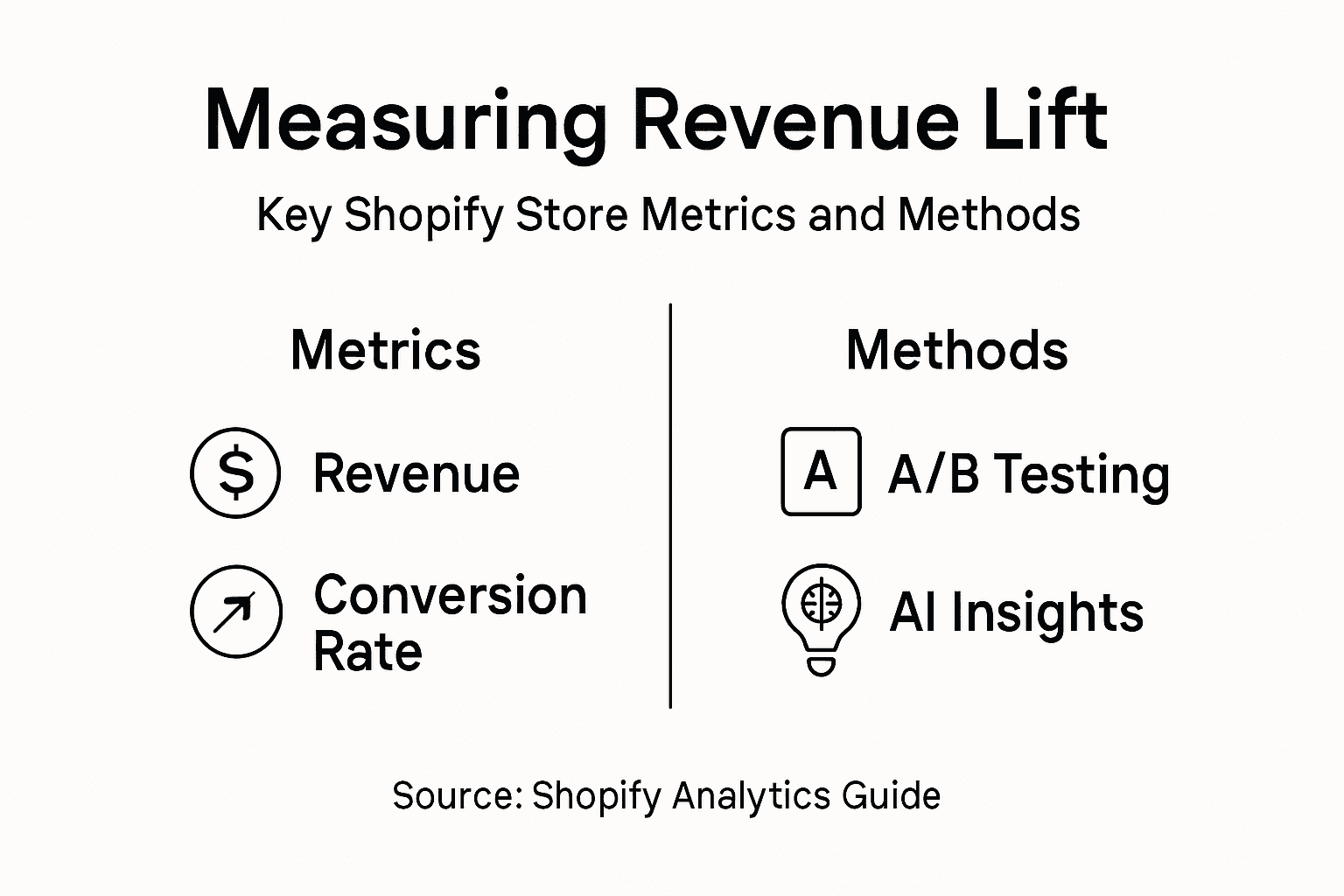
Shopify Analytics provides comprehensive performance tracking across multiple dimensions critical for understanding revenue generation. These analytics enable merchants to dissect traffic acquisition, customer behavior, sales performance, and marketing effectiveness with unprecedented granularity. By examining these interconnected metrics, Shopify store owners can identify precise sources of revenue lift and develop targeted optimization strategies.
Key metrics for measuring revenue lift include:
- Conversion Rate: Percentage of visitors completing purchases
- Average Order Value: Total revenue per transaction
- Customer Acquisition Cost: Expense required to attract each new customer
- Retention Rate: Percentage of customers making repeat purchases
- Marketing Channel Performance: Revenue generated through specific marketing efforts
Understanding these metrics requires more than surface-level observation. Store owners must develop a nuanced approach to data interpretation, looking beyond individual data points to recognize broader trends and potential optimization opportunities. By connecting these metrics and understanding their interdependence, Shopify entrepreneurs can unlock meaningful insights that drive substantial revenue improvements.
This table compares major revenue lift metrics and what influences them in a Shopify store:
| Metric | What It Measures | Influencing Factors |
|---|---|---|
| Conversion Rate | Buyers vs. total visitors | Site design, trust, UX |
| Average Order Value | Revenue per transaction | Upsells, cross-sells, pricing |
| Customer Acquisition Cost | Cost to get a new customer | Ad spend, targeting, referrals |
| Retention Rate | Frequency of repeat purchases | Loyalty programs, email, CX |
| Marketing Channel Revenue | Sales from each marketing source | Campaign relevance, channel mix |
Pro Tip: Create custom dashboards in Shopify Analytics that highlight your most critical revenue lift metrics, allowing for quick visual assessment of store performance trends.
Common Pitfalls And How To Avoid Them
A/B testing for Shopify stores can be a powerful optimization strategy, but numerous hidden challenges can undermine the effectiveness of your experiments. Successful implementation requires a sophisticated understanding of statistical principles, experimental design, and potential methodological traps that can distort your results and lead to misguided business decisions.
E-commerce A/B testing pitfalls reveal critical mistakes that can compromise the reliability of your revenue lift experiments. Common errors include running tests with insufficient sample sizes, testing multiple elements simultaneously, conducting tests for inadequate durations, and failing to account for external variables that might influence outcomes. These mistakes can create false impressions of performance improvements and lead to misguided strategic decisions.
Key pitfalls to avoid in Shopify A/B testing include:
- Insufficient Sample Size: Drawing conclusions from statistically insignificant data
- Premature Test Termination: Stopping experiments before reaching reliable confidence levels
- Confirmation Bias: Interpreting results to match preexisting expectations
- Ignoring Cross-Device Variations: Failing to test experiences across different platforms
- Overlooking Statistical Significance: Mistaking random fluctuations for meaningful changes
Mitigating these risks requires a disciplined, methodical approach to experimental design. Store owners must develop robust testing protocols that incorporate rigorous statistical methods, comprehensive data analysis, and a commitment to objective interpretation. By understanding and proactively addressing these potential pitfalls, Shopify entrepreneurs can develop more reliable, actionable insights from their A/B testing efforts.
Pro Tip: Establish a standardized A/B testing protocol that includes predefined stopping criteria, minimum sample size requirements, and a clear hypothesis before launching any experiment.
Unlock True Revenue Lift With AI-Powered A/B Testing for Shopify Stores
If you are looking to overcome common challenges like insufficient sample size, premature test endings, or poor personalization mentioned in the article, Automagic.li offers the perfect solution. The platform’s AI-driven technology automates and simplifies complex A/B testing tasks so you can boost your store’s conversion rate and average order value without coding or guesswork. With a library of over 40 pre-tested variations, you gain access to proven strategies that generate measurable revenue lift.
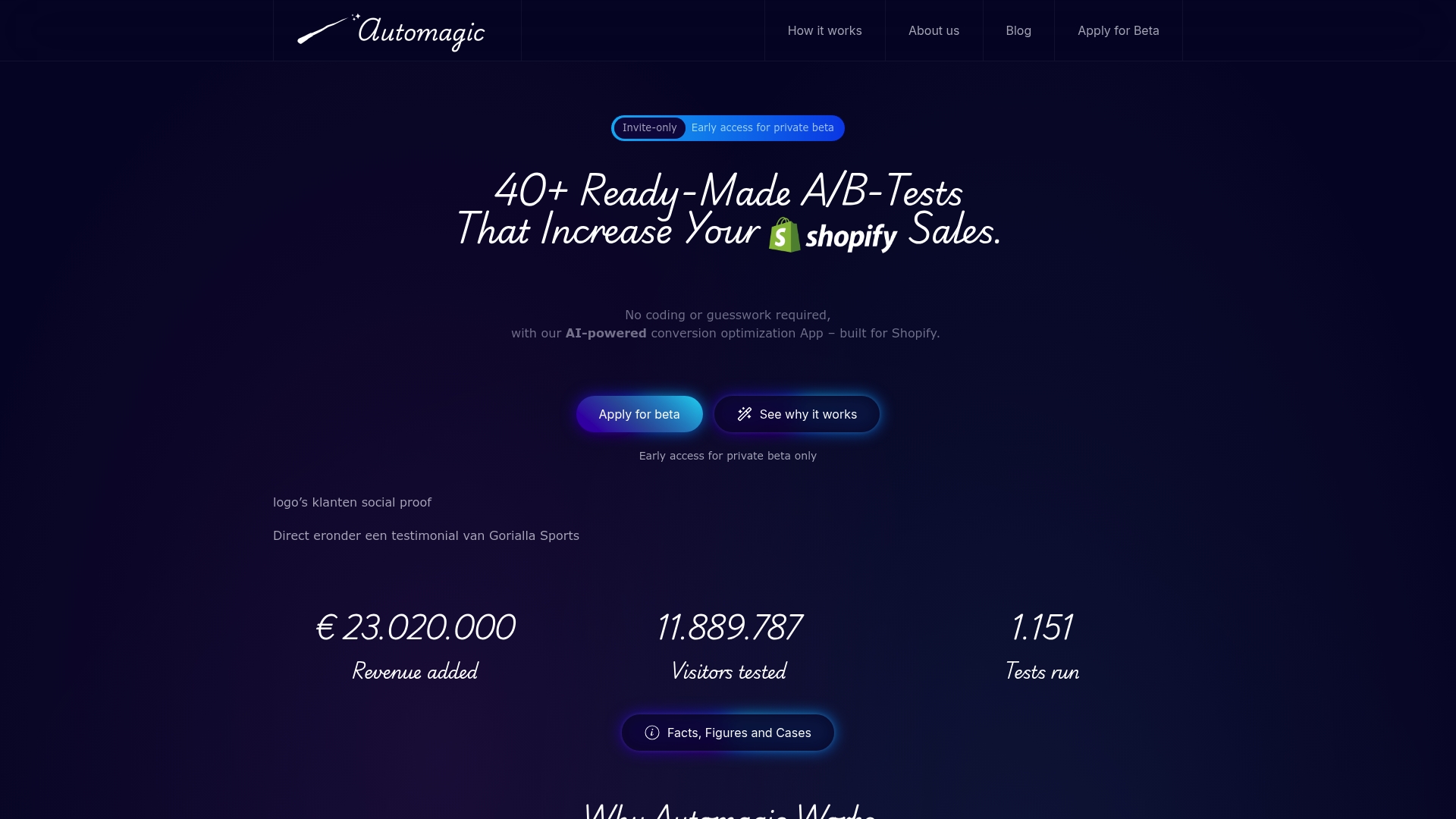
Take control of your Shopify store’s growth today by leveraging AI for smart, data-driven optimization. Start using Automagic.li to eliminate manual errors, increase test reliability, and see real-time revenue improvements. Don’t wait to transform your eCommerce performance with effortless AI-powered experiments. Visit our landing page now and experience how easy building conversion lift can be with the right tools designed specifically for Shopify entrepreneurs.
Frequently Asked Questions
What is revenue lift in eCommerce?
Revenue lift in eCommerce refers to the measurable increase in sales value attributed to specific enhancements in e-commerce strategies and consumer behavior changes, showing the financial impact of optimization efforts.
How can I achieve revenue lift for my Shopify store?
You can achieve revenue lift through strategies such as A/B testing, targeted marketing campaigns, improved website design, and streamlined checkout processes. Each of these can enhance conversion rates and customer experiences.
What role does AI-powered A/B testing play in generating revenue lift?
AI-powered A/B testing helps optimize store performance by providing data-driven insights and dynamically customizing user experiences based on predictive analytics, leading to improved conversion rates and reduced customer acquisition costs.
What key metrics should I track to measure revenue lift in my Shopify store?
Key metrics to track include conversion rate, average order value, customer acquisition cost, retention rate, and marketing channel performance. These will help you assess the effectiveness of your optimization efforts and understand sources of revenue lift.