
Revenue Uplift: Driving Sales Growth for Shopify Stores
Most American Shopify store owners want results fast, but figuring out how to increase revenue without advanced coding or technical skills can be tough. With online competition rising and customer preferences shifting daily, one simple test can mean the difference between missing out and making thousands more in sales. This guide explains how smart A/B testing and data-driven revenue uplift strategies deliver measurable growth for store owners seeking quicker profits with zero coding stress.
Table of Contents
- Defining Revenue Uplift And Key Concepts
- Types Of Revenue Uplift In Ecommerce
- How Ai A/B Testing Boosts Uplift
- Measuring And Maximizing Revenue Uplift
- Common Pitfalls And What To Avoid
Key Takeaways
| Point | Details |
|---|---|
| Revenue Uplift Definition | Revenue uplift involves maximizing business performance by identifying opportunities for incremental revenue growth through targeted marketing interventions. |
| Types of Uplift Strategies | Distinguish between conversion uplift, which focuses on transaction probability, and revenue uplift, which quantifies incremental monetary value and optimizes targeting. |
| AI in A/B Testing | AI-driven A/B testing enhances revenue uplift by automating variant selection and providing personalized insights across customer segments. |
| Avoiding Common Pitfalls | Focus on profitability and avoid superficial metrics while ensuring a smooth user experience to prevent undermining revenue growth. |
Defining Revenue Uplift and Key Concepts
Revenue uplift represents a strategic approach to maximizing business performance by identifying and targeting opportunities for incremental revenue growth. In the context of ecommerce and digital marketing, revenue uplift focuses on understanding how specific interventions can systematically increase monetary value beyond baseline expectations. Revenue uplift modeling provides businesses with a sophisticated method to predict and enhance financial outcomes through data-driven insights.
At its core, revenue uplift involves measuring the causal impact of marketing actions on customer behavior. Unlike traditional analysis that simply tracks overall response rates, uplift modeling seeks to understand the differential effect of marketing interventions across various customer segments. This approach allows businesses to distinguish between customers who will naturally respond positively and those whose behavior can be meaningfully influenced by targeted strategies.
The key components of revenue uplift modeling include:
- Incrementality: Measuring the additional revenue generated specifically due to a marketing action
- Heterogeneous Customer Response: Recognizing that different customer segments react uniquely to marketing interventions
- Causal Effect Estimation: Quantifying the precise revenue impact of specific marketing strategies
- Predictive Segmentation: Identifying customer groups most likely to generate incremental revenue
Pro tip: Focus on developing granular customer segments and test targeted interventions to maximize your revenue uplift potential.
Types of Revenue Uplift in Ecommerce
Ecommerce revenue uplift strategies can be categorized into distinct models that help businesses maximize their financial performance. Comparative uplift modeling approaches reveal two primary types of revenue enhancement techniques: conversion uplift and revenue uplift modeling, each targeting different aspects of customer interaction and monetary value.
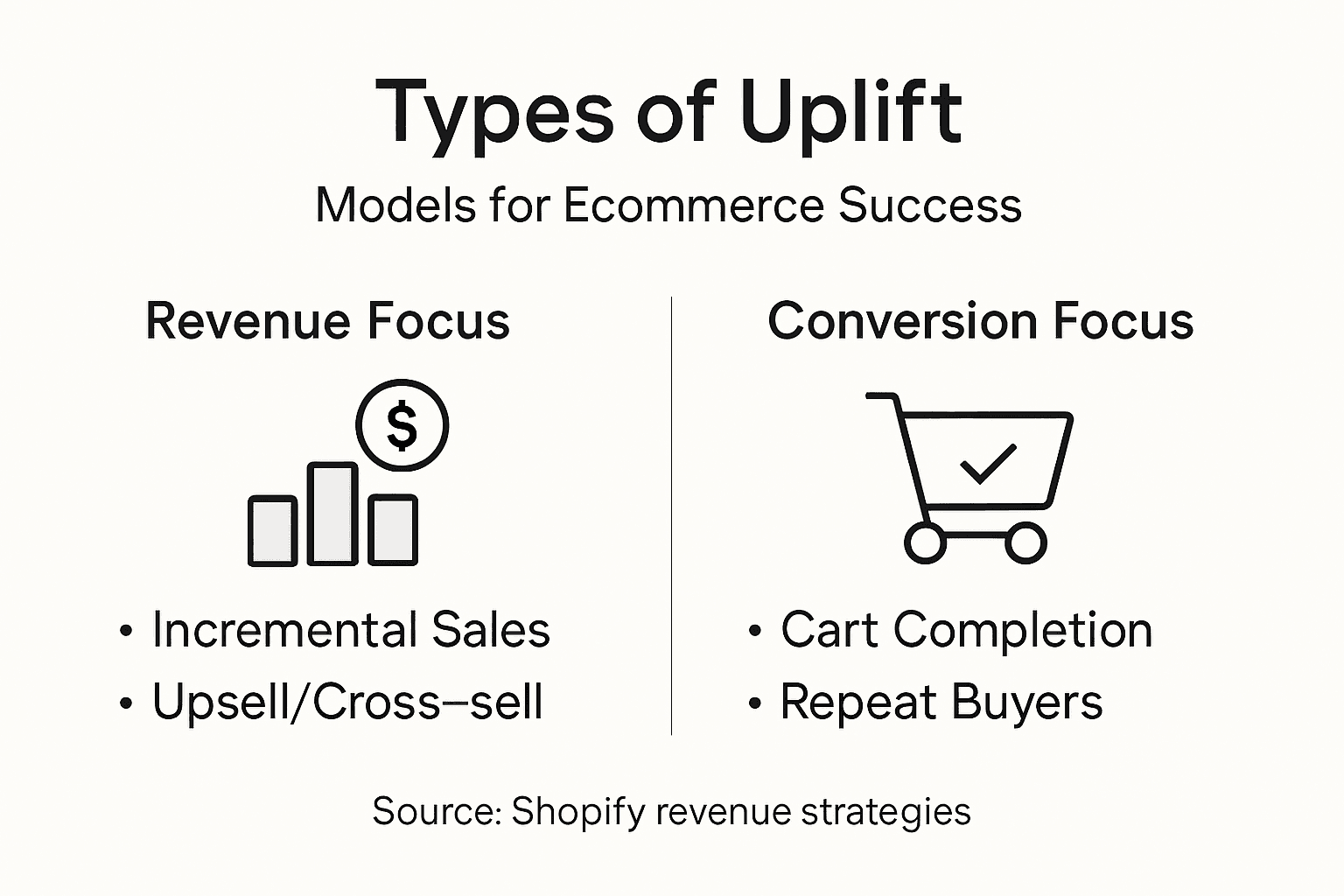
Conversion uplift focuses on increasing the probability of customer transactions, essentially measuring how marketing interventions improve the likelihood of a customer making a purchase. This approach examines the incremental conversion rate generated by specific marketing actions, helping businesses understand which strategies most effectively transform potential customers into actual buyers. In contrast, revenue uplift modeling goes beyond simple conversion rates, analyzing the potential monetary value generated by marketing interventions across different customer segments.
The key distinctions between these revenue uplift types include:
- Conversion Uplift:
- Measures transaction probability
- Focuses on increasing purchase likelihood
- Evaluates marketing effectiveness in driving initial sales
- Revenue Uplift:
- Quantifies incremental monetary value
- Considers customer spending heterogeneity
- Optimizes marketing targeting for maximum financial gain
For Shopify store owners, understanding these nuanced approaches enables more sophisticated marketing strategies that can significantly improve overall business performance. By leveraging detailed customer segmentation and targeted interventions, businesses can develop more precise revenue generation techniques.
Here’s a comparison of revenue uplift versus conversion uplift models for ecommerce businesses:
| Criteria | Revenue Uplift Modeling | Conversion Uplift Modeling |
|---|---|---|
| Main Focus | Incremental revenue generation | Increased purchase likelihood |
| Customer Differentiation | Targets spending differences | Targets conversion probability |
| Long-term Impact | Enhances lifetime customer value | Improves initial sales volume |
| Best Use Cases | High-value segment targeting | Mass audience conversion optimization |
Pro tip: Implement granular customer segmentation to differentiate between conversion and revenue uplift strategies, allowing for more targeted and financially effective marketing approaches.
How AI A/B Testing Boosts Uplift
Artificial Intelligence is revolutionizing A/B testing by transforming traditional experimentation methods into sophisticated, adaptive strategies for driving revenue uplift. AI-powered A/B testing techniques enable businesses to move beyond static experiments, creating dynamic testing environments that continuously learn and optimize performance in real time.

Traditional A/B testing often involves manual design, execution, and analysis of experiments, which can be time-consuming and limited in scope. AI dramatically changes this landscape by introducing multi-armed bandit testing, an advanced approach that automatically allocates traffic to the most promising variations. This intelligent method allows Shopify stores to rapidly identify and scale high-performing design elements, reducing the time and resources typically required for comprehensive conversion optimization.
Key advantages of AI-driven A/B testing include:
- Automated Variant Selection:
- Dynamically shifts traffic to winning variations
- Minimizes potential revenue loss during testing
- Reduces manual intervention and decision-making
- Personalization at Scale:
- Generates insights across multiple customer segments
- Adapts testing strategies based on individual user behaviors
- Provides granular understanding of conversion drivers
- Predictive Performance Modeling:
- Forecasts potential outcomes before full-scale implementation
- Identifies subtle performance indicators
- Enables proactive optimization strategies
For Shopify merchants, AI A/B testing represents a powerful tool for understanding and maximizing revenue potential. By leveraging machine learning algorithms, businesses can uncover nuanced insights that traditional testing methods might overlook, ultimately driving more strategic and effective conversion optimization.
Pro tip: Implement AI-powered A/B testing with a clear hypothesis and track micro-conversions to gain comprehensive insights into user behavior and potential revenue uplift.
Measuring and Maximizing Revenue Uplift
Measuring revenue uplift requires sophisticated analytical approaches that go beyond traditional conversion tracking. Advanced revenue uplift modeling techniques provide Shopify store owners with powerful methods to quantify and optimize their marketing strategies, transforming raw data into actionable insights that directly impact bottom-line performance.
The process of measuring revenue uplift involves decomposing campaign profits and understanding the incremental revenue generated by specific marketing interventions. Traditional metrics like conversion rates offer only a partial view of performance, whereas revenue uplift analysis reveals the true economic impact of marketing efforts. By employing machine learning models that can predict individual customer responses, businesses can develop more nuanced strategies that target high-value customer segments with precision.
Key strategies for measuring and maximizing revenue uplift include:
- Granular Customer Segmentation:
- Identify high-potential customer groups
- Develop targeted marketing approaches
- Customize messaging for specific segments
- Predictive Modeling Techniques:
- Use machine learning algorithms
- Forecast individual customer value
- Estimate potential incremental revenue
- Comprehensive Performance Metrics:
- Track beyond simple conversion rates
- Analyze customer lifetime value
- Measure long-term revenue impact
For Shopify entrepreneurs, understanding revenue uplift means moving beyond surface-level analytics to develop data-driven strategies that systematically increase monetary value. By implementing advanced measurement techniques, businesses can transform raw transactional data into strategic insights that drive sustainable growth.
Pro tip: Implement zero-based tracking of marketing interventions, measuring incremental revenue against a baseline to accurately quantify the true economic impact of each strategy.
Common Pitfalls and What to Avoid
Successful revenue uplift strategies require understanding potential obstacles that can derail optimization efforts. Common e-commerce revenue pitfalls demonstrate that many Shopify store owners inadvertently undermine their growth potential by making predictable and avoidable mistakes in their marketing and conversion strategies.
One of the most significant errors is focusing exclusively on sales volume without considering profitability. Superficial metrics can create a false sense of progress while actually eroding overall business health. Successful stores recognize that not all revenue is created equal – the true measure of success lies in understanding customer acquisition costs, average order value, and long-term customer lifetime value. This nuanced approach requires moving beyond simplistic revenue tracking to develop more sophisticated performance evaluation methods.
Key pitfalls Shopify store owners should avoid include:
- Misaligned Performance Metrics:
- Prioritizing total sales over profit margins
- Ignoring customer acquisition costs
- Overlooking repeat purchase rates
- Poor User Experience:
- Complicated checkout processes
- Non-responsive mobile design
- Unclear product information
- Marketing Strategy Mistakes:
- Generic, non-personalized messaging
- Inconsistent brand communication
- Neglecting customer segmentation
By recognizing and proactively addressing these potential challenges, Shopify entrepreneurs can develop more resilient and effective revenue optimization strategies. The goal is not just to increase sales, but to create sustainable, profitable growth that provides genuine value to both the business and its customers.
Below is a summary of common pitfalls and their long-term effects on revenue optimization:
| Pitfall | Long-Term Effect | Example Business Impact |
|---|---|---|
| Overvaluing sales volume | Reduced profitability | High costs with minimal net gain |
| Ignoring mobile optimization | Lost conversions | Abandoned carts on smartphones |
| Generic marketing campaigns | Lower customer engagement | Declining repeat purchases |
Pro tip: Regularly audit your store’s performance metrics, focusing on profitability indicators beyond simple sales numbers to identify and address potential revenue optimization barriers.
Unlock Revenue Uplift for Your Shopify Store with Automagic.li
The article highlights critical challenges for Shopify store owners such as understanding incremental revenue, mastering customer segmentation, and leveraging AI-driven optimization to maximize sales growth. If you want to overcome obstacles like inefficient A/B testing or generic marketing efforts that limit your store’s profitability you need a solution designed specifically for Shopify merchants trying to boost their revenue uplift.
Automagic.li offers a powerful SaaS platform that simplifies AI-powered A/B testing by providing a library of over 40 ready-made, high-impact variations tailored to your store’s unique design — no coding skills required. This means you can quickly implement the most effective strategies for predictive segmentation and personalized testing that directly tie into the revenue uplift techniques covered in the article.
Take control of your store’s growth by combining smart revenue uplift modeling with easy and automated A/B testing. Start seeing real improvements in conversion rates and incremental revenue today with Automagic.li, your partner for data-driven optimization.
Ready to transform Shopify store data into store profit? Visit Automagic.li now to explore how AI-powered testing can help you implement the proven strategies from this article. Don’t wait—start maximizing your revenue uplift and gain a competitive edge today.
Frequently Asked Questions
What is revenue uplift in ecommerce?
Revenue uplift refers to the incremental revenue growth achieved through specific marketing interventions that target and influence customer behavior, helping businesses maximize their financial performance.
How can AI A/B testing help increase revenue uplift for Shopify stores?
AI A/B testing enhances revenue uplift by dynamically optimizing marketing strategies, automatically allocating traffic to the most successful variations, and generating personalized insights that improve conversion rates across different customer segments.
What are the key components of revenue uplift modeling?
The key components include incrementality, heterogeneous customer response, causal effect estimation, and predictive segmentation, all of which help businesses understand and enhance the financial impact of their marketing actions.
How can Shopify store owners effectively measure revenue uplift?
Store owners can measure revenue uplift by utilizing advanced analytical techniques, focusing on granular customer segmentation, implementing predictive modeling, and considering comprehensive performance metrics that go beyond traditional conversion tracking.