
How to Reduce Shopify Cart Abandonment With AI A/B Tests
Watching potential sales slip away as customers abandon carts can frustrate Shopify store owners from Canada to Australia. Cart abandonment isn’t just a mystery—it’s a challenge that demands clear insight and actionable steps. By using AI-driven A/B testing and focusing on real cart abandonment data, you can uncover what truly holds shoppers back and target changes that make a measurable difference, all without learning complex code.
Table of Contents
- Step 1: Assess Cart Abandonment Data In Your Shopify Store
- Step 2: Select High-Impact A/B Tests Using AI Recommendations
- Step 3: Deploy Ready-Made Test Variations For Quick Optimization
- Step 4: Monitor Test Results To Determine Winning Strategies
- Step 5: Implement Proven Changes To Maximize Conversions
Quick Summary
| Key Point | Explanation |
|---|---|
| 1. Analyze Cart Abandonment Metrics | Use Shopify Analytics to identify abandonment rates, time spent in checkout, product categories, and device breakdown to improve conversions. |
| 2. Prioritize A/B Tests Using AI | Leverage AI insights to select high-impact A/B tests that target conversion barriers and maximize potential revenue impacts. |
| 3. Utilize Ready-Made A/B Test Variations | Implement pre-built test variations quickly to accelerate optimization efforts without extensive custom development. |
| 4. Monitor Results for Insights | Analyze A/B test outcomes using key performance indicators to adapt and refine conversion strategies effectively. |
| 5. Implement Data-Driven Changes | Make strategic modifications based on test results, emphasizing checkout flow, product presentation, and trust signals for higher conversions. |
Step 1: Assess cart abandonment data in your Shopify store
Understanding why customers leave your Shopify store without completing a purchase is crucial for improving conversion rates. In this step, you’ll dive deep into analyzing your cart abandonment metrics to uncover hidden patterns and potential improvement areas.
To effectively assess your cart abandonment data, start by navigating to your Shopify Analytics dashboard. Here, you’ll find critical insights into customer behavior and checkout performance. Systematic cart abandonment research highlights several key metrics you should closely examine:
- Abandonment Rate: Calculate the percentage of initiated checkouts that do not convert to completed purchases
- Time Spent in Checkout: Identify potential friction points causing customers to exit
- Product Categories: Determine which specific product types experience higher abandonment rates
- Device Breakdown: Analyze abandonment patterns across mobile, tablet, and desktop platforms
Pro tip: Use the insights from your abandoned cart data to create targeted recovery strategies and minimize future lost sales opportunities.
Step 2: Select high-impact A/B tests using AI recommendations
Reducing cart abandonment requires strategic testing that targets your most critical conversion barriers. In this step, you’ll leverage AI-powered insights to identify and prioritize the most impactful A/B tests for your Shopify store.

AI-driven decision support systems transform how you approach optimization by analyzing vast amounts of historical performance data to recommend the most promising test variations. These intelligent systems help you focus on tests most likely to improve your conversion rates.
When selecting high-impact A/B tests, consider the following strategic approaches:
- Checkout Flow Tests: Analyze and simplify your current checkout process
- Product Page Variations: Experiment with different image layouts, descriptions, and call-to-action placements
- Pricing Strategy Tests: Compare different pricing presentation methods
- Trust Element Optimization: Test security badges, customer reviews, and guarantee displays
AI recommendations can dramatically reduce the guesswork in conversion optimization, targeting your most critical performance bottlenecks.
Key Selection Criteria for AI-recommended tests include:
- Predicted conversion rate improvement
- Statistical confidence level
- Potential revenue impact
- Implementation complexity
Pro tip: Start with AI-recommended tests that have the highest predicted uplift and lowest implementation barrier to maximize your initial optimization efforts.
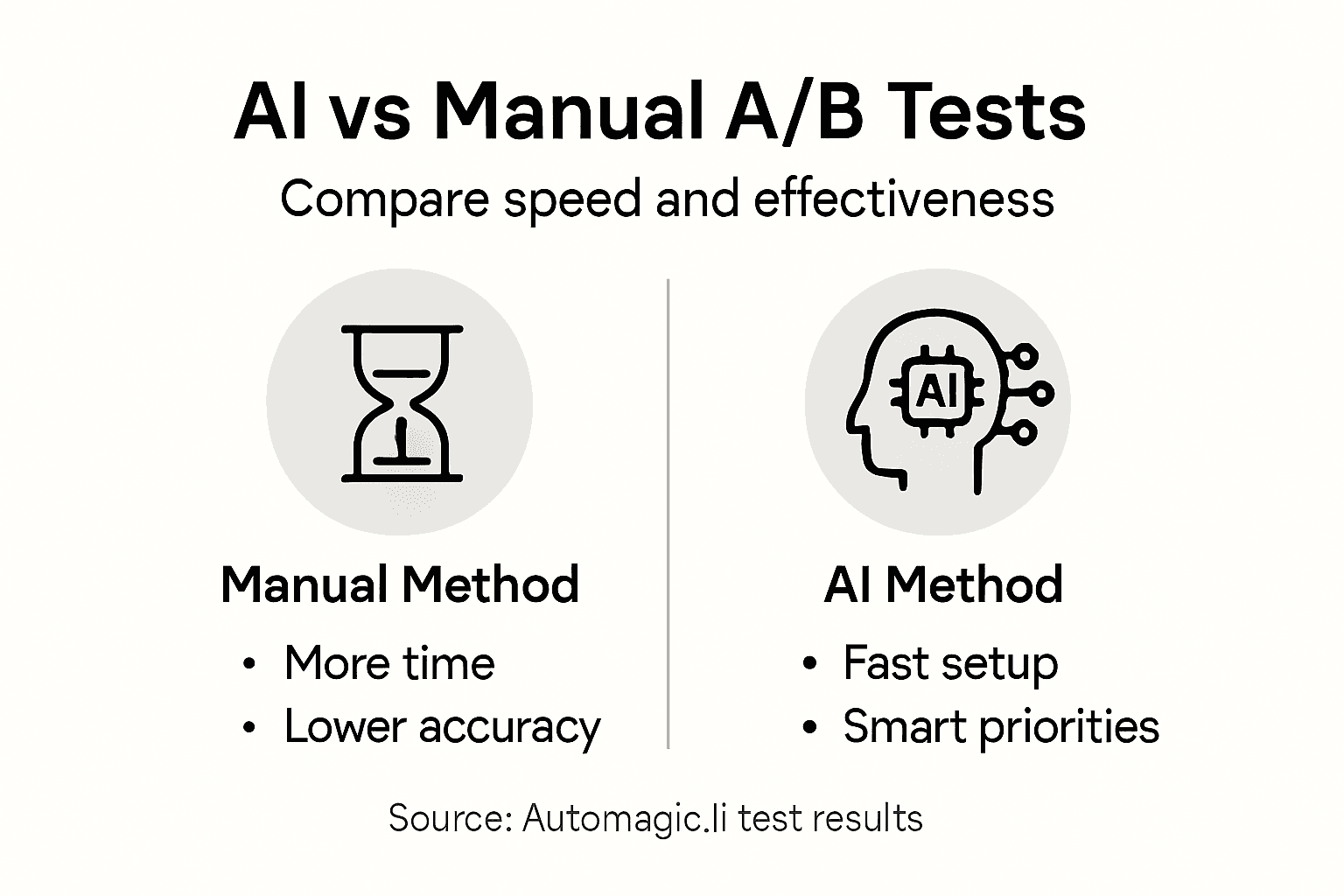
Here’s a comparison of manual versus AI-driven A/B test selection for Shopify stores:
| Method | Time Investment | Prioritization Accuracy | Resource Efficiency |
|---|---|---|---|
| Manual Test Selection | High (manual setup) | Relatively low | May waste efforts on low-impact tests |
| AI-Driven Selection | Low (automated) | Highly targeted | Focuses on top conversion opportunities |
Step 3: Deploy ready-made test variations for quick optimization
Streamlining your Shopify store’s optimization process means leveraging pre-built A/B test variations that can be quickly implemented without extensive custom development. By using strategically designed test variations, you can accelerate your conversion improvement efforts and minimize the time spent creating tests from scratch.
When deploying ready-made test variations, focus on these key implementation strategies:
- Rapid Deployment: Select variations that match your store’s design and objectives
- Minimal Technical Setup: Choose tests requiring zero custom coding
- High-Impact Areas: Prioritize tests targeting checkout, product pages, and pricing
- Performance Tracking: Enable built-in tracking for immediate insights
Ready-made A/B test variations can reduce experimentation time by up to 70%, allowing faster performance improvements.
Step-by-step implementation of ready-made tests:
- Review available test variations
- Select tests aligned with your specific conversion goals
- Configure test parameters
- Launch and monitor results
Pro tip: Start with 2-3 pre-configured test variations that require minimal setup to build momentum and confidence in your optimization strategy.
Step 4: Monitor test results to determine winning strategies
Analyzing A/B test outcomes is critical for transforming experimental data into actionable insights that drive your Shopify store’s conversion performance. By leveraging advanced statistical techniques, you can move beyond surface-level metrics and make data-driven decisions that significantly impact your store’s revenue.
When monitoring test results, focus on these key performance indicators:
- Conversion Rate: Percentage of visitors completing purchases
- Statistical Significance: Confidence level of test results
- Revenue Per Visitor: Total revenue generated during the test
- Interaction Metrics: User engagement and behavior changes
Effective test result monitoring can reveal subtle performance differences that dramatically improve your store’s conversion strategy.
Key steps for comprehensive result analysis:
- Wait for statistically significant sample size
- Compare variations across multiple performance metrics
- Validate results with secondary data points
- Document learnings for future optimization
Pro tip: Maintain a systematic tracking document that captures not just winning variations, but also insights about why certain tests performed better than others.
Step 5: Implement proven changes to maximize conversions
Transforming your A/B test insights into tangible improvements requires a strategic and methodical approach to implementation. Behavioral data integration reveals that successful conversion optimization goes beyond simple design changes, demanding a comprehensive understanding of user interactions and experience.
To effectively implement proven changes, prioritize modifications that directly address your most significant conversion barriers:
- Checkout Flow Refinement: Simplify and streamline the purchase process
- Product Page Optimization: Enhance visual presentation and information clarity
- Trust Signal Placement: Strategically position security badges and testimonials
- Call-to-Action Improvements: Redesign buttons for maximum visibility and appeal
Small, data-driven changes can yield substantial improvements in your store’s overall conversion performance.
Step-by-step implementation strategy:
- Rank test variations by potential impact
- Create a phased rollout plan
- Monitor performance after each change
- Document and validate improvements
Pro tip: Implement changes incrementally and track individual modifications to understand exactly which adjustments drive the most significant conversion improvements.
Summary of key optimization focus areas and their expected impact on conversions:
| Area Optimized | Typical Improvement | Business Benefit |
|---|---|---|
| Checkout Flow | Reduced drop-off | Increased completed sales |
| Product Page Layout | Higher engagement | More informed purchases |
| Trust Signal Placement | Greater confidence | Fewer abandoned carts |
| Call-to-Action Design | More clicks | Boosted order rate |
Boost Your Shopify Store Conversion With AI-Powered A/B Testing
Cart abandonment in Shopify stores often stems from complex checkout flows and ineffective test selections. This article highlights how AI-driven A/B testing can pinpoint high-impact areas, deploy ready-made variations, and maximize conversions without heavy technical skills. If you want to overcome checkout friction and unlock real revenue growth, personalized AI recommendations and quick deployment are essential.
At Automagic.li, our SaaS platform empowers Shopify store owners by offering a library of over 40 proven, pre-tested A/B test variations that require no coding knowledge. Using AI customization, we tailor tests to your store’s unique design and business goals making it easier than ever to reduce cart abandonment and increase sales. Explore how Automagic.li automates test creation and deployment so you can focus on driving results, not managing technical details.
[Transform your Shopify store’s checkout and product pages today with AI-powered tests]
Don’t let abandoned carts hold your business back. Visit Automagic.li now to quickly implement high-impact, expertly recommended A/B tests and convert more visitors into paying customers with confidence.
Frequently Asked Questions
How can I assess cart abandonment data in my Shopify store?
To assess cart abandonment data, navigate to your Shopify Analytics dashboard and examine key metrics such as the abandonment rate, time spent in checkout, and device breakdown. Analyze this data to identify areas for improvement and develop targeted recovery strategies.
What A/B tests should I prioritize to reduce cart abandonment?
Prioritize A/B tests that focus on your checkout flow, product page variations, and trust elements like security badges. Start with tests that have a high predicted conversion rate improvement to maximize your optimization efforts quickly.
How can AI help in selecting A/B tests for my Shopify store?
AI can analyze historical performance data to recommend A/B tests that are most likely to improve conversion rates. Use AI-driven insights to streamline your testing process and focus on high-impact areas, potentially saving time and resources.
What are some quick ways to implement A/B test variations on Shopify?
Select ready-made A/B test variations that require minimal technical setup for rapid deployment. Focus on high-impact areas such as checkout and product pages to quickly enhance your store’s performance and reduce cart abandonment.
How do I monitor test results effectively after implementing A/B tests?
Monitor test results by analyzing conversion rates, statistical significance, and revenue per visitor. Wait for a statistically significant sample size before making decisions, and document your findings to inform future optimizations.
What steps should I take to implement changes based on A/B test insights?
Implement changes by ranking winning test variations by their potential impact, then create a phased rollout plan. Monitor performance after each change to understand its effectiveness and make continuous improvements.