
Why Data Helps Conversions for Shopify Stores
Most American Shopify stores lose nearly half of potential sales due to ineffective conversion strategies. With every decision impacting your bottom line, the pressure to deliver measurable results never fades. Data-driven optimization gives eCommerce managers a reliable way to improve conversion rates using actionable insights and straightforward A/B testing—no coding required. This guide breaks down proven methods and practical analytics, helping you turn metrics into opportunities for increased sales and better customer experiences.
Table of Contents
- Data-Driven Conversion Optimization Explained
- Types of Data That Influence Conversions
- How AI-Powered A/B Testing Drives Results
- Common Misconceptions About Data Usage
- Risks and Mistakes in Data-Driven Decisions
Key Takeaways
| Point | Details |
|---|---|
| Data-Driven Optimization | Continuously collect and analyze user interaction data to enhance conversion rates and user experience. |
| Types of Data | Integrate both quantitative and qualitative data for a comprehensive understanding of customer behavior and conversion potential. |
| AI-Powered A/B Testing | Implement AI-driven A/B testing for real-time, adaptive optimization to quickly identify effective design elements. |
| Misconceptions in Data Use | Avoid common pitfalls such as confusing correlation with causation and always ensure data quality through rigorous validation. |
Data-Driven Conversion Optimization Explained
Data-driven conversion optimization transforms raw website metrics into strategic insights that systematically improve ecommerce performance. By leveraging quantitative and qualitative data, Shopify store owners can make informed decisions that directly impact sales and user experience. Systematic research methodologies enable businesses to understand customer behavior beyond surface-level analytics.
The core principle of data-driven optimization involves continuously collecting, analyzing, and acting upon user interaction data. This approach moves beyond guesswork by utilizing machine learning predictive models that uncover hidden patterns in customer engagement. Conversion tracking becomes more than just monitoring numbers – it transforms into a comprehensive strategy for understanding user psychology and removing potential barriers to purchase.
Successful data-driven optimization requires multiple interconnected techniques. These include:
- Comprehensive user behavior analysis
- Heat map tracking
- Session recording reviews
- Quantitative conversion funnel assessments
- Statistically significant A/B testing protocols
Pro tip: Start tracking micro-conversions alongside macro conversions to gain deeper insights into your customer journey and identify subtle optimization opportunities.
Types of Data That Influence Conversions
In the complex landscape of ecommerce optimization, understanding the various data types becomes crucial for improving Shopify store conversions. Comprehensive data classification reveals that conversion insights emerge from multiple sources, each offering unique perspectives on customer behavior and purchasing patterns.
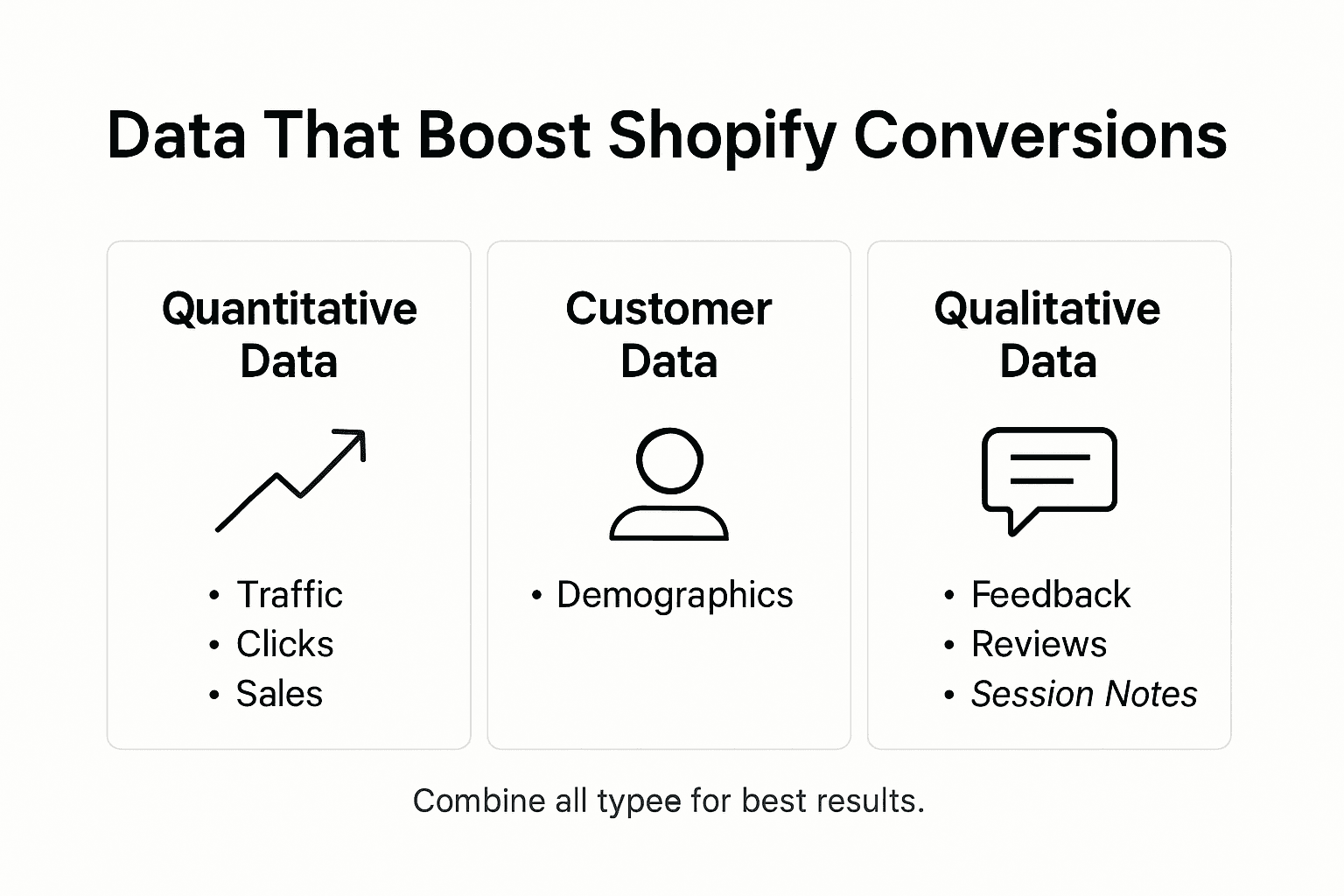
Two primary data categories drive meaningful conversion analysis: quantitative and qualitative data. Quantitative data provides numerical evidence about user interactions, including metrics like click-through rates, cart abandonment percentages, and average time spent on product pages. These statistical measurements offer concrete, measurable insights into store performance. Qualitative data, in contrast, delves deeper into customer motivations, capturing nuanced feedback through user reviews, survey responses, and customer support interactions.
Specific data types that significantly influence conversion rates include:
- Website traffic sources
- User demographic information
- Session duration and interaction patterns
- Conversion funnel progression
- Customer lifetime value metrics
- Product page engagement statistics
Pro tip: Integrate both quantitative and qualitative data analysis to create a holistic understanding of your store’s conversion potential and identify subtle optimization opportunities.
Here’s a quick comparison of data types and their impact on Shopify conversion optimization:
| Data Type | Example Metrics | Insights Provided | Typical Business Impact |
|---|---|---|---|
| Quantitative | Cart abandonment rate | Identifies drop-off points | Pinpoints areas for revenue growth |
| Qualitative | User reviews, surveys | Reveals customer motivations | Enhances product and service quality |
| Behavioral | Session recordings | Tracks user interaction paths | Improves website usability |
| Demographic | Age, location data | Highlights audience segments | Enables targeted marketing |
How AI-Powered A/B Testing Drives Results
Artificial Intelligence has revolutionized A/B testing for Shopify stores, transforming traditional experimentation into a dynamic, intelligent optimization process. AI-powered testing methodologies enable store owners to move beyond static experiments, creating adaptive testing environments that continuously learn and improve conversion strategies.

The core advantage of AI-driven A/B testing lies in its ability to make real-time, data-driven decisions. Intelligent algorithms dynamically redistribute traffic to better-performing variations, ensuring that the most effective design elements are quickly identified and implemented. This approach goes beyond traditional split testing by utilizing advanced techniques like multi-armed bandit algorithms and uplift modeling, which provide more nuanced insights into user behavior and preferences.
Key benefits of AI-powered A/B testing for Shopify stores include:
- Faster statistical significance
- Reduced time and resource investment
- More accurate user segment targeting
- Continuous performance optimization
- Adaptive testing protocols
- Minimized conversion rate losses during experiments
Pro tip: Implement AI-powered A/B testing as an ongoing process, treating it as a continuous optimization strategy rather than a one-time experiment.
The following table summarizes common AI-powered A/B testing methods and their unique advantages:
| Testing Method | How It Works | Main Advantage | Best Use Case |
|---|---|---|---|
| Multi-armed bandit | Allocates traffic to better variants | Accelerates winning variant discovery | Rapid design iteration |
| Uplift modeling | Predicts response differences | Improves personalized experiences | Targeted messaging |
| Traditional split test | Evenly splits visitor traffic | Simplifies experimental setup | Testing single design element |
Common Misconceptions About Data Usage
Data analysis is fraught with potential misunderstandings that can derail critical business insights. Persistent misconceptions in data interpretation can lead Shopify store owners down costly and ineffective optimization paths, making it crucial to understand and challenge common analytical assumptions.
One of the most significant misunderstandings involves confusing correlation with causation. Many store owners mistakenly believe that simply collecting more data automatically leads to better insights. In reality, data quality and proper analysis matter far more than sheer volume. Statistical literacy requires distinguishing between observable patterns and genuine causal relationships that directly impact conversion rates. This means critically examining data sources, understanding sampling methods, and recognizing the limitations of statistical measurements.
Common data usage misconceptions in ecommerce include:
- Assuming more data always means better insights
- Overrelying on superficial statistical metrics
- Misinterpreting non-significant experimental results
- Failing to account for data collection bias
- Believing correlation implies direct causation
- Neglecting data provenance and reliability
Pro tip: Always validate your data sources and critically examine the context behind statistical findings before making significant business decisions.
Risks and Mistakes in Data-Driven Decisions
Navigating the complex landscape of data-driven decision making requires more than just collecting information—it demands critical analysis and strategic interpretation. Data-driven decision risks can significantly undermine a Shopify store’s performance if leaders fail to understand the nuanced challenges inherent in statistical analysis.
The most dangerous pitfalls emerge when store owners misinterpret statistical evidence, confusing correlation with causation or overgeneralizing findings without considering contextual limitations. Meaningful data analysis goes beyond surface-level metrics, requiring a sophisticated approach that evaluates data validity, understands experimental design, and ensures that chosen metrics genuinely reflect strategic business objectives. This means critically examining sample sizes, recognizing potential biases, and maintaining a holistic view of performance indicators.
Critical risks in data-driven decision making include:
- Misinterpreting statistical correlations as causal relationships
- Overgeneralizing narrow or limited study findings
- Neglecting important contextual factors
- Using inappropriate or irrelevant performance metrics
- Failing to validate data collection methodologies
- Ignoring potential sampling and selection biases
Pro tip: Develop a rigorous validation process that challenges your initial data interpretations, seeking alternative explanations and cross-referencing findings with multiple independent sources.
Unlock Your Shopify Store’s True Potential with Data-Driven AI Testing
The article highlights how critical it is to move beyond guesswork and embrace data-driven conversion optimization using AI-powered techniques like adaptive A/B testing and detailed user behavior analysis. If you struggle with interpreting complex data, finding statistically significant wins, or spending too many resources on coding custom tests, these are common pain points that can stall your Shopify store’s growth.
Automagic.li is designed precisely to address these challenges. It offers a powerful SaaS platform that delivers over 40 pre-tested AI-powered A/B test variations, tailored automatically to your store’s unique design without any coding required. This means you get faster results, smarter test selections based on conversion impact and certainty, and seamless deployment through intelligent code adjustments. By automating the toughest parts of data collection, analysis, and test execution, Automagic.li frees you to focus on growing sales with confidence.
Ready to transform your Shopify store using proven data-driven methods and AI-powered optimization?
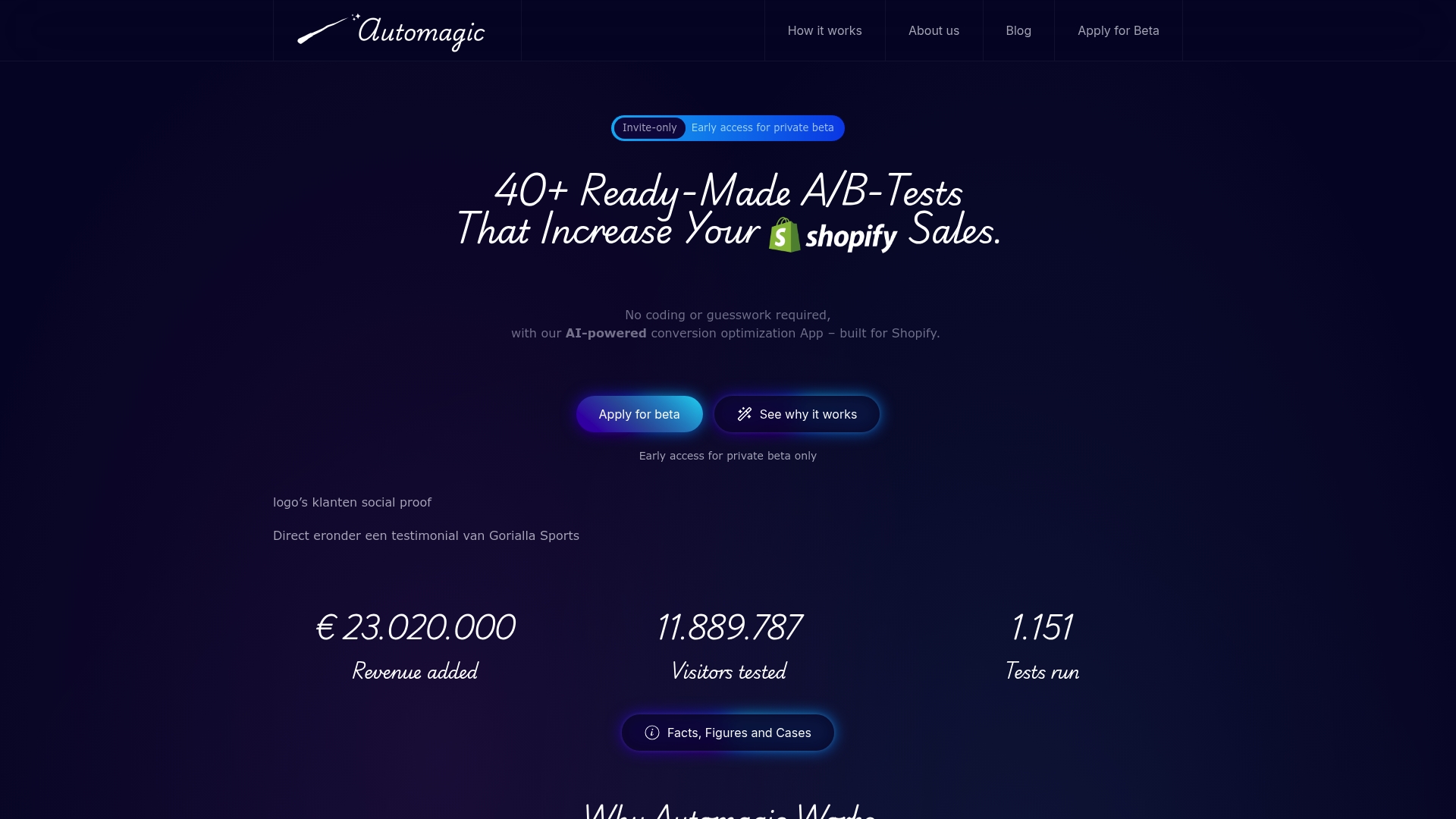
Discover how easy advanced conversion optimization can be. Visit Automagic.li to explore our platform, read testimonials from successful ecommerce businesses, and start running high-impact, no-code A/B tests today. Don’t wait for another lost sale—make data work for you now with Automagic.li.
Frequently Asked Questions
What is data-driven conversion optimization?
Data-driven conversion optimization is the process of using quantitative and qualitative data to improve the performance of e-commerce platforms like Shopify by making informed decisions that enhance sales and user experience.
How can Shopify store owners collect user data?
Shopify store owners can collect user data through various methods, including website traffic analytics, heat map tracking, session recordings, surveys, and capturing customer feedback through reviews and support interactions.
What types of data are most important for improving conversion rates?
The most important types of data for improving conversion rates include quantitative data (like click-through rates and cart abandonment percentages) and qualitative data (like customer reviews and survey responses) that together provide a comprehensive understanding of customer behavior.
How does AI enhance A/B testing for Shopify stores?
AI enhances A/B testing by enabling real-time, data-driven decisions and adaptive testing processes that continuously optimize conversion strategies, resulting in faster identification of high-performing design variations and improved user engagement.