
Conversion Uplift: Boosting Shopify Store Sales
Most American Shopify store owners find it tough to identify which changes truly increase sales. With more than 60 percent of eCommerce campaigns missing their mark due to broad targeting, entrepreneurs waste time and budget without real impact. Understanding conversion uplift helps you pinpoint exactly which marketing moves drive additional purchases, so you can achieve smarter growth while solving frustrating user experience challenges worldwide.
Table of Contents
- Defining Conversion Uplift In Ecommerce
- Types Of Conversion Uplift Strategies
- How Ai-Powered A/B Testing Works
- Financial Impact Of Conversion Uplift
- Avoiding Common Pitfalls In Optimization
Key Takeaways
| Point | Details |
|---|---|
| Conversion Uplift Analysis | Conversion uplift focuses on the incremental impact of marketing strategies, allowing businesses to understand which tactics genuinely drive additional sales. |
| Types of Strategies | Three main strategies—treatment effect modeling, response transformation, and profit decomposition—enable precise targeting and resource allocation. |
| AI-Powered Testing | AI-driven A/B testing enhances conversion optimization through advanced data analysis, improving traffic allocation and uncovering deep customer behavior insights. |
| Optimization Pitfalls | Businesses must avoid lack of structured experimentation, confirmation bias, and unclear hypotheses to build a robust culture of continuous improvement in conversion rates. |
Defining Conversion Uplift in ECommerce
Conversion uplift represents a sophisticated analytical approach that goes beyond traditional conversion tracking, focusing on understanding the incremental impact of marketing interventions on consumer behavior. Unlike standard conversion metrics that simply measure overall response rates, uplift modeling captures the precise causal effect of specific marketing strategies on individual consumer actions.
In practical eCommerce terms, conversion uplift examines which marketing tactics genuinely drive additional sales that would not have occurred naturally. This means identifying segments of customers who are uniquely influenced by a particular intervention, distinguishing them from those who would have purchased regardless. The goal is surgical precision in targeting – understanding not just who converts, but why and how they convert.
The core methodology involves segmenting customers into distinct groups based on their response patterns. Marketers using uplift modeling can pinpoint exactly which customer groups are most likely to be positively influenced by a specific campaign. This approach transforms marketing from a broad, generalized strategy to a highly targeted, data-driven discipline that maximizes return on investment by focusing resources on the most responsive segments.
Pro tip: To effectively implement conversion uplift analysis, start by establishing clear control and treatment groups in your Shopify store experiments, ensuring you can accurately measure the incremental impact of each marketing intervention.
Types of Conversion Uplift Strategies
Conversion uplift strategies represent a nuanced approach to marketing optimization, moving beyond traditional conversion tracking by utilizing advanced analytical techniques. Sophisticated modeling approaches transform how businesses understand customer responses, enabling more precise targeting and resource allocation.
Three primary types of conversion uplift strategies emerge in modern eCommerce: treatment effect modeling, response transformation, and profit decomposition. Treatment effect modeling focuses on identifying causal relationships between marketing interventions and customer behavior, isolating specific segments most likely to respond positively. Response transformation techniques analyze how different customer groups react to varied marketing approaches, allowing businesses to customize interventions based on predicted incremental impact.
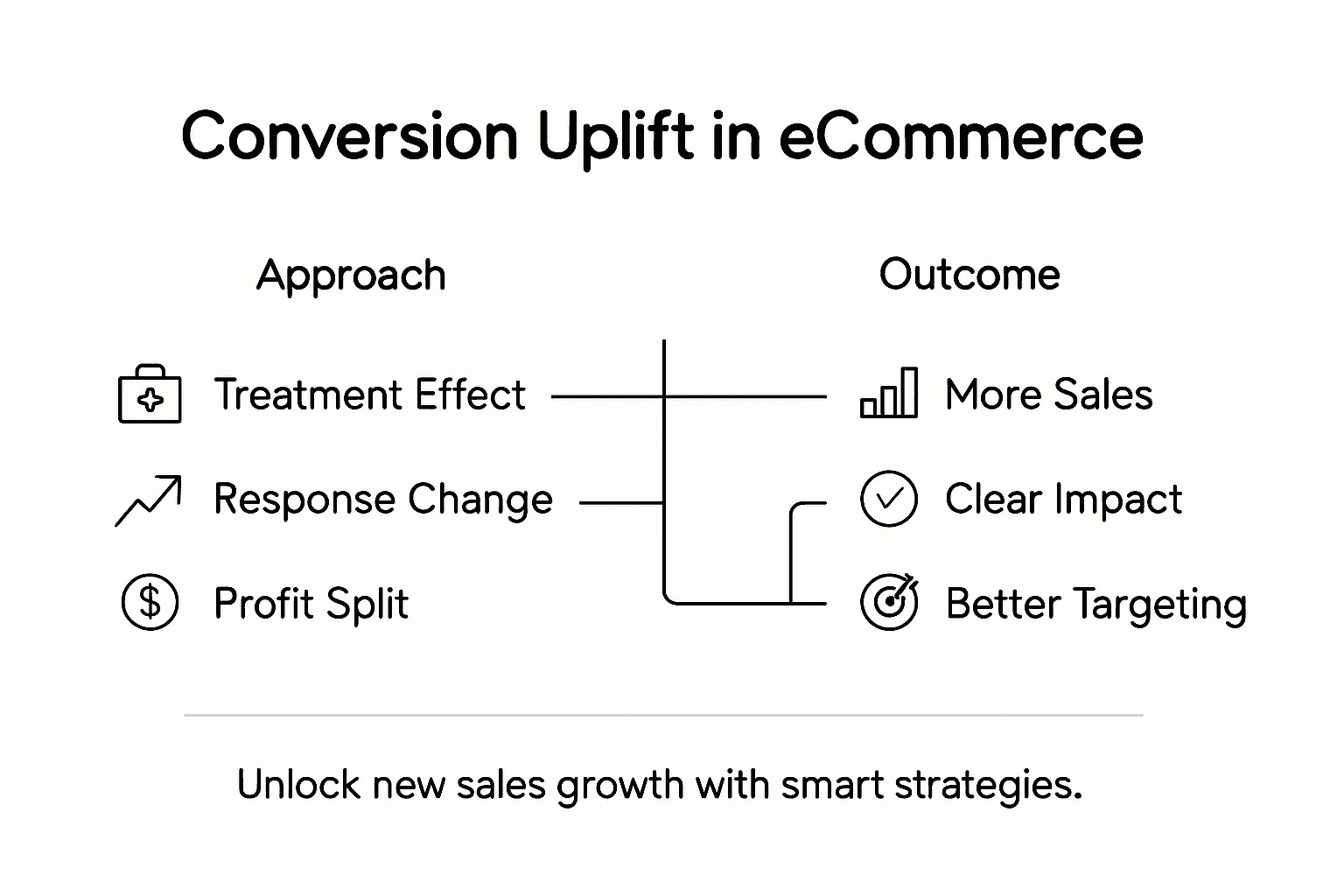
Profit decomposition strategies take this analysis further by breaking down potential revenue gains at a granular level. This method enables marketers to not just understand conversion likelihood, but to quantify the potential financial uplift of each targeted intervention. By segmenting customers into distinct response categories – such as those who will convert with intervention, those who will convert anyway, and those who will not convert regardless of marketing efforts – businesses can strategically allocate marketing resources for maximum efficiency.
Here’s how key conversion uplift strategies differ in focus and outcome:
| Strategy Type | Main Focus | Typical Outcome |
|---|---|---|
| Treatment Effect Modeling | Identifies causal relationships | Pinpoints responsive segments |
| Response Transformation | Analyzes varied customer reactions | Customizes marketing approaches |
| Profit Decomposition | Quantifies incremental revenue | Optimizes resource allocation |
Pro tip: Implement a robust A/B testing framework that clearly distinguishes control and treatment groups to accurately measure the incremental impact of each marketing strategy.
How AI-Powered A/B Testing Works
AI-powered A/B testing represents a revolutionary approach to conversion optimization that goes far beyond traditional experimental methods. By integrating advanced machine learning algorithms, this innovative technique transforms how Shopify store owners understand and improve their online performance, moving from manual guesswork to intelligent, data-driven decision-making.
The core mechanism of AI-powered A/B testing involves three critical stages of intelligent analysis. First, machine learning algorithms generate sophisticated test hypotheses by analyzing historical store data, identifying potential improvement areas that human analysts might overlook. Second, the AI dynamically optimizes test traffic allocation, intelligently routing more visitors to variants showing higher performance potential. This means resources are automatically directed toward the most promising design or marketing variations, maximizing efficiency and minimizing wasted effort.

The final and most sophisticated stage involves real-time result analysis that penetrates far deeper than traditional statistical significance measurements. AI algorithms can uncover nuanced insights about customer behavior, detecting subtle interaction patterns and contextual factors that human analysts would typically miss. These insights enable Shopify store owners to make precision adjustments that incrementally improve conversion rates, creating a continuous improvement cycle powered by machine intelligence.
The following table summarizes the stages and benefits of AI-powered A/B testing:
| Stage | Key Activity | Business Impact |
|---|---|---|
| Hypothesis Generation | Analyze historical data | Uncovers improvement areas |
| Traffic Allocation | Route visitors dynamically | Maximizes test efficiency |
| Real-Time Analysis | Detect subtle patterns | Enables precise adjustments |
Pro tip: Configure your AI testing platform to track micro-conversions alongside primary conversion goals to gain a more comprehensive understanding of customer interaction patterns.
Financial Impact of Conversion Uplift
Advanced conversion uplift strategies have profound financial implications for eCommerce businesses, transforming marketing from a cost center to a precision revenue generation engine. By leveraging sophisticated data analysis, companies can move beyond traditional broad-based marketing approaches and create targeted interventions that directly impact bottom-line performance.
The core financial mechanism of conversion uplift involves targeted personalization and strategic resource allocation. Businesses can now identify specific customer segments most likely to generate incremental revenue, allowing for hyper-efficient marketing spend. This approach means marketing budgets are no longer scattered across large, undefined audiences, but strategically deployed to segments with the highest probability of generating additional sales. Personalized pricing and promotion strategies enable businesses to optimize unit economics by precisely balancing incremental conversion costs against potential revenue gains.
Most critically, conversion uplift provides a sophisticated framework for understanding true marketing effectiveness. Traditional metrics like overall conversion rates become less meaningful when compared to the granular insights provided by uplift modeling. By calculating the conditional average treatment effect, businesses can quantify exactly how much additional revenue each marketing intervention generates, moving from guesswork to data-driven precision. This approach allows companies to not just increase sales, but to understand the nuanced economic impact of each marketing strategy.
Pro tip: Implement a comprehensive tracking system that measures not just conversion rates, but the incremental revenue generated by specific marketing interventions to truly understand your uplift performance.
Avoiding Common Pitfalls in Optimization
Small and medium enterprises frequently encounter significant challenges when implementing conversion optimization strategies, often derailing their efforts before meaningful progress can be achieved. The most critical obstacle is not technological limitation, but the fundamental mindset required to approach conversion improvement as a systematic, data-driven process.
Three primary pitfalls emerge that consistently undermine optimization efforts. First, many businesses lack a structured experimentation framework, treating A/B testing as an occasional activity rather than a continuous improvement methodology. Second, organizations frequently suffer from confirmation bias, designing tests that validate existing assumptions instead of genuinely challenging them. Third, teams often fail to establish clear, measurable hypotheses before launching tests, resulting in inconclusive or misleading results that provide no actionable insights.
Successful optimization requires building a robust culture of experimentation that transcends traditional marketing approaches. This means creating systematic processes for generating hypotheses, designing rigorous test protocols, and interpreting results with statistical objectivity. Businesses must shift from reactive problem-solving to proactive performance enhancement, viewing each test as an opportunity to deeply understand customer behavior and incrementally improve their digital experience. The goal is not just to increase conversion rates, but to develop a sophisticated, learning-oriented approach to digital strategy.
Pro tip: Develop a standardized test documentation template that requires explicit hypothesis statements, predicted outcomes, and clear success metrics before launching any optimization experiment.
Unlock True Conversion Uplift for Your Shopify Store Today
The challenge of accurately measuring and maximizing incremental sales impact is at the heart of boosting Shopify store revenue. This article highlights the power of conversion uplift modeling and AI-driven A/B testing to precisely identify which marketing actions truly drive new customer conversions rather than just attributing to general traffic fluctuations. If you want to overcome common pitfalls like unstructured testing and confirmation bias while achieving targeted personalization and financial uplift, Automagic.li offers a tailor-made solution designed specifically for Shopify stores.
Our SaaS platform delivers an extensive library of AI-powered, ready-made A/B tests that require no coding expertise—eliminating the hassle of manual test creation and enabling you to focus on real data-driven decisions. With automated test deployment that adapts to your store’s unique design and an intuitive interface, you can easily conduct structured experiments that generate actionable insights. This empowers you to move beyond guesswork to continuously optimize your conversion rates and maximize your marketing ROI.
Take control of your eCommerce growth with techniques grounded in the conversion uplift principles discussed here. Experience how Automagic.li can bring clarity, precision, and measurable revenue gains to your Shopify optimization efforts. Explore the platform now at Automagic.li.
Ready to see which changes really move the needle for your store? Visit Automagic.li to start leveraging AI-powered A/B testing for conversion uplift. Transform your Shopify optimization strategy by implementing proven, high-impact tests that deliver real financial results—without needing a technical team. Act now to enhance every experiment with data-driven insights that drive lasting sales growth.
Frequently Asked Questions
What is conversion uplift in eCommerce?
Conversion uplift refers to the analytical approach that measures the incremental impact of marketing strategies on customer behavior, identifying how specific marketing interventions drive additional sales that wouldn’t have occurred naturally.
How can I implement conversion uplift analysis in my Shopify store?
To effectively implement conversion uplift analysis, establish clear control and treatment groups in your marketing experiments, which will allow you to measure the incremental impact of each intervention accurately.
What are the different types of conversion uplift strategies?
The main types of conversion uplift strategies include treatment effect modeling, response transformation, and profit decomposition. Each focuses on understanding customer responses and optimizing marketing resources for better outcomes.
How does AI-powered A/B testing improve conversion rates?
AI-powered A/B testing enhances conversion rates by using machine learning to generate hypotheses, dynamically allocate test traffic, and analyze results in real time, allowing for data-driven decision-making that uncovers insights human analysts might overlook.