
7 Conversion Rate Optimization Tips for Shopify Stores
Over 60 percent of American Shopify stores face plateaued sales when they neglect simple conversion tactics. For store owners without a technical background, optimizing every click and page can feel overwhelming. Whether your shop is in Canada, Europe, or anywhere else, proven strategies exist that require no coding skills. This guide shares actionable techniques backed by real data, helping you transform your store’s performance and maximize results with straightforward, ready-to-use solutions.
Table of Contents
- Choose High-Impact A/B Tests From a Ready-Made Library
- Use AI to Automate and Personalize Store Improvements
- Leverage Data-Driven Results for Smarter Decisions
- Apply Social Proof to Build Trust With Customers
- Optimize Product Pages for Clear Calls to Action
- Test Multiple Variations to Find Top Performers
- Track Revenue and Metrics to Measure Success
Quick Summary
| Takeaway | Explanation |
|---|---|
| 1. Utilize A/B Testing Libraries | Implement ready-made A/B tests to enhance conversion rates without extensive technical skills. Focus on tests relevant to your store’s design and audience. |
| 2. Automate Personalization with AI | Use AI tools to tailor customer experiences based on behaviors and preferences, maximizing engagement and conversions. Start with a couple of features for effectiveness. |
| 3. Leverage Data for Decisions | Collect and analyze customer data to uncover insights that drive growth. Focus on key metrics like conversion rates and purchase patterns for strategic improvements. |
| 4. Emphasize Social Proof | Display customer reviews and testimonials to build trust. Authentic social proof can significantly reduce purchase hesitation and increase conversions. |
| 5. Optimize Product Page Calls to Action | Design product pages with clear, compelling calls to action that guide customers smoothly to purchase. Test different designs to find what resonates best. |
1. Choose High-Impact A/B Tests From a Ready-Made Library
Skipping the complex process of designing A/B tests from scratch can dramatically accelerate your Shopify store’s conversion optimization strategy. By leveraging a pre-configured library of ready-made tests, store owners can implement proven strategies without requiring advanced technical skills or extensive development time.
The beauty of using a ready-made A/B testing library lies in its strategic selection of high-impact variations that have demonstrated success across multiple ecommerce scenarios. These libraries typically include tests targeting critical conversion elements like product page layouts, call-to-action button designs, checkout flow configurations, and compelling headline variations. Each test is meticulously crafted based on extensive research and real-world performance data.
Implementing these pre-built tests eliminates the guesswork and significant time investment typically associated with A/B testing. Store owners can quickly select and deploy tests that have already shown statistically significant improvements in conversion rates. The library approach allows even small ecommerce businesses to access sophisticated optimization techniques previously available only to large enterprises with dedicated conversion rate optimization teams.
When selecting tests from a ready-made library, focus on variations most aligned with your specific store’s design, product category, and target audience. Look for libraries that offer granular filtering options, allowing you to choose tests most relevant to your unique business context.
Key Elements to Prioritize in Pre-Built A/B Tests:
- Product page image layouts
- Add-to-cart button color and placement
- Checkout process step configurations
- Product description formatting
- Price display strategies
- Navigation menu designs
Pro tip: Start with 2-3 high-potential tests from the library and monitor their impact carefully, tracking conversion rate changes and adjusting your strategy based on real data performance.
2. Use AI to Automate and Personalize Store Improvements
Artificial Intelligence has transformed how Shopify store owners can optimize their online shopping experiences. By integrating AI powered tools, store owners can now automatically customize user interactions, product recommendations, and overall site experience with unprecedented precision and efficiency.
AI automation enables dynamic personalization across multiple store touchpoints. This technology analyzes individual user behavior, browsing history, and purchase patterns to create highly targeted experiences. For instance, AI can automatically adjust product displays, recommend complementary items, and even modify pricing strategies based on real-time customer engagement signals.
Key AI Personalization Capabilities:
- Intelligent product recommendation engines
- Dynamic content presentation
- Automated customer segmentation
- Personalized pricing strategies
- Predictive inventory management
- Customized user interface adaptations
The most powerful aspect of AI driven personalization is its ability to scale complex optimization processes that would be impossible manually. These systems continuously learn and improve, meaning your Shopify store becomes smarter and more effective at converting visitors with each interaction.
Pro tip: Start with one or two AI personalization features and measure their impact carefully before expanding your automated optimization strategy.
3. Leverage Data-Driven Results for Smarter Decisions
Data is the new currency for Shopify store optimization, transforming guesswork into precise strategic improvements. Machine learning techniques now enable predictive analytics that can dramatically enhance store performance by understanding customer behavior at unprecedented depths.
Successful data driven decision making involves collecting and analyzing multiple signals from your online store. This includes tracking customer interactions, purchase patterns, browsing behaviors, and conversion funnel metrics. By systematically examining these data points, store owners can uncover hidden insights that directly impact sales and customer experience.
Key Data Analysis Focus Areas:
- Customer segmentation patterns
- Conversion funnel drop off points
- Product performance metrics
- User engagement time
- Traffic source effectiveness
- Purchase frequency trends
The most powerful aspect of data driven optimization is its ability to move beyond surface level observations. Advanced analytics can predict customer preferences, recommend personalization strategies, and identify potential improvements before they become obvious problems.
Pro tip: Invest in robust analytics tools that offer visual dashboards and actionable insights, making complex data interpretation straightforward and immediately applicable to your store strategy.
4. Apply Social Proof to Build Trust with Customers
Social proof is the psychological phenomenon where potential customers trust the actions and recommendations of others when making purchasing decisions. Research demonstrates that strategic social proof mechanisms can dramatically reduce consumer purchase hesitation and increase overall conversion rates for online stores.
In the digital marketplace, social proof serves as a powerful trust signal that helps potential buyers overcome skepticism. When shoppers see evidence that others have successfully purchased and enjoyed a product, they feel more confident in their own potential purchase. This psychological validation can transform uncertain browsers into committed buyers.
Effective Social Proof Strategies:
- Customer review displays
- Star rating aggregations
- Testimonial showcases
- User generated content
- Influence endorsements
- Purchase count notifications
- Real time buyer activity displays
The most compelling social proof feels authentic and represents genuine customer experiences. Shopify store owners should focus on collecting and prominently displaying diverse forms of social validation that reflect the true value of their products.
Pro tip: Rotate and refresh your social proof content regularly to maintain credibility and showcase the most recent and relevant customer experiences.
5. Optimize Product Pages for Clear Calls to Action
Product pages are the critical conversion points where potential customers decide whether to purchase. Strategically designed product pages with prominent calls to action can significantly increase click-through and purchase rates by guiding visitors seamlessly toward making a purchase.
A well-optimized product page reduces friction in the buying process by creating visual hierarchy, clarity, and compelling user pathways. This means designing pages that immediately communicate product value, highlight key features, and make the purchasing process feel intuitive and straightforward.
Key Call to Action Optimization Strategies:
- Use high contrast button colors
- Position purchase buttons prominently
- Write clear action oriented button text
- Create visual urgency with stock levels
- Minimize steps between viewing and purchasing
- Ensure mobile responsive design
- Simplify form fields
The most effective calls to action speak directly to customer motivations. Instead of generic phrases like click here, use specific language that emphasizes the immediate benefit customers will receive by taking action.
Pro tip: Test multiple button designs and action phrases to discover which combinations generate the highest conversion rates for your specific audience.
6. Test Multiple Variations to Find Top Performers
Successful Shopify stores rely on continuous experimentation to discover what truly resonates with their customers. Implementing a robust A/B testing framework allows store owners to systematically evaluate multiple design and content variations to identify the most effective conversion strategies.
Multivariate testing goes beyond simple binary comparisons by exploring complex interactions between different page elements. This approach enables you to understand not just which single variation performs best, but how different combinations of changes impact overall store performance.
Key Elements to Test Simultaneously:
- Product page layouts
- Button color and placement
- Headline messaging
- Image configurations
- Pricing display strategies
- Checkout process steps
- Product description formats
The most powerful testing strategies focus on incremental, data driven improvements. Rather than making massive sweeping changes, successful optimization involves carefully measured adjustments that can be precisely attributed to performance shifts.
Pro tip: Maintain a consistent testing schedule and track statistically significant results to build a comprehensive understanding of your store’s unique conversion dynamics.
7. Track Revenue and Metrics to Measure Success
Smart Shopify store owners understand that data is the compass guiding business growth. Comprehensive analytics provide a clear roadmap for understanding customer behavior and revenue performance by transforming raw numbers into actionable strategic insights.
Tracking the right metrics goes beyond simple revenue calculations. It involves understanding the complex interactions between different performance indicators that collectively reveal your store’s health and potential for improvement. By systematically monitoring key metrics, you can identify strengths, diagnose problems, and make informed decisions that directly impact your bottom line.
Critical Metrics to Monitor:
- Conversion rate
- Average order value
- Customer acquisition cost
- Cart abandonment rate
- Revenue per visitor
- Customer lifetime value
- Return customer rate
Successful metric tracking requires more than just collecting data. The real value comes from interpreting these numbers in context, understanding the story they tell about your store’s performance, and using those insights to drive strategic improvements.
Pro tip: Create a monthly dashboard that compares your current metrics against previous periods, helping you quickly identify trends and potential areas for optimization.
Below is a comprehensive table summarizing the key strategies and insights outlined in the article for optimizing Shopify store performance.
| Topic | Description | Key Benefits |
|---|---|---|
| High-Impact A/B Tests | Utilize a library of ready-made, proven A/B tests tailored for ecommerce. | Saves development time and optimizes conversions using validated strategies. |
| AI Personalization | Integrate AI tools to customize user experiences dynamically. | Enhances customer satisfaction and increases engagement through tailored recommendations. |
| Data-Driven Insights | Employ advanced data analytics and predictive modeling. | Identifies customer behavior patterns to inform strategic optimizations. |
| Application of Social Proof | Showcase reviews, ratings, and real-time customer activity to build trust. | Encourages purchase decisions by leveraging psychological validation. |
| Optimized Product Pages | Design effective product pages with strong calls to action. | Improves purchase rates and guides visitors seamlessly toward conversion. |
| Continuous A/B Testing | Conduct systematic tests of page elements and variations. | Discovers impactful design changes and enhances conversion strategies. |
| Revenue Tracking & Metrics | Monitor and analyze key performance metrics regularly. | Enables informed decision-making and highlights store operational effectiveness. |
Unlock Your Shopify Store’s Potential with AI-Powered A/B Testing
If you are striving to boost your Shopify store conversion rate but struggling with complex A/B testing or lack of technical skills, you are not alone. The article highlights key challenges such as choosing the right high-impact tests, personalizing store experiences with AI, and tracking meaningful metrics without overwhelming guesswork. Pain points like designing optimized calls to action and implementing data-driven decisions require smart solutions that save time and bring clear results.
At Automagic.li, we provide an advanced SaaS platform tailored specifically for Shopify store owners who want to skip the trial and error. Our library of over 40 ready-made, pre-tested A/B tests targets critical areas such as product page layouts, button placement, and social proof integration. With AI automation, we handle code adjustments seamlessly so you do not need developers or coding knowledge to launch optimized tests fast. By focusing on data-backed variations carefully sorted by impact and certainty, Automagic.li accelerates your growth with confidence.
Accelerate your conversion optimization today with AI-driven tools that simplify and amplify your Shopify store’s success.
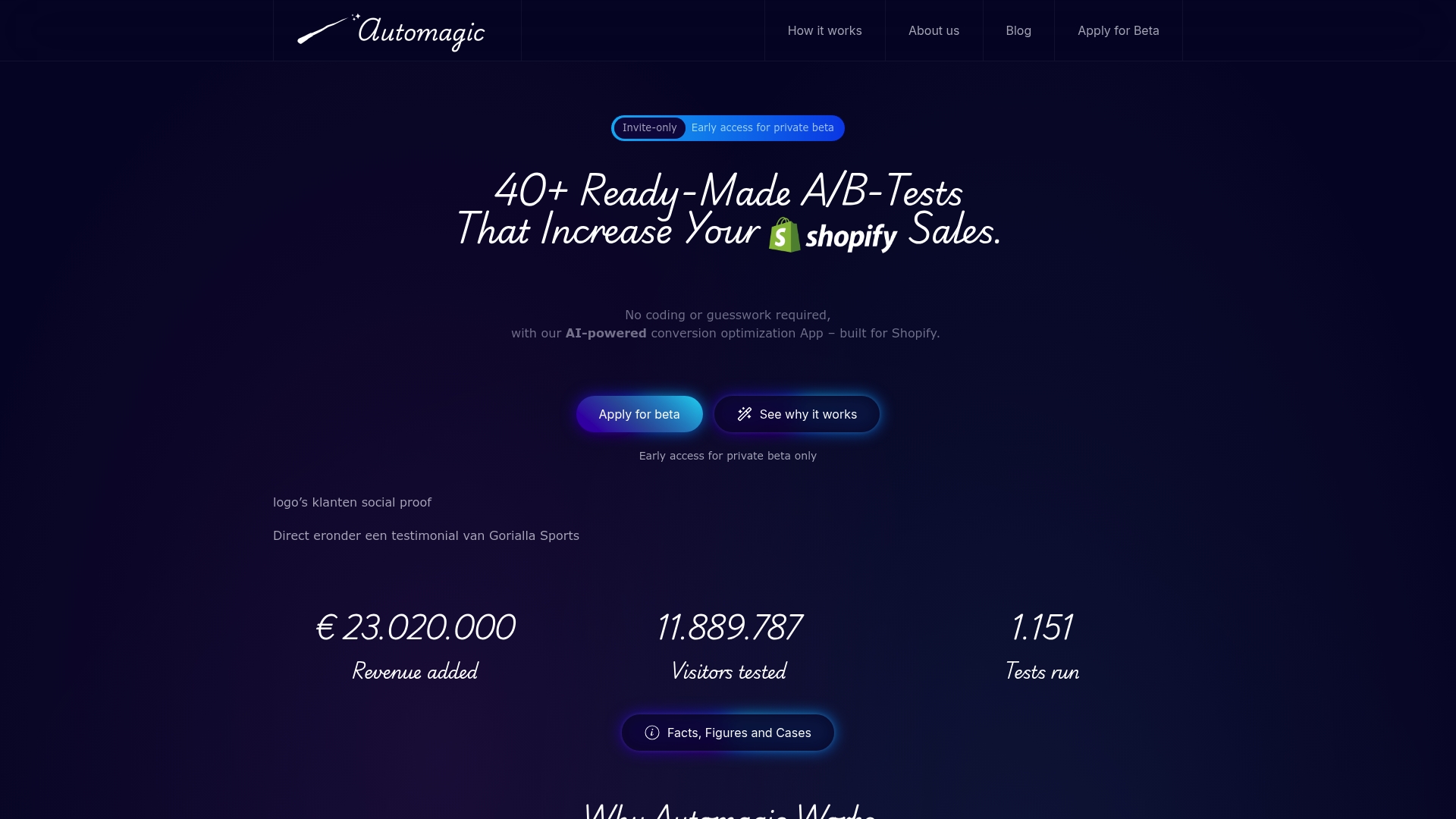
Experience the ease and power of automated personalization customized to your unique store. Visit Automagic.li now to start applying high-impact A/B tests, gain actionable insights, and drive measurable sales increases with no hassle. Take that smart step to transform browsers into loyal customers before your competitors do.
Frequently Asked Questions
How can I choose high-impact A/B tests for my Shopify store?
Start by selecting tests from a ready-made library tailored for Shopify stores. Focus on variations such as product page layouts and call-to-action button designs that align with your audience preferences, and implement 2-3 tests at a time for effective monitoring.
What AI tools can I use to automate improvements in my Shopify store?
Integrate AI-powered tools that offer features like personalized product recommendations and dynamic content presentation. Start with one or two key features, and measure their impact over the next few weeks to fine-tune your approach.
What data metrics should I track for conversion rate optimization?
Monitor critical metrics such as conversion rate, average order value, and cart abandonment rate. Create a monthly dashboard to visualize trends and identify areas for improvement to enhance your store’s overall performance.
How can I effectively use social proof to increase trust with my customers?
Incorporate authentic customer reviews and testimonials prominently on your product pages. Regularly update this content to showcase recent interactions, which can help build credibility and trust among potential buyers.
What elements should I focus on when optimizing product pages?
Concentrate on creating clear calls to action, using high-contrast button colors and persuasive wording. Test different button designs and placements, aiming for a conversion increase of at least 15% with each iteration.
How do I implement a successful A/B testing framework for my Shopify store?
To implement A/B testing, start by testing multiple variations of key elements like headlines and button colors simultaneously. Maintain a consistent testing schedule, tracking results for statistical significance to understand which changes positively impact conversion rates.