
Shopify Optimization Strategies: Maximize Store Conversions
Over 70 percent of American shoppers will leave a slow or confusing online store before making a purchase. For store owners, this means every detail on your Shopify site can make or break a sale. Clear optimization strategies help American entrepreneurs turn more visitors into paying customers without guesswork. Discover how focusing on speed, personalization, streamlined checkouts, and trust-building elements translates to higher conversion rates and more loyal shoppers.
Table of Contents
- Defining Shopify Optimization Strategies Clearly
- Leveraging AI‑Powered Personalization
- Speed, Mobile & Technical Performance
- Streamlined Checkout And Payment Options
- Trust Signals, Social Proof And Urgency
- Data‑Driven A/B Testing Strategies
Key Takeaways
| Point | Details |
|---|---|
| Optimization Strategies | Comprehensive analysis of website elements is crucial for improving conversion rates and user experience. Continuous measurement and refinement are necessary for success. |
| AI-Powered Personalization | Leveraging AI allows for tailored shopping experiences that enhance customer engagement and conversion through data-driven insights. |
| Technical Performance | Fast loading speeds and mobile optimization are key to retaining customer interest and improving search engine rankings. |
| Trust Signals | Implementing trust signals, such as customer reviews and security badges, builds customer confidence and reduces purchase hesitation. |
Defining Shopify Optimization Strategies Clearly
Shopify optimization strategies represent systematic approaches designed to enhance online store performance, focusing specifically on improving conversion rates and user experience. At their core, these strategies involve methodically analyzing and refining different elements of an ecommerce website to drive more sales and increase customer engagement. Conversion optimization goes beyond simple design tweaks, requiring a comprehensive understanding of user behavior, technical performance, and strategic improvements.
Successful optimization involves multiple critical components, including website speed, product page design, checkout process efficiency, and strategic A/B testing. Conversion tracking plays a pivotal role in understanding how different modifications impact store performance. Store owners must collect and analyze data systematically, identifying precise areas where incremental changes can yield significant revenue improvements. These strategies demand a combination of technical knowledge, user experience design principles, and data-driven decision making.
The most effective Shopify optimization approaches typically include several key tactics: improving page load speeds, creating compelling product descriptions, optimizing mobile responsiveness, simplifying navigation, and implementing trust signals like customer reviews and secure payment icons. A/B testing provides a structured method for systematically evaluating which design and content modifications generate the most significant improvements. By continuously testing and refining different elements of their online store, Shopify entrepreneurs can incrementally boost their conversion rates and overall store performance.
Ultimately, Shopify optimization is an ongoing process that requires consistent attention, measurement, and strategic refinement. Successful store owners recognize that optimization is not a one-time task but a continuous journey of understanding customer behavior, testing hypothetical improvements, and adapting to changing market dynamics. The most successful strategies combine technical precision with creative problem-solving, always keeping the end goal of creating a seamless, compelling shopping experience for potential customers.
Leveraging AI‑Powered Personalization
AI-powered personalization represents a transformative approach for Shopify stores to create highly targeted, individualized shopping experiences that dramatically improve conversion rates. By leveraging advanced machine learning algorithms, ecommerce platforms can now analyze vast amounts of customer data to predict preferences, customize product recommendations, and deliver precisely tailored interactions. Personalization technology enables stores to move beyond generic marketing approaches, creating dynamic experiences that feel uniquely crafted for each individual customer.
The core strength of AI personalization lies in its ability to process complex data sets and generate insights faster than traditional methods. Automagic’s platform demonstrates how AI can transform conversion strategies, enabling store owners to implement sophisticated personalization techniques without requiring extensive technical expertise. These intelligent systems can track customer browsing patterns, purchase history, and contextual behaviors to generate real-time recommendations that feel intuitive and relevant. Key personalization strategies include dynamically adjusting product displays, creating individualized email marketing campaigns, and presenting customized pricing or promotional offers based on specific customer segments.
Successful AI-powered personalization strategies typically involve several critical components: advanced customer segmentation, predictive recommendation engines, behavioral tracking, and contextual content adaptation. Shopify stores can leverage these technologies to create micro-targeted experiences that significantly enhance user engagement. For instance, an AI system might recognize that a customer frequently purchases outdoor equipment and automatically highlight related products, adjust website messaging, or provide specialized discount offers that align with their demonstrated interests. These nuanced, intelligent interactions transform standard ecommerce transactions into memorable, individualized shopping journeys.
Ultimately, AI-powered personalization represents more than just a technological innovation – it’s a fundamental reimagining of how online stores interact with customers. By treating each visitor as a unique individual with specific preferences and needs, Shopify entrepreneurs can create more meaningful connections, increase customer loyalty, and drive substantial improvements in conversion rates. The most successful implementations will balance sophisticated technological capabilities with a genuine understanding of human behavior, creating experiences that feel both intelligent and authentically personal.
Speed, Mobile & Technical Performance
Technical performance represents a critical foundation for successful Shopify stores, directly impacting user experience, search engine rankings, and ultimately, conversion rates. Modern ecommerce platforms demand lightning-fast loading speeds, seamless mobile responsiveness, and robust technical infrastructure that can handle complex user interactions. Website performance goes far beyond simple page load times, encompassing a holistic approach to creating smooth, intuitive digital shopping experiences across multiple devices and connection types.
Web performance optimization techniques are essential for creating high-converting Shopify stores. These strategies involve multiple interconnected technical elements, including image compression, minimizing server response times, leveraging browser caching, and implementing efficient content delivery networks. Mobile optimization has become particularly crucial, with over 70% of ecommerce traffic now originating from smartphones and tablets. Store owners must ensure their websites deliver equally exceptional experiences across desktop and mobile platforms, with responsive designs that adapt seamlessly to different screen sizes and resolutions.

Accessibility guidelines provide critical frameworks for technical performance that extend beyond traditional speed metrics. These comprehensive standards ensure websites are not just fast, but also usable for individuals with diverse technological capabilities and potential disabilities. Key technical performance considerations include reducing unnecessary script loading, implementing lazy loading for images, utilizing modern image formats like WebP, and creating clear, navigable page structures. Shopify store owners should focus on creating technically robust websites that balance aesthetic appeal with exceptional functional performance, recognizing that even milliseconds of load time can significantly impact user engagement and conversion rates.
Ultimately, technical performance represents an ongoing optimization process rather than a one-time achievement. Successful Shopify stores continuously monitor and refine their technical infrastructure, using advanced analytics tools to identify potential bottlenecks and performance opportunities. By adopting a proactive approach to technical optimization, store owners can create digital experiences that feel instantaneous, trustworthy, and professionally crafted, ultimately transforming casual browsers into committed customers.
Streamlined Checkout And Payment Options
Checkout optimization represents a critical strategic element for Shopify stores, directly impacting conversion rates and overall customer satisfaction. The checkout process serves as the final and most crucial interaction between a potential customer and an online store, where even minor friction can result in significant revenue loss. Checkout experience encompasses more than just transactional mechanics – it represents the culmination of a store’s entire user journey, requiring meticulous design and strategic implementation to minimize abandonment and maximize completed purchases.
Checkout usability research reveals that complex, time-consuming payment processes can dramatically reduce conversion rates. Successful Shopify stores implement streamlined checkout strategies that prioritize simplicity, transparency, and multiple payment options. Key optimization techniques include reducing form fields, offering guest checkout capabilities, providing clear progress indicators, and supporting diverse payment methods such as credit cards, digital wallets, and alternative payment platforms. By eliminating unnecessary steps and creating intuitive navigation, stores can significantly decrease cart abandonment rates and improve overall customer conversion.
Modern checkout optimization demands a sophisticated approach that balances technical efficiency with user-friendly design. Shopify entrepreneurs should focus on implementing multiple payment gateways, ensuring secure transaction processing, and creating visually clean checkout interfaces that inspire customer confidence. Critical elements include displaying trust signals like security badges, offering transparent shipping cost calculations, providing multiple payment method choices, and enabling quick account creation or guest checkout options. Stores that successfully reduce cognitive load during the final purchase stage can transform hesitant browsers into committed customers.
Ultimately, checkout optimization is an ongoing process of continuous refinement and adaptation. Successful Shopify stores recognize that payment processes must evolve continuously, responding to changing consumer preferences, emerging payment technologies, and shifting expectations around digital transactions. By treating the checkout experience as a dynamic, customer-centric interaction rather than a static transactional endpoint, store owners can create seamless purchase journeys that feel effortless, trustworthy, and aligned with modern consumer expectations.
Trust Signals, Social Proof And Urgency
Building customer trust represents a fundamental challenge for Shopify stores operating in an increasingly competitive digital marketplace. Trust signals function as critical psychological mechanisms that transform uncertain online interactions into confident purchasing decisions. These strategic elements go beyond simple visual cues, representing complex psychological tools that reassure potential customers about product quality, store reliability, and transaction safety.
Effective trust signals encompass multiple strategic approaches, including customer reviews, security badges, transparent return policies, and verifiable social proof. Automagic’s conversion optimization platform demonstrates how carefully implemented trust mechanisms can significantly improve customer confidence. Visual elements like verified purchase indicators, real-time customer testimonials, and third-party certification logos create immediate credibility. Urgency tactics such as limited-time offers, stock scarcity notifications, and countdown timers further enhance conversion potential by creating a sense of time-sensitive opportunity.
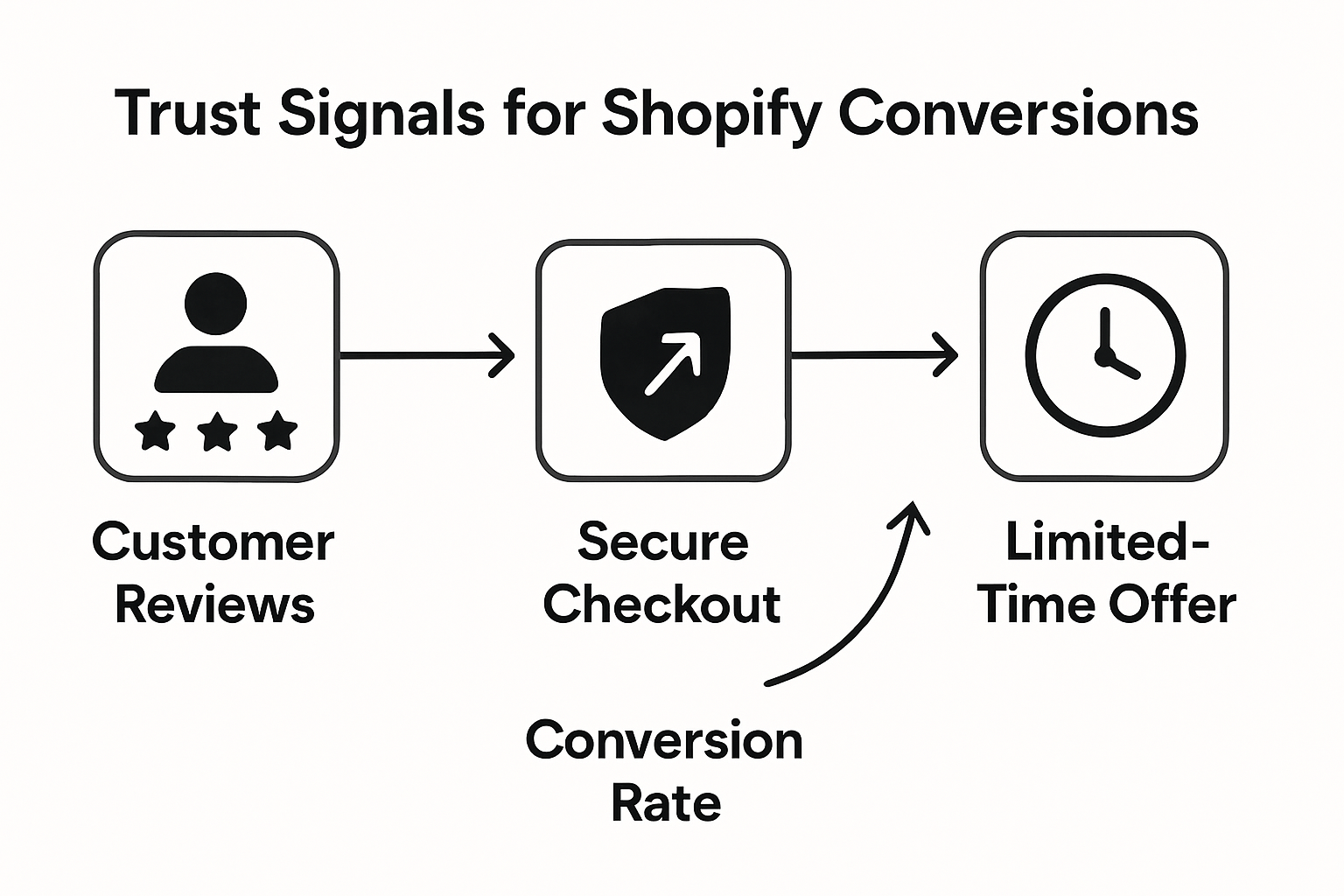
Shopify store owners can strategically deploy trust signals through several key methods: displaying detailed customer reviews, showcasing professional certifications, highlighting secure payment icons, sharing transparent shipping information, and presenting clear, comprehensive product details. Advanced techniques include featuring user-generated content, displaying real-time purchase notifications, and integrating social media verification. By creating a holistic ecosystem of trust signals, stores can transform hesitant browsers into confident purchasers, reducing friction in the buying process and creating a sense of reliability that transcends traditional transactional relationships.
Ultimately, trust-building represents an ongoing, dynamic process of communication and validation. Successful Shopify entrepreneurs recognize that modern consumers demand authenticity, transparency, and social validation before committing to a purchase. By continuously refining trust signals, responding to customer feedback, and maintaining a consistently professional online presence, stores can create digital environments that feel safe, credible, and genuinely customer-focused.
Data‑Driven A/B Testing Strategies
Data-driven A/B testing represents a sophisticated approach to conversion optimization, enabling Shopify store owners to make strategic decisions based on empirical evidence rather than intuition. A/B testing methodology transforms website optimization from guesswork into a precise, measurable science, allowing entrepreneurs to systematically improve their online store’s performance. By comparing two distinct versions of a webpage, store owners can identify exactly which design elements, copy, and user experience modifications generate the most significant conversion improvements.
Shopify A/B testing strategies require a structured approach that goes beyond simple random variations. Successful testing involves creating hypotheses based on user behavior data, designing controlled experiments, and implementing statistically significant variations. Key elements include selecting the right metrics, determining appropriate sample sizes, establishing clear testing durations, and understanding how different page elements impact user decision-making. Store owners should focus on testing critical conversion components such as product descriptions, pricing displays, call-to-action buttons, image selections, and overall page layouts.
Effective A/B testing demands a comprehensive strategy that addresses multiple aspects of store performance. Advanced testing libraries provide ready-made variations that can be quickly deployed across different store elements. Successful Shopify entrepreneurs approach A/B testing as an ongoing process of incremental improvement, systematically collecting data, analyzing results, and implementing validated changes. Critical testing areas include checkout process optimization, product page design, mobile responsiveness, pricing strategies, and promotional messaging. By maintaining a disciplined, data-driven approach, stores can continuously refine their user experience and incrementally improve conversion rates.
Ultimately, data-driven A/B testing represents more than a technical exercise – it’s a fundamental approach to understanding customer behavior and preferences. Successful store owners recognize that continuous testing is not about finding a single perfect solution, but about creating a dynamic, adaptive approach to digital commerce. By embracing a culture of experimentation, leveraging advanced testing technologies, and maintaining a rigorous commitment to data analysis, Shopify entrepreneurs can transform their stores into highly optimized, customer-centric digital experiences that consistently deliver improved performance.
Unlock Your Shopify Store’s Full Potential with AI‑Powered Optimization
Many Shopify entrepreneurs struggle with converting visits into sales due to challenges like slow checkout, unclear trust signals, and guesswork-driven website changes. This article highlights key pain points such as the critical need for data-driven A/B testing, streamlined checkout experiences, and personalized user journeys. If you seek to maximize conversions without the headache of complex coding or hiring developers, understanding and applying proven Shopify optimization strategies is essential.
Automagic.li offers a powerful solution tailored to these exact needs by delivering an AI-powered A/B testing platform designed specifically for Shopify stores. With a comprehensive library of over 40 pre-tested test variations, the platform automates test deployment and customization using artificial intelligence. This means you can effortlessly improve product pages, checkout flows, and trust signals based on real data rather than guesswork. Empower your store with faster, smarter optimization that grows revenue and builds customer confidence.
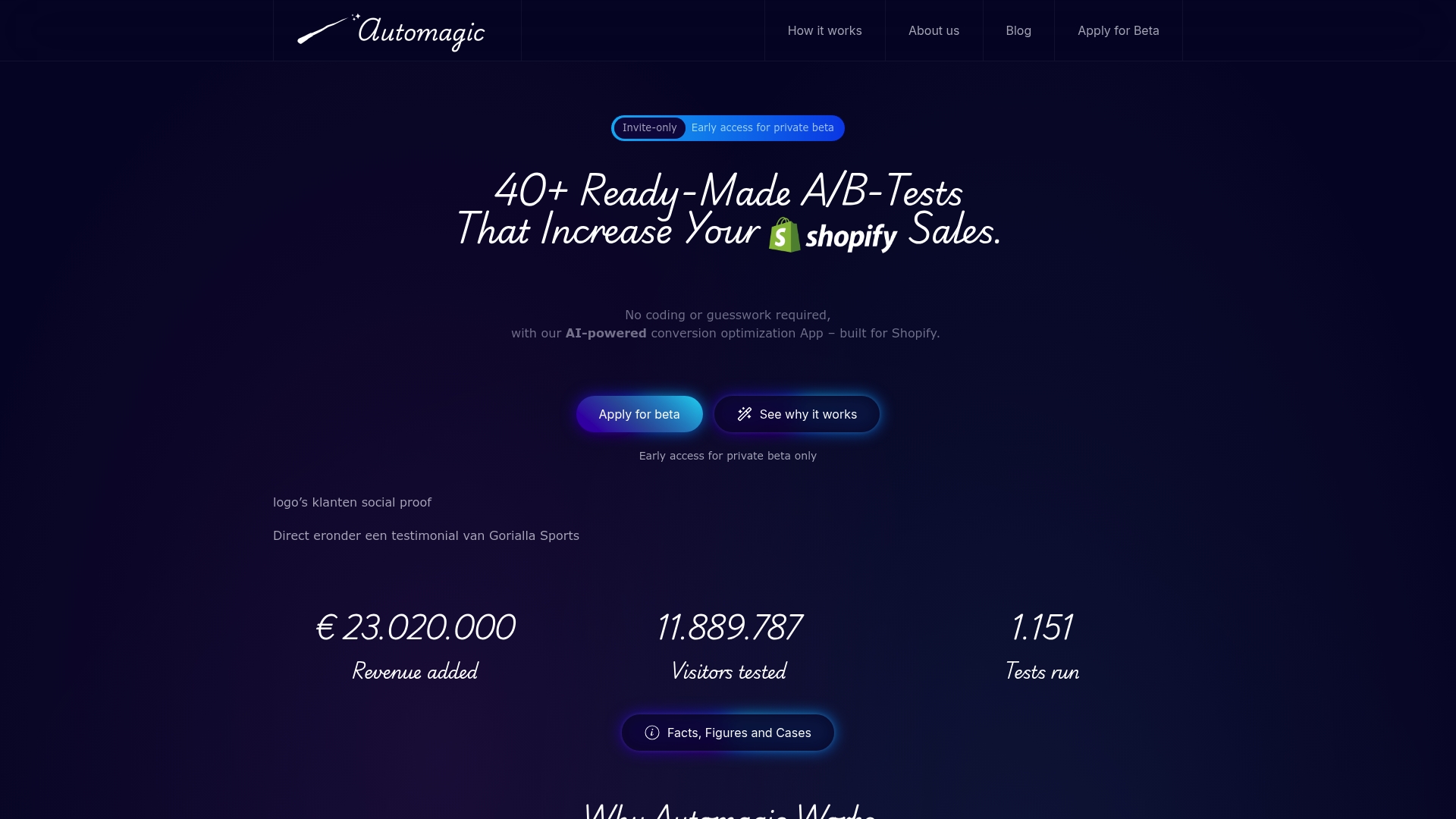
Take control of your Shopify conversion rate today by visiting Automagic.li. Start leveraging AI-driven personalization and seamless A/B testing to transform hesitant shoppers into loyal customers. Don’t wait for lost sales to add up. Act now, optimize continuously, and watch your ecommerce business thrive.
Frequently Asked Questions
What are some effective Shopify optimization strategies to improve conversions?
Effective Shopify optimization strategies include improving website speed, enhancing product page design, streamlining the checkout process, implementing AI-powered personalization, and conducting A/B testing to evaluate changes.
How does AI-powered personalization enhance the shopping experience on Shopify?
AI-powered personalization enhances the shopping experience by analyzing customer data to provide tailored product recommendations, individualized email marketing, and customized promotional offers, making interactions feel uniquely crafted for each visitor.
Why is technical performance crucial for a successful Shopify store?
Technical performance is crucial because it impacts user experience, search engine rankings, and conversion rates. Key factors include fast loading speeds, mobile responsiveness, and robust infrastructure to ensure seamless user interactions.
What role do trust signals and social proof play in enhancing conversions?
Trust signals and social proof build customer confidence by validating product quality and store reliability. Effective use of customer reviews, security badges, and urgency tactics can significantly reduce frictions and increase purchase completion rates.