
What Is Revenue Attribution and Why It Matters
Running a Shopify store can feel overwhelming when you do not know which marketing efforts are actually driving sales. Successful eCommerce depends on more than just clicks or page views. By understanding revenue attribution, you can finally track how different emails, ads, or social posts connect to your store’s revenue. This introduction cuts through confusion, making it easier to see what works and where to invest for real growth.
Table of Contents
- Defining Revenue Attribution In eCommerce
- Popular Attribution Models For Shopify Stores
- How Revenue Attribution Powers Data-Driven Decisions
- Risks And Common Pitfalls For Store Owners
- Comparing Revenue Attribution Tools And Methods
Key Takeaways
| Point | Details |
|---|---|
| Understanding Revenue Attribution | Revenue attribution tracks which marketing channels contribute to sales, helping businesses make informed marketing investments. |
| Evaluating Attribution Models | Shopify store owners should consider various attribution models, such as time decay and data-driven, to accurately assess customer interactions. |
| Integrating Data Sources | Combining online and offline data sources is essential to avoid data fragmentation and develop a holistic view of customer journeys. |
| Avoiding Common Pitfalls | Implementing multi-touch attribution and recognizing early customer interactions can help prevent misallocation of marketing resources. |
Defining Revenue Attribution in eCommerce
Revenue attribution is the strategic process of tracking and analyzing which marketing channels, touchpoints, and customer interactions contribute directly to generating sales revenue. In the competitive world of eCommerce, understanding revenue attribution helps businesses make data-driven decisions about where to invest their marketing resources and optimize their sales strategies.
At its core, revenue attribution allows online store owners to trace customer journeys through complex marketing channels. Instead of relying on isolated metrics like page views or click-through rates, this approach connects specific marketing efforts with actual revenue outcomes. This means you can pinpoint exactly which ads, emails, social media posts, or search campaigns are driving real financial results for your business.
The primary goals of revenue attribution in eCommerce include:
- Identifying the most effective marketing channels
- Understanding customer interaction patterns
- Allocating marketing budgets more strategically
- Calculating precise return on investment (ROI)
- Optimizing conversion paths
Modern revenue attribution goes beyond simple last-click tracking. It provides a comprehensive view of the entire customer journey, recognizing that purchases often result from multiple interactions across different platforms. By mapping these touchpoints, businesses can create more nuanced and effective marketing strategies that address customer needs at every stage of the buying process.
Pro tip: Start tracking your marketing channel performance with granular attribution models to uncover hidden revenue opportunities and optimize your marketing spend more effectively.
Popular Attribution Models for Shopify Stores
Shopify store owners have several powerful attribution models to choose from when analyzing their marketing performance. Marketing attribution models help merchants understand complex customer journeys by assigning credit to different touchpoints throughout the purchasing process. These models provide critical insights into which marketing channels and interactions are most effective at driving sales.
The most common attribution models used by Shopify stores include:
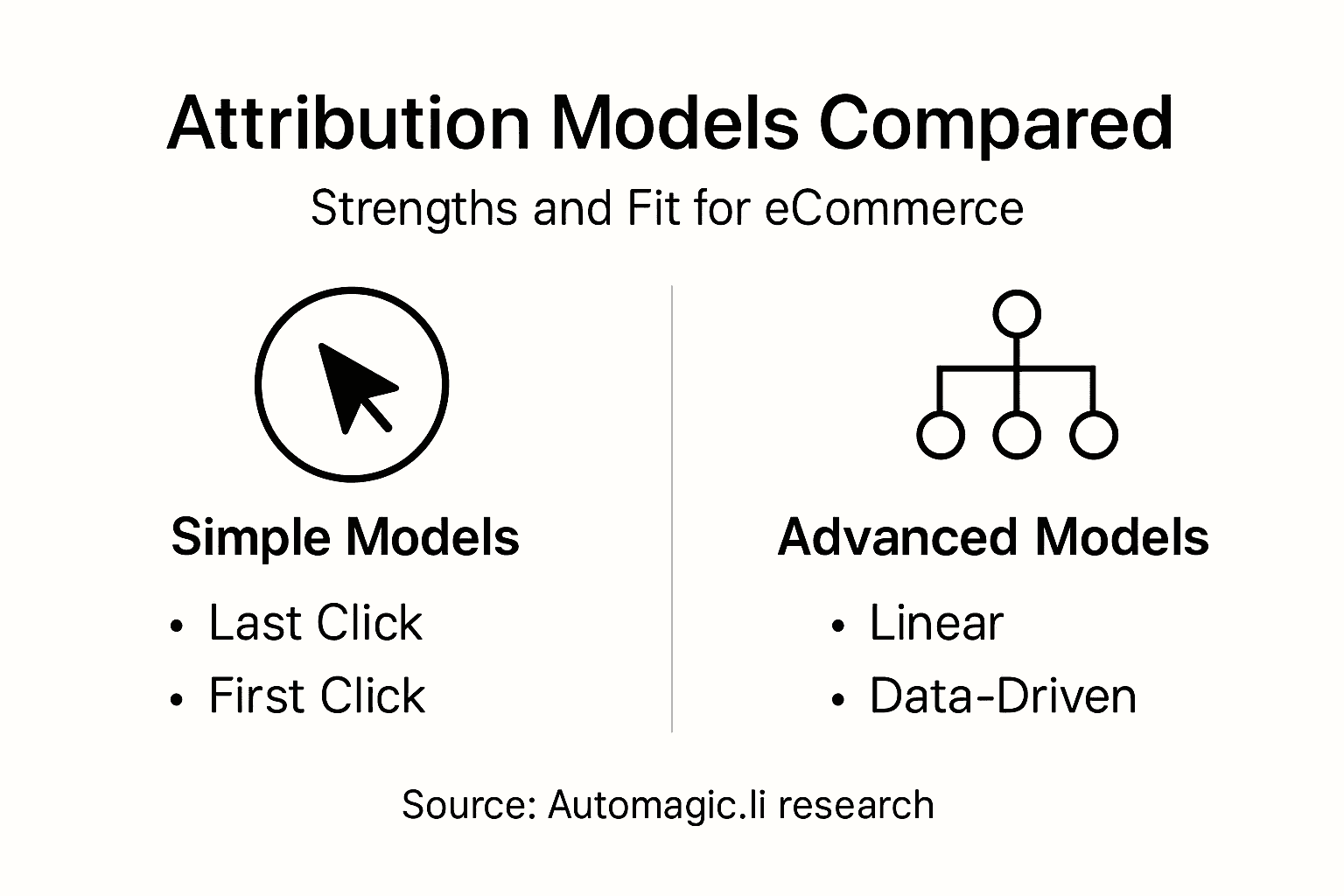
- Last Click Attribution: Credits the final touchpoint before purchase
- First Click Attribution: Gives full credit to the initial customer interaction
- Linear Attribution: Distributes credit equally across all touchpoints
- Time Decay Attribution: Assigns more credit to interactions closer to the purchase
- Position-Based Attribution: Allocates credit with more weight to first and last interactions
Each attribution model offers unique advantages depending on your specific business goals. Last click attribution is straightforward but may oversimplify the customer journey, while more sophisticated models like time decay provide a nuanced view of how different marketing efforts contribute to conversions. Advanced Shopify stores often use multiple models simultaneously to gain comprehensive insights into their marketing performance.
Here’s a quick comparison of common attribution models and their ideal use case:
| Model Type | Best For | Complexity |
|---|---|---|
| Last Click | Quick performance checks | Low |
| First Click | Brand awareness campaigns | Low |
| Linear | Multi-channel campaigns | Medium |
| Time Decay | Frequent, recurring touchpoints | Medium |
| Position-Based | Balancing acquisition and conversion | Medium |
| Data-Driven | Stores with large, complex datasets | High |
Data-driven attribution models represent the most advanced approach, using machine learning algorithms to dynamically assign credit based on actual conversion patterns. These models continuously adapt, providing increasingly accurate insights into which marketing channels and specific campaigns are generating the most revenue for your store.
Pro tip: Experiment with different attribution models to uncover hidden marketing insights and optimize your Shopify store’s conversion strategy.
How Revenue Attribution Powers Data-Driven Decisions
Revenue attribution transforms raw marketing data into actionable insights that drive strategic business decisions. Analytical methodologies connect consumer behavior with revenue outcomes, enabling businesses to make precise, data-driven choices that directly impact profitability. This approach goes far beyond simple number tracking, offering a comprehensive view of how different marketing efforts contribute to overall business performance.
The key components of data-driven decision-making through revenue attribution include:
- Identifying most profitable marketing channels
- Measuring true return on marketing investment
- Understanding complex customer interaction patterns
- Optimizing budget allocation across marketing efforts
- Predicting future revenue potential
- Revealing hidden marketing performance insights
By leveraging advanced attribution models, businesses can move from guesswork to strategic planning. These models help break down the entire customer journey, revealing which touchpoints have the most significant impact on conversions. This granular understanding allows marketers to allocate resources more effectively, focusing on channels and strategies that generate the highest revenue.

Modern revenue attribution goes beyond traditional metrics by incorporating machine learning and predictive analytics. These advanced techniques can forecast potential revenue streams, identify emerging trends, and provide real-time insights that enable businesses to adapt their strategies quickly. The result is a more agile, responsive approach to marketing that continuously optimizes performance and drives sustainable growth.
Pro tip: Implement a multi-touch attribution model that tracks customer interactions across all channels to gain a comprehensive view of your marketing performance.
Risks and Common Pitfalls for Store Owners
Shopify store owners face significant challenges when implementing revenue attribution strategies. Common attribution pitfalls can lead to misleading marketing insights, potentially causing substantial financial miscalculations and ineffective resource allocation. Understanding these risks is crucial for maintaining an accurate and reliable approach to tracking marketing performance.
The most critical risks and pitfalls include:
- Over-relying on single-click attribution models
- Failing to integrate online and offline data sources
- Neglecting cost data in attribution calculations
- Inconsistent tracking across different marketing channels
- Ignoring early-stage customer interactions
- Not accounting for cross-channel customer journeys
Many store owners inadvertently create data blind spots by using simplistic attribution approaches. Last-click models, for instance, can dramatically undervalue earlier marketing touchpoints that initially sparked customer interest. This myopic view can lead to cutting potentially effective marketing channels that actually play a crucial role in the overall conversion process.
Advanced attribution requires a holistic approach that captures the entire customer journey. Store owners must develop robust tracking systems that provide transparent, comprehensive insights into how different marketing efforts contribute to revenue. This means moving beyond basic metrics and creating a nuanced understanding of customer interactions that considers the complex, multi-touchpoint nature of modern eCommerce purchasing decisions.
This table summarizes key challenges in revenue attribution and smart strategies to overcome each:
| Challenge | Smart Solution |
|---|---|
| Data fragmentation | Integrate analytics platforms |
| Overvaluing single touchpoints | Use multi-touch attribution |
| Ignoring offline sources | Combine online/offline data |
| Inconsistent tracking | Standardize tagging and UTM usage |
| Budget misallocation | Review attribution data regularly |
| Underestimating early stages | Value initial customer actions |
Pro tip: Implement a multi-touch attribution model that weights different customer interactions based on their proven impact on final conversions.
Comparing Revenue Attribution Tools and Methods
Revenue attribution tools have evolved dramatically, offering Shopify store owners increasingly sophisticated methods for tracking marketing performance. Comparative studies reveal diverse approaches to attribution modeling, ranging from simple heuristic models to advanced machine learning techniques that provide nuanced insights into customer journeys.
The primary attribution models can be categorized into several key types:
- Last-Click Attribution: Simplest method, crediting final touchpoint
- First-Click Attribution: Emphasizes initial customer interaction
- Linear Attribution: Distributes credit equally across touchpoints
- Time Decay Attribution: Weights recent interactions more heavily
- Position-Based Attribution: Allocates more credit to first and last interactions
- Data-Driven/Algorithmic Attribution: Uses machine learning to dynamically assign credit
Each attribution method comes with unique strengths and limitations. Simplistic single-touch models like last-click provide easy implementation but often miss the complexity of modern customer journeys. In contrast, multi-touch and machine learning models offer more comprehensive insights but require more sophisticated tracking and computational resources.
Advanced attribution tools now incorporate predictive analytics and privacy-compliant tracking mechanisms. These sophisticated solutions go beyond traditional tracking, using complex algorithms to understand not just where conversions happen, but why they happen. By analyzing intricate patterns of customer interactions, these tools help store owners make more informed marketing decisions and optimize their overall revenue strategies.
Pro tip: Select an attribution tool that offers flexibility in model selection and can adapt to your specific business’s unique customer interaction patterns.
Unlock the Full Potential of Revenue Attribution with Automagic.li
Revenue attribution reveals the true impact of every marketing touchpoint in your Shopify store’s customer journey. If you struggle with data fragmentation, inaccurate ROI calculations, or identifying high-impact conversion levers, you need a powerful solution that turns insight into action. Automagic.li combines AI-powered A/B testing with easy-to-deploy, pre-configured experiments designed specifically for Shopify merchants aiming to optimize conversions based on proven revenue impact.
Take control of your revenue attribution insights and convert them into real growth today. With Automagic.li, you get a library of over 40 high-impact test variations that require no coding and adapt intelligently to your store design. Start making data-driven decisions that optimize budgets and improve marketing ROI without the guesswork. Visit Automagic.li now to see how effortless conversion optimization can be when powered by AI and tailored for Shopify’s unique customer journeys.
Explore more about turning attribution models into actionable improvements with Automagic.li’s AI-driven testing platform. Don’t let hidden conversion opportunities slip away before your competition finds them.
Frequently Asked Questions
What is revenue attribution?
Revenue attribution is the process of tracking and analyzing which marketing channels, touchpoints, and customer interactions contribute to generating sales revenue in eCommerce.
Why is revenue attribution important for eCommerce businesses?
Revenue attribution helps businesses make data-driven decisions about marketing investments, optimize sales strategies, and identify the most effective marketing channels that drive revenue.
What are some common models used in revenue attribution?
Common attribution models include Last Click Attribution, First Click Attribution, Linear Attribution, Time Decay Attribution, and Position-Based Attribution, each offering different methods for allocating credit to marketing touchpoints.
How can businesses implement revenue attribution effectively?
Businesses can implement revenue attribution effectively by using a multi-touch attribution model to capture the entire customer journey, integrating various data sources, and standardizing tracking methods across marketing channels.