
Role of Testimonials in Conversions for Shopify Stores
Choosing the right approach to win customer trust often feels risky for Shopify store owners who want results without complex tools. Faced with uncertainty and competition, store visitors hesitate to buy until they see proof that someone else took the leap and succeeded. Authentic user testimonials and strategic social proof address those doubts by showing real experiences and outcomes, helping you turn browsers into buyers. Discover how these proven methods can build credibility and increase conversions while keeping things simple.
Table of Contents
- Defining Testimonials And Social Proof
- Types Of Testimonials That Drive Conversions
- How Testimonials Influence Buyer Psychology
- Strategic Placement For Maximum Impact
- Common Pitfalls When Using Testimonials
- Measuring The Conversion Impact Of Testimonials
Key Takeaways
| Point | Details |
|---|---|
| Importance of Testimonials | Authentic customer testimonials significantly reduce perceived risk and influence purchase decisions by providing relatable evidence of product effectiveness. |
| Types of Effective Testimonials | Detailed case studies and video testimonials are most impactful as they provide concrete proof and build emotional connections with potential buyers. |
| Strategic Placement | Testimonial placement should address specific customer doubts at critical moments in their journey, such as product pages and checkout. |
| Measuring Impact | Implement A/B testing and track metrics like conversion rates and click-throughs to quantify the effect of testimonials on sales. |
Defining Testimonials and Social Proof
When a potential customer visits your Shopify store, they’re making a decision under uncertainty. They don’t know if your product will actually solve their problem, if the quality matches the price, or if they can trust you as a seller. This is where testimonials and social proof become powerful forces in driving conversions. At their core, testimonials are authentic statements from real customers sharing their experiences with your product or service. They’re not marketing claims written by your team—they’re unfiltered feedback from people who have already made the purchase and can vouch for your business. Social proof, on the other hand, is the broader psychological concept that influences how people make decisions. The core idea is simple: when people are uncertain about something, they look to what others have done or said to guide their own choices. The psychological tendency to rely on others’ behaviors especially in ambiguous situations, shapes consumer decisions more than most store owners realize.
Think of it this way. Imagine walking into a restaurant you’ve never been to before. The dining room is empty except for one table of happy customers enjoying their meals. You’d likely feel more confident sitting down and ordering. That visual proof of satisfaction makes the decision easier. Now flip that scenario: the same restaurant is completely empty, no one eating, no signs of other customers. Suddenly, doubt creeps in. Online shopping creates this same dynamic, except your customers can’t see the happy diners in your “restaurant.” They can’t feel the energy of satisfied buyers. Testimonials solve this by creating that social proof digitally. They reassure new visitors that real people have already taken the leap and come out happy on the other side.
What makes testimonials so effective is that they reduce perceived risk and uncertainty in purchasing decisions through authentic, relatable evidence. When someone reads a detailed review from a customer who faced a similar problem and found your product solved it, their brain treats that as stronger evidence than any marketing copy your team could write. The customer review feels honest because it often includes specific details—the exact problem solved, how long it took, whether it was worth the price. These details make the testimonial credible. A generic statement like “Great product!” carries almost no weight. But a review like “I couldn’t find a tool that worked with my custom theme until this. Setup took 20 minutes, and sales increased within a week” provides the kind of concrete, relatable proof that moves people from browsing to buying.
For Shopify store owners, understanding this distinction matters because it shapes how you collect, display, and use testimonials. You’re not just gathering nice words to put on your website. You’re building a system that demonstrates to skeptical visitors that your store delivers results. The best testimonials tell a story—they show a real person with a real problem discovering your solution and experiencing real benefits. This narrative structure is what makes social proof work. Without it, testimonials become background noise, just another generic sales tactic. With it, they become conversion drivers that speak louder than any discount offer or sales banner ever could.
Pro tip: When requesting testimonials from customers, ask specific questions about the problem they faced before purchasing and the specific result they achieved afterward. This approach generates detailed, conversion-focused reviews rather than vague praise, making them far more persuasive to store visitors.
Types of Testimonials That Drive Conversions
Not all testimonials are created equal. A single star review that says “Good” carries virtually no weight compared to a detailed case study showing exactly how a customer solved a problem using your product. The type of testimonial you collect and display directly impacts whether visitors trust your store enough to buy. Understanding which types convert best allows you to focus your efforts on gathering the testimonials that actually move the needle on sales. The most effective testimonials share common traits: they feel authentic, they address specific customer concerns, and they come from credible sources. But the format and context matter just as much as the content itself.
Customer reviews and detailed case studies represent two of the most powerful testimonial formats for Shopify stores. Customer reviews are typically short, direct statements from real buyers sharing their experience. They work best when they include specific details like the problem the customer faced, how your product solved it, and measurable results. A review that reads “This tool increased my email list by 340 subscribers in two weeks” converts far better than “Great tool, highly recommend.” Case studies go deeper. They tell a complete story from problem to solution to results, often with screenshots, metrics, or before-and-after data. Case studies require more effort to produce but deliver exponential returns because they reduce buyer uncertainty at every stage of the decision. They show not just that your product works, but exactly how it works and who it works for. Beyond these, various types of testimonials including expert endorsements and influencer testimonials each serve distinct purposes in building credibility across different customer segments.
Video testimonials, star ratings, and user-generated content create different conversion dynamics by triggering distinct psychological responses. Video testimonials carry unusual power because they’re harder to fake. When a real person sits on camera and talks about your product, skeptical visitors find it nearly impossible to dismiss as fabricated marketing. The human face, tone of voice, and genuine emotion create connection that written text alone cannot match. Star ratings and review counts function differently. They work through pattern recognition and social conformity. When potential buyers see that 847 people gave your product five stars, they subconsciously think “this must be good, otherwise this many people wouldn’t agree.” The number matters more than the individual content. User-generated content like customer photos, unboxing videos, or before-and-after images adds authenticity because customers created them without your prompting. These formats feel less like marketing and more like real proof.
What ties these different types together is that specific, relatable, and authentic testimonials connect emotionally with prospects and address common buyer concerns. A Shopify store owner selling a conversion optimization tool needs different testimonials than a seller of luxury goods. A merchant selling fitness products wants video testimonials showing real body transformations. A SaaS seller needs case studies with revenue metrics. The context determines which type works best. Your strategy should involve collecting multiple formats simultaneously. Use short reviews to build social proof quickly and hit the crucial “first impression” moment when visitors land on your store. Use case studies to close hesitant buyers who need detailed proof before committing. Use video testimonials to humanize your brand and stand out from competitors. Combine star ratings and review counts as visual proof that reassures visitors at a glance. When these different types work together, they create a comprehensive proof ecosystem that addresses skepticism at every stage of the buyer journey.
One critical distinction shapes how you should display testimonials: the difference between solicited reviews (you asked the customer for feedback) and unsolicited reviews (customers left feedback without prompting). Unsolicited reviews carry more weight because they appear unbiased. A customer who volunteered a glowing review has no reason to exaggerate. Solicited reviews, while valuable, carry a whisper of “the company might have cherry-picked only the positive ones.” This doesn’t mean you shouldn’t ask for testimonials. It means you should display your unsolicited reviews prominently and use solicited reviews strategically to fill gaps in coverage.
Pro tip: Diversify your testimonial mix by collecting at least three types: short text reviews for volume and social proof, one detailed case study for complex decision-makers, and one video testimonial for emotional connection, then position each type strategically across your product pages based on where visitors hesitate in your sales funnel.
Here’s a comparison of the most common testimonial formats and their impact on conversion:
| Testimonial Format | Key Attributes | Impact on Conversion | Best Use Case |
|---|---|---|---|
| Short Text Review | Concise, highlights problem and benefit | Boosts social proof quickly | Homepage, product pages |
| Detailed Case Study | Narrative, data-rich, before/after details | Reduces buyer uncertainty | Dedicated landing pages |
| Video Testimonial | Human face, tone, emotion | Builds trust, emotional link | Homepage, brand story pages |
| Star Ratings/Counts | Quantitative, immediately scannable | Leverages conformity bias | Across all product pages |
| User-Generated Content | Genuine images or videos from customers | Increases authenticity | Galleries, checkout, social |
How Testimonials Influence Buyer Psychology
Your store visitor is standing at a crossroads. They found your product, they think it might solve their problem, but doubt whispers in their ear. What if it doesn’t work? What if they waste money? What if they buy and regret it immediately? In this moment of uncertainty, testimonials become psychological tools that quiet doubt and move people toward purchase. Understanding exactly how testimonials work inside the buyer’s mind explains why some stores see conversion rates triple after adding strategic testimonials while others see minimal movement. The difference lies in understanding the specific psychological mechanisms at play. When a customer reads a testimonial from someone similar to them, their brain doesn’t just process information—it experiences a vicarious journey. They mentally walk through the problem, the purchase decision, and the positive outcome. This vicarious experience is far more powerful than any sales pitch because it lets the prospect imagine themselves succeeding with your product before they actually buy.
Risk reduction operates as the primary psychological driver behind testimonial effectiveness. Every purchase carries perceived risk. Expensive purchases carry high risk. Purchases from unfamiliar brands carry high risk. Purchases without clear social proof carry high risk. When a prospect sees multiple testimonials from real people saying “I bought this and it worked,” their brain calculates the risk differently. The social proof serves as evidence that risk is lower than they initially thought. This is why a store with fifty detailed customer reviews converts better than an identical store with zero reviews, even if both stores have identical products and pricing. Testimonials activate social proof mechanisms that reduce purchase risk and build trust through the buyer experiencing stories similar to their own situation. The mechanism works because the prospect sees proof that someone in their situation took the risk and came out ahead. This shifts their perception from “Will this work for me?” to “It worked for someone like me, so it probably works.”

A secondary but equally important mechanism is emotional connection and similarity bias. Your brain is wired to trust people similar to itself more readily than strangers. When a testimonial comes from someone who shares your problems, your business model, your industry, or even your personality type, you naturally trust it more. A Shopify store owner reading a testimonial from another store owner saying “This tool added $12,000 to my monthly revenue” experiences a different emotional response than reading a testimonial from someone in a completely different context. The similar situation creates identification. The prospect thinks, “This person faced what I’m facing. They tried this solution. They succeeded. I could succeed too.” This emotional resonance is what separates a testimonial that converts from one that gets skimmed and forgotten. The best testimonials don’t just state facts—they tell stories that let buyers see themselves in the narrative. They describe the specific frustration before purchase, the moment of decision, and the tangible result afterward. This narrative arc engages emotion alongside logic, creating stickier persuasion.
The third psychological layer involves authority bias and perceived credibility. Humans unconsciously assign different weight to information based on the source’s perceived authority or expertise. A testimonial from someone with relevant credentials or demonstrated success carries more weight than an anonymous review. A five-star review from a verified buyer matters more than a five-star review from an unverified account. A case study that includes the customer’s name, company, and measurable metrics creates more authority than a generic positive comment. This is why testimonials reduce skepticism by serving as communal endorsements that mitigate perceived risk especially in high-uncertainty buying scenarios and why store owners see dramatically better conversion results when they pair testimonial content with identifying information about the reviewer. The prospect’s brain processes this information as “a real, identifiable person with something to lose by lying is willing to publicly attach their name to this endorsement.” That simple fact triggers powerful trust mechanisms.
Understanding these psychological layers changes how you should approach gathering and displaying testimonials. Don’t collect generic praise. Collect stories that include the before state, the decision moment, and the measurable after state. Don’t display testimonials randomly. Group them by customer type, industry, or use case so that visitors see testimonials from people similar to themselves. Don’t hide reviewer information. Display names, companies, photos, or video when possible to trigger authority bias. The psychology of testimonials isn’t mysterious. It’s rooted in basic human patterns—people trust people like themselves, people reduce uncertainty by looking at how others solved similar problems, and people assign credibility based on identifiable sources. Master these patterns and your testimonials become conversion machines.
Pro tip: When requesting testimonials, ask customers to mention their specific situation before using your product and the measurable outcome afterward, then prioritize displaying testimonials from customers who match your ideal customer profile on product pages to maximize psychological identification and conversion rates.
Strategic Placement for Maximum Impact
Having powerful testimonials means nothing if they’re hidden where customers never see them. Placement is the difference between testimonials that sit quietly in a reviews section nobody visits and testimonials that actively push hesitant visitors across the finish line into making a purchase. Think about your customer’s journey through your store. They land on your homepage with general interest. They click to a product page with serious intent. They reach the checkout page with their finger hovering over the buy button, wrestling with doubt. Each of these moments represents a friction point where testimonials can either dissolve hesitation or remain invisible. Strategic placement puts the right testimonial at the right moment, directly addressing the specific doubt the customer feels at that exact stage of their journey.
The most impactful placement positions happen near moments of maximum doubt. Your homepage needs testimonials because many visitors are still deciding whether your brand is even worth exploring. A homepage banner featuring a powerful customer quote or star rating creates immediate credibility and reassures visitors that they’re on the right track. Product pages demand testimonials because this is where prospects transition from curiosity to consideration. They want to know specifically whether this product solves their problem. Place detailed testimonials directly below the product description and price, not tucked away in a separate tab. Strategic testimonial placement near calls-to-action and throughout the purchase process reduces hesitation and increases conversions because prospects see proof right when their doubt peaks. Your pricing page or comparison table should include testimonials that address price objections directly. A testimonial like “The price seemed high until I calculated the time saved. Now it’s the best investment I’ve made” speaks directly to the doubt many prospects face. The checkout page represents your final opportunity before purchase. Adding a testimonial carousel or quick review highlight in the final moments before someone completes their order can reduce abandoned carts by addressing last-minute hesitation.
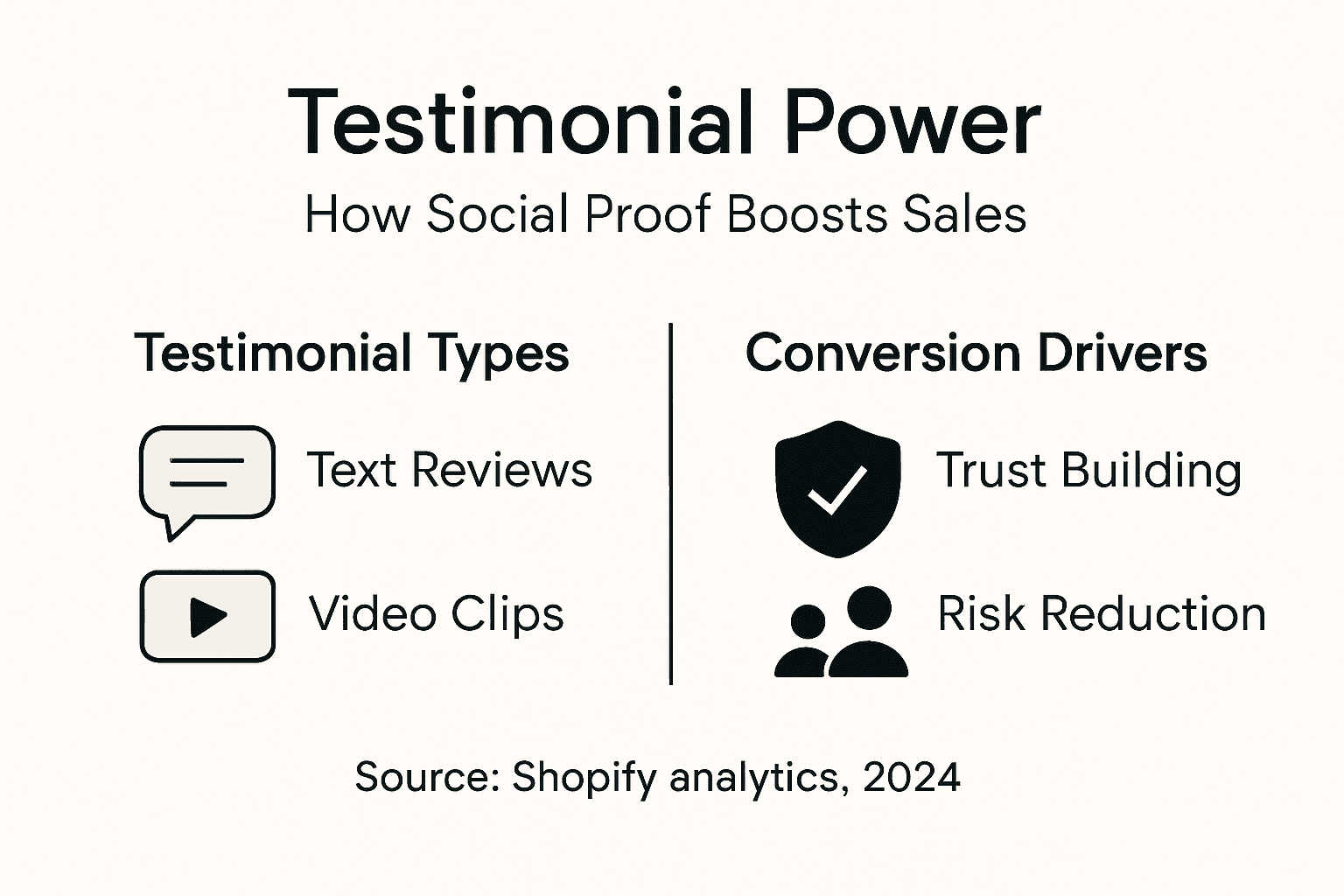
Tactical Placement Strategies Across Your Store
Different pages solve different problems and require different testimonial approaches. Your homepage functions as a trust builder for cold traffic encountering your brand for the first time. Use short, punchy testimonials here that quickly communicate that real customers trust you. Star ratings and review counts work brilliantly on homepages because they’re visually scannable and create instant social proof. Product pages need testimonials that directly address questions about that specific product. Group testimonials by use case or customer type so that visitors see reviews from people in situations similar to their own. If you sell tools for e-commerce store owners, feature testimonials from store owners on product pages, not reviews from marketing agencies or freelancers. The checkout page is sacred real estate. This is where you fight against purchase anxiety and cart abandonment. Short testimonials, star ratings, and customer photos work best here because you have limited attention and must be direct. Trust badges showing review counts and average ratings carry enormous weight in the final moments.
Beyond pages, consider placing testimonials where prospects experience maximum doubt or friction including pricing pages and post-purchase confirmation pages. Your frequently asked questions page should weave testimonials directly into answers. If someone asks “Is this really worth the money,” answer with facts alongside a relevant testimonial from a customer who addressed that exact concern. Email campaigns and abandoned cart sequences offer another critical placement opportunity. A customer who walked away from checkout without completing their purchase may respond to a testimonial email that directly addresses their likely hesitation. These strategic placements work together to create a comprehensive social proof ecosystem that touches prospects at every decision point.
Refresh your testimonials regularly. A testimonial from three years ago feels stale and creates doubt about whether your product still works the same way. Rotate new customer testimonials into key placements quarterly. Vary your testimonial format based on placement. Long-form case studies work on dedicated pages. Short text testimonials work on product pages. Video testimonials create emotional impact on your homepage. Star ratings and review counts work everywhere because they’re universally recognizable trust signals. Align your testimonial selection with the specific conversion goal of each page. A pricing page testimonial should address cost concerns. A product page testimonial should address functionality concerns. A checkout page testimonial should address purchase anxiety. When testimonials speak directly to the doubt that prospect feels at that moment, they become conversion accelerators.
Pro tip: Map your customer journey from homepage through checkout, identify the specific doubt or hesitation at each stage, then deliberately place or create testimonials that directly address that particular concern rather than using generic testimonials randomly across all pages.
Common Pitfalls When Using Testimonials
Testimonials are powerful conversion tools, but they can backfire spectacularly if handled poorly. A fake testimonial discovered by a savvy customer doesn’t just fail to convert. It destroys trust in your entire store. A generic testimonial that says nothing specific feels like marketing manipulation rather than authentic proof. An outdated testimonial from years ago raises questions about whether your product still delivers results. The difference between testimonials that drive conversions and testimonials that repel customers often comes down to avoiding common mistakes that undermine credibility. Many store owners rush into testimonial collection and display without understanding what makes them effective or what makes them fail. Understanding these pitfalls protects your store from the damage that poorly executed testimonials can inflict.
The most damaging pitfall is using fake or unverifiable testimonials. This seems obvious, yet many store owners cut corners by fabricating testimonials, hiring freelancers to write fake reviews, or displaying testimonials from people who never actually used the product. Search engine algorithms and social platforms increasingly flag suspicious review patterns. More importantly, one customer who discovers your fake testimonial will broadcast that discovery on social media, destroying months of trust-building work. Failing to verify authenticity and lack of credible signatories directly undermines consumer trust and reduces testimonial effectiveness. Real testimonials from real customers carry weight precisely because they’re verifiable. A customer can see a name, company, or even a photo and think, “This is a real person willing to attach their reputation to this endorsement.” Fake testimonials have the opposite effect. They create doubt in everything else on your site. The cost of collecting real testimonials is infinitely lower than the cost of being caught faking them.
The second major pitfall is overly generic testimonials that lack specificity. A testimonial that says “Great product, highly recommend” could apply to any store selling anything. It provides zero differentiation and zero proof of actual impact. Prospects scroll past it without processing information because it contains nothing actionable or relatable. Compare that to a specific testimonial: “I was losing customers because my checkout process was too complicated. After implementing this, my cart completion rate jumped from 62% to 79%, which added $8,400 in monthly revenue.” The second testimonial demonstrates specific problems solved and measurable outcomes. Generic testimonials make prospects think your store is so desperate for feedback that you’ll accept anything. Specific testimonials signal that you’re confident in your product and only feature testimonials that prove real value. Over-reliance on overly positive or generic testimonials that lack contextual relevance reduces credibility because they feel inauthentic to experienced buyers who have encountered manipulative marketing.
Other Critical Pitfalls to Avoid
Misaligned testimonials represent another silent killer. You’re selling B2B software to enterprise companies, but your testimonials come from freelancers and small side hustles. You’re selling premium products to high-income customers, but your testimonials emphasize affordability. You’re selling to marketing professionals, but your testimonials are generic praise. These misalignments create subconscious doubt because prospects don’t see proof from people like themselves. A manufacturing company owner reading testimonials from e-commerce sellers won’t feel reassured because the context doesn’t match their situation.
Stale testimonials damage credibility in ways store owners often overlook. A testimonial praising your product from 2021 raises questions. Does your product still work this way? Have you made changes that invalidated these results? A three-year-old testimonial feels like proof you’re not confident enough in your current product to collect fresh feedback. Refresh testimonials quarterly at minimum. Rotate in new customer testimonials, especially from recent purchases where the experience is fresh and current.
Ethical misrepresentation comes in subtle forms. Testimonials that cherry-pick positive outcomes while hiding typical results. Testimonials that overstate impact or misrepresent the effort required. Testimonials that imply guaranteed results when results are actually variable. These create backlash because customers who try your product and experience more modest results feel deceived. The ethical approach builds stronger long-term trust. Display testimonials honestly. Include at least some testimonials that acknowledge limitations or realistic timelines alongside the impressive results.
Pro tip: Always collect testimonials that include the customer’s name, company, specific problem solved, and measurable result, then verify each testimonial independently with the customer before publishing to ensure authenticity and relevance that actually converts visitors.
Here is a summary of common testimonial pitfalls and how to avoid them:
| Pitfall | Why It Harms Credibility | How to Avoid Effectively |
|---|---|---|
| Fake Testimonials | Destroys trust if discovered | Only publish verified, real feedback |
| Generic Praise | Lacks believability and detail | Request specifics, focus on outcomes |
| Outdated Testimonial | Raises doubts about current value | Refresh testimonials each quarter |
| Misaligned Source | Fails to reassure ideal audience | Match testimonial to target segment |
| Overstated Claims | Creates ethical or legal risks | Present balanced, honest experiences |
Measuring the Conversion Impact of Testimonials
You can’t improve what you don’t measure. Many Shopify store owners add testimonials to their site, hope for the best, and never actually track whether those testimonials drive conversions. This is leaving money on the table. Without measurement, you’re flying blind. You don’t know if your testimonials are working, if certain types convert better than others, or where to place them for maximum impact. Measurement transforms testimonials from a guessing game into a data-driven strategy. It tells you exactly which testimonials move the needle on sales and which ones waste valuable page real estate. The good news is that measuring testimonial impact doesn’t require advanced technical skills or expensive tools. It requires understanding which metrics matter and how to isolate testimonial influence from other variables in your store.
The foundational approach to measuring testimonial impact uses A/B testing, which is the gold standard for isolating cause and effect. Here’s how it works: You show one version of a page with testimonials to half your traffic and an identical page without testimonials to the other half. You track conversion rates for both groups. The difference in conversion rates tells you exactly how much impact those testimonials have. For instance, if the page with testimonials converts at 4.2% and the page without converts at 3.1%, you’ve just proven that testimonials are driving an additional 1.1 percentage point lift. Over time, that compounds into significant revenue. Rigorous measurement methodologies include A/B testing of testimonial presence and tracking changes in click-through and purchase rates to assess impact comprehensively. The beauty of A/B testing is that it works for every testimonial decision. Want to know if video testimonials convert better than text? A/B test them. Want to know if testimonials on your homepage impact overall store conversions? A/B test with and without them. Want to know which testimonial type your audience responds to best? A/B test different formats against each other. A/B testing removes opinion and replaces it with data.
Key Metrics and Tracking Framework
Beyond A/B testing, track specific metrics that reveal testimonial influence throughout your conversion funnel. Conversion rate is the obvious one—the percentage of visitors who purchase. Track this before adding testimonials and after to see the baseline impact. Click-through rate from product pages to checkout shows whether testimonials reduce hesitation at specific decision points. Cart abandonment rate reveals whether testimonials added to checkout reduce people backing out at the final moment. Average order value sometimes increases when testimonials emphasize premium quality or transformative results. Track this to see if certain testimonials attract higher-spending customers. Time on page and scroll depth tell you if customers actually engage with your testimonials or scroll past them. If visitors spend less time on a page after you add testimonials, something’s wrong with how you’ve positioned them.
Track visitor segments separately. New visitors may respond differently to testimonials than returning customers. Mobile visitors may engage differently than desktop visitors. Paid traffic visitors may have different baseline conversion rates than organic traffic visitors. By segmenting your data, you see which audiences testimonials impact most. This guides your optimization strategy. Maybe testimonials have huge impact on new visitors but minimal impact on returners. That tells you to prioritize testimonial placement where new visitors see them first. Practical measurement uses analytics tools to track visitor behavior, conversion funnels, and sales performance before and after testimonial implementation, then isolates testimonial influence from other marketing variables through continuous testing.
Customer feedback and surveys provide qualitative data that numbers alone can’t capture. Ask customers who purchased what influenced their decision. Did testimonials matter? Which testimonials specifically convinced them? Ask customers who abandoned their cart why they left. Would a testimonial addressing their specific concern have changed their decision? This feedback reveals which testimonials work and which miss the mark. Combine this with your quantitative data and you get a complete picture of testimonial impact.
Implement tracking systematically. Use UTM parameters to track traffic from specific testimonials or testimonial placements. Use conversion pixels and event tracking in your analytics platform to track which visitors engaged with testimonials before converting. Set up goals or funnels in Google Analytics or your platform’s native analytics to track specific conversion paths. Document your baseline metrics before adding testimonials, then measure again after implementation to isolate testimonial impact from seasonal changes or other marketing activities.
Pro tip: Start with A/B testing one page type at a time by showing testimonials to 50% of traffic and measuring conversion rate difference over at least 100 conversions per variation to ensure statistical significance, then scale successful testimonial strategies to other pages while continuously tracking which specific testimonial types drive the highest lift.
Unlock the Full Power of Testimonials to Boost Your Shopify Store Conversions
The article highlights a common challenge faced by Shopify store owners: turning genuine testimonials into effective conversion drivers amid customer skepticism and purchase hesitation. Store owners need to deliver authentic, relatable social proof exactly when visitors experience doubt. This means not just collecting reviews but strategically testing their impact on buying decisions to maximize results. With Automagic.li’s AI-powered A/B testing platform, you can effortlessly identify which testimonial formats and placements truly resonate with your audience without hiring developers or guesswork.
Key benefits Automagic.li offers:
- Access to over 40 pre-tested, high-impact A/B test variations focused on social proof and testimonials
- AI-driven customization that tailors tests to your unique Shopify store design
- Quick deployment that puts conversion-boosting testimonials in the right places to reduce hesitation
Experience the conversion lift that comes from data-driven social proof optimization. Start testing the real impact of your testimonials today with Automagic.li and transform your Shopify store into a trust-building, sales-generating powerhouse. Ready to stop doubting and start growing? Explore how our platform empowers Shopify owners like you at Automagic landing page and see why dozens of merchants trust our automated A/B tests for rapid revenue gains. Take control of your testimonials impact now and watch your sales soar.
Frequently Asked Questions
What are testimonials and how do they influence conversions in Shopify stores?
Testimonials are authentic statements from real customers sharing their experiences with a product or service. They influence conversions by reducing perceived risk and uncertainty, helping potential buyers feel more confident in their purchasing decisions.
How can I effectively collect testimonials from my customers?
To collect effective testimonials, ask specific questions about the problems customers faced before purchasing and the results they achieved afterward. This approach results in detailed and persuasive reviews that resonate with future buyers.
What types of testimonials are most effective for driving conversions?
Customer reviews, detailed case studies, video testimonials, star ratings, and user-generated content are some of the most effective types of testimonials. Each format serves different purposes and can be strategically used to address specific buyer concerns and boost conversions.
How should I strategically place testimonials on my Shopify store?
Place testimonials near moments of maximum doubt in the customer journey, such as on the homepage, product pages, and checkout pages. This enhances their impact by addressing customer hesitations directly at critical decision points.