
Optimizing Mobile Ecommerce: Boosting Shopify Sales
Navigating the challenge of low mobile sales can be frustrating for Shopify store owners, especially when so many customers browse on smartphones. As mobile ecommerce continues to transform retail across regions like North America, Asia, and Europe, making your store mobile-friendly is more than just a technical upgrade. This guide reveals practical, no-code strategies and powerful AI solutions that empower you to optimize mobile conversion rates and create a truly seamless user experience that meets global consumer expectations.
Table of Contents
- What Is Mobile Ecommerce Optimization?
- Key Elements Of High-Converting Mobile Stores
- AI And No-Code Solutions For Shopify
- Common Challenges And How To Overcome Them
- Measuring Success: Metrics That Matter
Key Takeaways
| Point | Details |
|---|---|
| Mobile Optimization is Essential | Adapting online stores for mobile users is critical for enhancing usability and increasing conversion rates. |
| User Experience Drives Conversions | Simplifying navigation and streamlining checkout processes can significantly boost mobile sales. |
| AI and No-Code Solutions Empower Merchants | Utilizing AI tools and no-code platforms enhances ecommerce capabilities without requiring technical expertise. |
| Monitor Key Metrics for Success | Regularly tracking metrics like mobile conversion rates and cart abandonment helps identify areas for improvement. |
What Is Mobile Ecommerce Optimization?
Mobile ecommerce optimization is a strategic approach to transforming digital shopping experiences specifically designed for mobile devices. At its core, this process involves redesigning and fine-tuning online stores to deliver seamless, user-friendly interactions that encourage smartphone and tablet users to complete purchases.
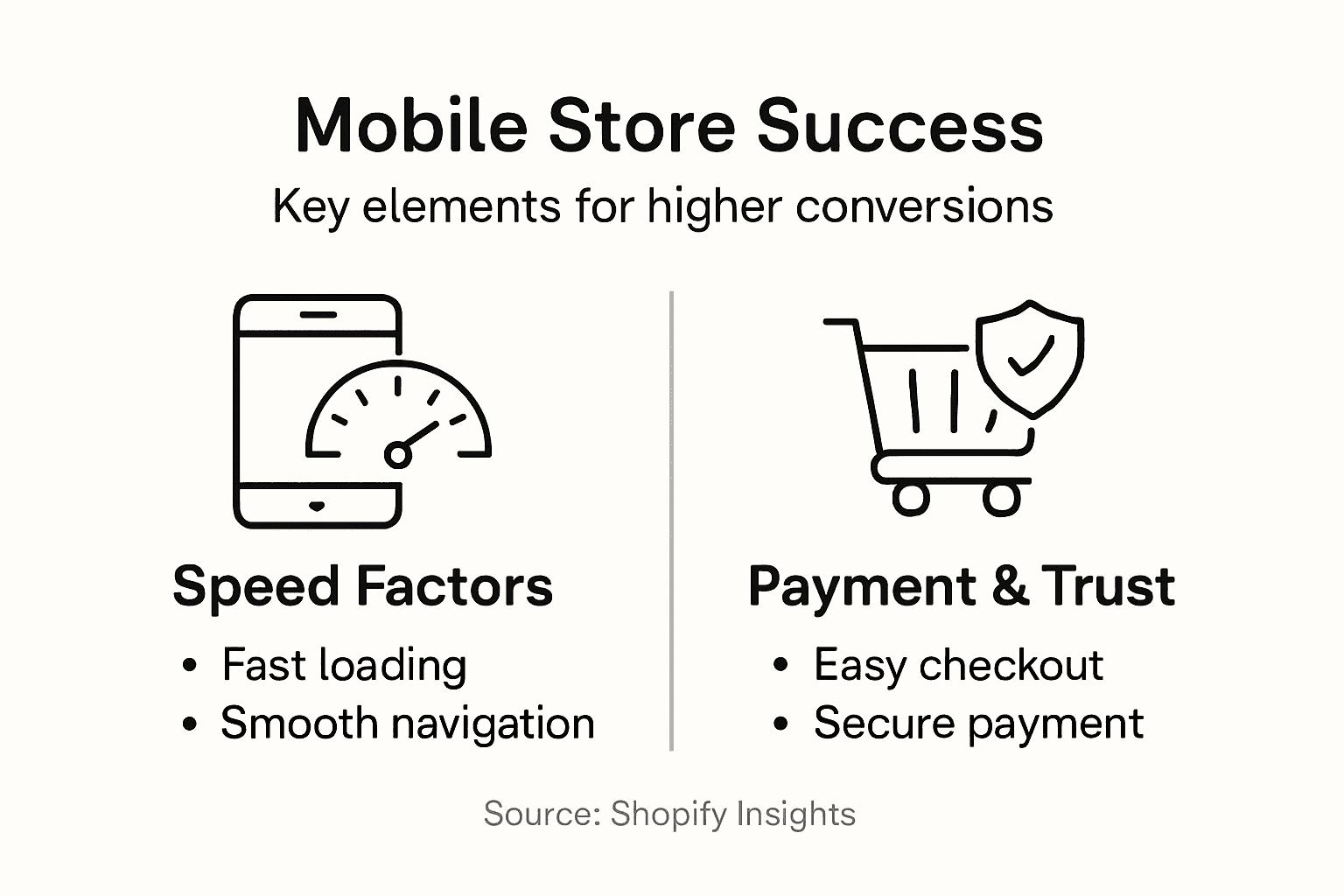
The significance of mobile optimization stems from dramatic shifts in consumer behavior. Mobile commerce trends worldwide demonstrate that smartphone shopping is no longer optional—it’s essential. Consumers expect fast-loading pages, intuitive navigation, and streamlined checkout processes that work perfectly on smaller screens.
Key components of effective mobile ecommerce optimization include:
- Responsive web design that adapts to different device screen sizes
- Fast page loading speeds (under 3 seconds)
- Simple, thumb-friendly navigation interfaces
- Mobile-optimized product images and descriptions
- One-click purchasing capabilities
- Secure and diverse mobile payment options
Mobile conversion rates depend critically on these technical and user experience factors. Retailers who invest in sophisticated mobile optimization can see significant improvements in sales, customer engagement, and brand perception.
Pro tip: Regularly test your mobile site’s performance using tools that simulate real-world user experiences and network conditions.
Key Elements of High-Converting Mobile Stores
Successful mobile ecommerce stores go far beyond simple responsiveness. They create immersive, friction-free shopping experiences that anticipate and meet customer needs across multiple touchpoints. Mobile commerce strategies demonstrate that nuanced design and functionality are critical for converting mobile shoppers.
The foundational elements of high-converting mobile stores include several key technical and user experience considerations:
- Rapid page loading (under 2 seconds)
- Touch-friendly navigation interfaces
- Streamlined, minimal checkout process
- Large, tappable buttons and interactive elements
- High-quality, zoomable product images
- Persistent cart and wishlist features
- Mobile-optimized search functionality
Psychological factors play a significant role in mobile purchasing decisions. Simplified user journeys reduce cognitive load, making customers more likely to complete transactions. This means eliminating unnecessary steps, providing clear product information, and creating intuitive pathways from product discovery to purchase.
Mobile payment integration represents another crucial conversion driver. Modern consumers expect diverse, secure payment options like digital wallets, one-click purchasing, and seamless third-party payment systems that work effortlessly on smaller screens.

Pro tip: Conduct regular mobile usability testing with real users to identify and eliminate potential friction points in your shopping experience.
AI and No-Code Solutions for Shopify
The landscape of Shopify optimization has transformed dramatically with the emergence of AI-powered, no-code solutions that democratize advanced ecommerce capabilities. AI technologies in ecommerce platforms are revolutionizing how store owners approach optimization, making sophisticated tools accessible without extensive technical expertise.
Key AI and no-code solutions for Shopify merchants include:
- Automated customer segmentation
- Real-time personalization engines
- Intelligent product recommendation systems
- Conversational AI chatbots
- Dynamic pricing optimization
- Predictive inventory management
- Automated A/B testing platforms
Artificial intelligence enables Shopify store owners to implement complex strategies that were previously reserved for enterprise-level businesses. These tools analyze customer behavior, predict purchasing patterns, and automatically generate insights that can dramatically improve conversion rates and customer experience.
No-code platforms have particularly transformed the accessibility of advanced ecommerce technologies. Merchant-friendly AI solutions now allow store owners to implement sophisticated features through intuitive interfaces, eliminating the need for extensive programming knowledge or expensive development resources.
Here is a summary of the unique contributions of AI and no-code solutions for Shopify merchants:
| Solution Type | Primary Benefit | Business Impact |
|---|---|---|
| AI-powered platforms | Predictive analytics & automation | Higher conversion rates, reduced manual effort |
| No-code tools | Accessible customization | Rapid deployment, lower costs |
| Combined approach | Advanced features without coding | Increased agility, enterprise-grade capabilities |
Pro tip: Select AI tools that offer seamless Shopify integration and provide clear, actionable metrics to track their impact on your store’s performance.
Common Challenges and How to Overcome Them
Shopify store owners face numerous obstacles when optimizing mobile ecommerce experiences. Mobile ecommerce strategies reveal that navigating these challenges requires a strategic and adaptive approach to digital transformation.
Key challenges and their solutions include:
- Slow mobile loading speeds
- Optimize image sizes
- Use content delivery networks
- Implement lazy loading techniques
- Complex checkout processes
- Reduce form fields
- Enable guest checkout
- Integrate multiple payment options
- Limited screen real estate
- Design mobile-first interfaces
- Use collapsible menu structures
- Prioritize essential information
Performance constraints significantly impact mobile shopping experiences. Store owners must balance comprehensive functionality with lightning-fast responsiveness, ensuring that every interaction feels seamless and intuitive across different mobile devices and network conditions.
Customer trust remains a critical factor in overcoming mobile ecommerce challenges. Security and user experience are interconnected, requiring merchants to implement transparent policies, secure payment gateways, and clear communication about data protection and transaction safety.
The table below highlights the most common mobile ecommerce challenges Shopify merchants face and the results of effective solutions:
| Challenge | Result of Solution | Long-term Benefit |
|---|---|---|
| Slow loading speeds | Faster page response times | Improved user satisfaction |
| Complex checkout steps | Streamlined purchase process | Higher conversion rate |
| Limited screen space | Clear, focused content | Easier navigation, lower abandonment |
Pro tip: Regularly conduct mobile usability testing with diverse user groups to identify and systematically eliminate potential friction points in your shopping experience.
Measuring Success: Metrics That Matter
Successful mobile ecommerce optimization requires a comprehensive understanding of key performance indicators that reveal the true health of your Shopify store. Mobile commerce metrics provide critical insights into user behavior and store performance.
The most important metrics for tracking mobile ecommerce success include:
- Mobile Conversion Rate
- Percentage of mobile visitors completing purchases
- Benchmark: 1.5-2.5% for ecommerce
- Bounce Rate
- Percentage of users leaving site quickly
- Target: Below 45% for mobile
- Average Order Value (AOV)
- Total revenue divided by number of orders
- Track mobile-specific AOV trends
- Cart Abandonment Rate
- Percentage of users who start but don’t complete checkout
- Ideal rate: Below 60%
- Customer Retention Rate
- Percentage of customers returning to make additional purchases
- Goal: 20-30% for ecommerce
Performance tracking goes beyond simple numerical analysis. Each metric tells a story about user experience, revealing potential friction points and opportunities for optimization. Successful Shopify store owners continuously monitor these indicators, making data-driven adjustments to improve mobile shopping experiences.
Contextualizing metrics is crucial for meaningful insights. Compare your store’s performance against industry benchmarks, but remember that every business has unique characteristics that influence these numbers.
Pro tip: Set up automated dashboard reporting to track these key metrics in real-time, allowing you to quickly identify and address performance issues.
Unlock Your Shopify Store’s Full Potential with AI-Powered Mobile Optimization
Mobile ecommerce success depends on fast-loading pages, simple checkout, and intuitive navigation just like this article highlighted. Yet many Shopify store owners face the frustrating challenge of identifying which mobile optimizations will truly boost conversions without technical headaches. With Automagic.li, you can overcome these obstacles confidently by leveraging AI-driven A/B testing designed specifically for Shopify mobile experiences.
Experience the power of over 40 pre-tested, high-impact variations that require zero coding and adapt automatically to your unique store design. Automagic.li’s no-code platform simplifies the complexity of mobile ecommerce optimization so you can focus on scaling sales and delighting customers. Take control of your mobile conversion rate today by visiting Automagic.li and discover how easy it is to implement proven optimizations that improve page speed, streamline checkout, and enhance user experience across all devices. Do not wait while slow loading times and complicated checkouts cause you to lose valuable sales—start optimizing now and watch your Shopify store thrive.
Frequently Asked Questions
What is mobile ecommerce optimization?
Mobile ecommerce optimization is the process of enhancing online shopping experiences specifically for mobile devices. It focuses on redesigning and fine-tuning online stores to ensure they are user-friendly, fast, and easy to navigate on smartphones and tablets.
Why is mobile optimization important for ecommerce?
Mobile optimization is crucial because consumer behavior has shifted towards mobile shopping. Customers expect fast-loading pages and intuitive navigation, and optimized mobile experiences can lead to higher conversion rates and customer satisfaction.
What are key elements of a high-converting mobile store?
Key elements include rapid page loading (under 2 seconds), touch-friendly navigation, a streamlined checkout process, high-quality product images, and secure payment options. These factors create a frictionless shopping experience for customers.
How can I measure the success of my mobile ecommerce optimization efforts?
You can measure success through key performance indicators (KPIs) like mobile conversion rate, bounce rate, average order value, cart abandonment rate, and customer retention rate. These metrics provide insights into user behavior and the effectiveness of your mobile optimization strategies.