
How to Increase Shopify Conversions with AI A/B Testing
Most American Shopify store owners are surprised that their conversion rates often fall below 3 percent, leaving profits on the table. If you find navigating analytics confusing or coding a challenge, you are not alone. Understanding how to assess your store performance and harness AI-powered A/B testing can be the shortcut to meaningful sales growth, even for those without technical expertise.
Table of Contents
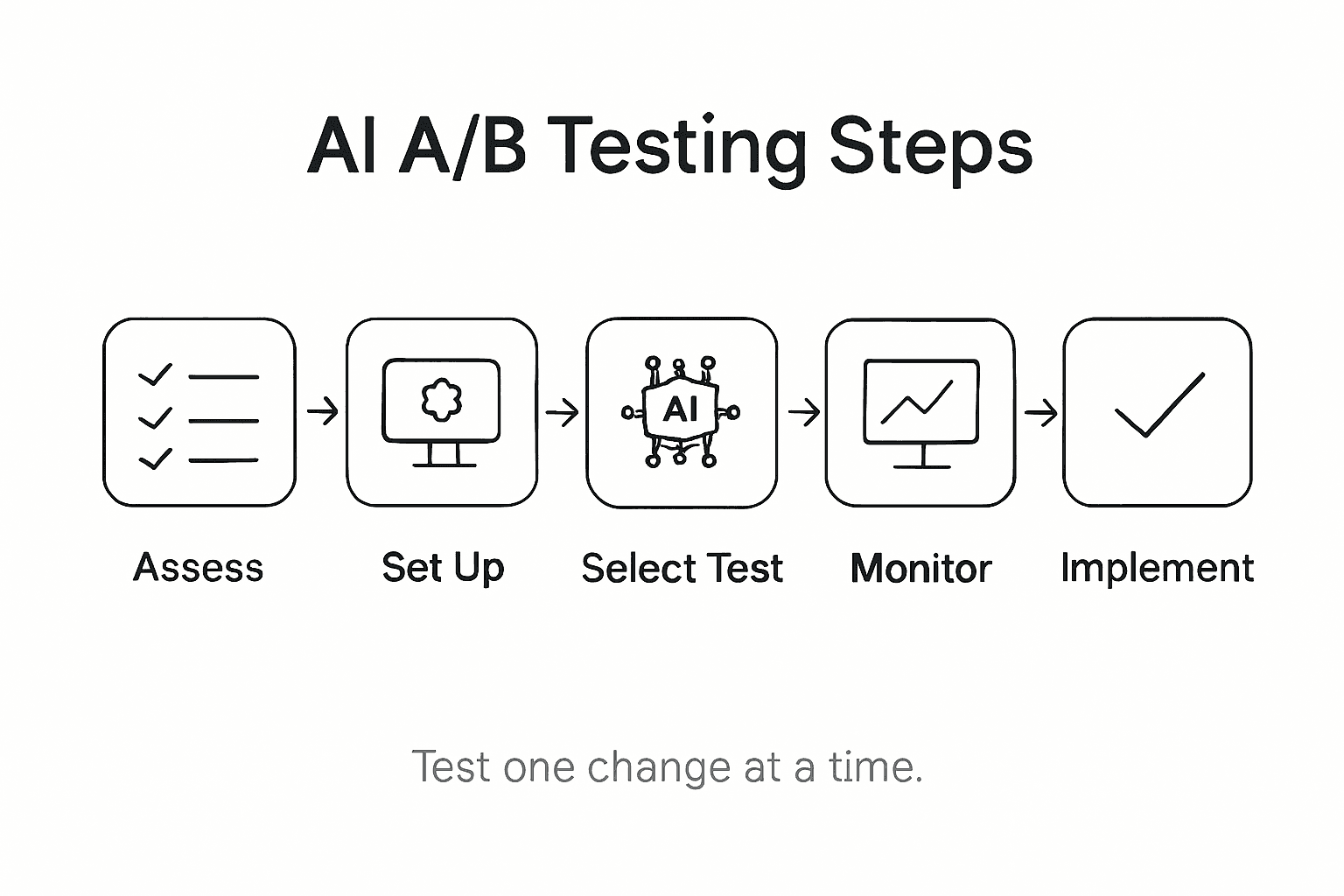
- Step 1: Assess Your Current Shopify Store Performance
- Step 2: Set Up AI-Powered A/B Testing Tools
- Step 3: Select and Deploy High-Impact Test Variations
- Step 4: Monitor Results and Analyze Conversion Data
- Step 5: Implement Winning Changes to Maximize Revenue
Quick Summary
| Key Insight | Explanation |
|---|---|
| 1. Analyze Your Current Performance | Review your Shopify store metrics like conversion rate and cart abandonment to identify improvement areas. |
| 2. Use AI for A/B Testing | Implement AI-powered tools that automate testing to optimize your store based on user behavior data. |
| 3. Focus on High-Impact Changes | Prioritize testing variations in key areas like product pages and checkout processes for better results. |
| 4. Monitor Test Results Closely | Track performance metrics thoroughly to assess the effectiveness of changes and derive actionable insights. |
| 5. Implement Winning Variations | Roll out successful test variations methodically to improve revenue and customer satisfaction effectively. |
Step 1: Assess Your Current Shopify Store Performance
To supercharge your Shopify store’s conversion rates, you first need a clear snapshot of your current performance. This crucial step involves diving deep into your store’s analytics and understanding key metrics that reveal how effectively you are converting visitors into paying customers.
Start by examining your Shopify conversion rate optimization workflow to establish a baseline. Look closely at metrics like overall conversion rate, average order value, bounce rate, and cart abandonment rate. These numbers tell a story about where potential customers are dropping off in your sales funnel. A typical Shopify store conversion rate ranges between 1% to 3%, but top performing stores can push this to 5% or higher.
Gather data from multiple sources including Shopify Analytics, Google Analytics, and any additional tracking tools you use. Pay special attention to traffic sources, user behavior flow, and device performance. Are mobile users converting differently than desktop visitors? Are specific product pages performing better or worse than others? By understanding these nuanced details, you can identify precise areas for improvement and optimization.
Pro tip: Create a performance tracking spreadsheet that logs your key metrics monthly. This will help you visualize progress and quickly identify trends or sudden changes in your store’s conversion dynamics.
Here’s an overview of key conversion metrics and their business significance:
| Metric | What It Measures | Business Impact |
|---|---|---|
| Conversion Rate | Percentage of visitors who purchase | Indicates effectiveness of sales funnel |
| Average Order Value | Average amount spent per transaction | Higher value boosts overall revenue |
| Bounce Rate | Percent leaving after one page | High rate signals user experience issues |
| Cart Abandonment Rate | Shoppers leaving before purchase | Identifies friction in checkout process |
| Customer Acquisition Cost | Cost to acquire a new customer | Affects store profitability |
Step 2: Set Up AI-Powered A/B Testing Tools
Now that you understand your store’s current performance, it is time to leverage AI-powered A/B testing tools to systematically improve your conversion rates. This step will help you select and implement cutting-edge testing technologies that can transform your Shopify store’s optimization strategy.
Begin by exploring AI in A/B testing platforms specifically designed for Shopify that offer intelligent, automated testing capabilities. Look for tools that provide machine learning algorithms capable of quickly analyzing multiple design variations, user behaviors, and potential conversion improvements. These advanced platforms can automatically generate test hypotheses, recommend design changes, and predict potential performance impacts without requiring extensive manual configuration.

When selecting an AI-powered A/B testing tool, consider key features like real-time statistical analysis, multivariate testing capabilities, machine learning recommendations, and seamless Shopify integration. Evaluate each platform based on its ability to provide actionable insights, ease of implementation, and the depth of its analytical capabilities. Pay attention to factors such as sample size requirements, confidence intervals, and the tool ability to isolate variables that significantly impact user conversions.
Pro tip: Always start with smaller, lower-risk tests to validate the AI testing tool performance before implementing complex or site-wide changes. This approach allows you to build confidence in the tool recommendations while minimizing potential negative impacts on your store’s conversion rates.
Compare traditional and AI-powered A/B testing tools for Shopify optimization:
| Aspect | Traditional A/B Testing | AI-Powered A/B Testing |
|---|---|---|
| Test Creation | Manual variant setup | Automated variant generation |
| Analysis Speed | Slower, manual analysis | Real-time, machine learning based |
| Scalability | Time-consuming for scaling | Easily handles many tests |
| Insight Quality | Basic statistical output | Actionable, predictive insights |
Step 3: Select and Deploy High-Impact Test Variations
With your AI-powered testing tools in place, you can now strategically select and deploy high-impact test variations that have the potential to dramatically improve your Shopify store conversions. This critical step involves identifying the most promising elements of your online store to optimize and creating targeted variations that can significantly boost your performance.
Begin by focusing on key conversion drivers such as product page layouts, call-to-action buttons, pricing displays, and checkout process design. Explore the comprehensive guide to A/B testing Shopify strategies to understand which elements typically yield the most substantial improvements. Prioritize variations that address potential friction points in the customer journey such as unclear product descriptions, complicated navigation, or unintuitive design elements. AI-powered testing tools can help you generate multiple variations quickly and provide predictive insights into which changes are most likely to increase conversion rates.
When deploying test variations, ensure you maintain statistical integrity by testing one primary variable at a time and allowing sufficient time and traffic to generate meaningful results. Create variations that are substantive enough to potentially impact user behavior but not so radical that they alienate your existing customer base. Monitor key performance indicators such as conversion rate, average order value, and bounce rate to understand the real-world impact of each test variation.
Pro tip: Document every test variation and its results meticulously. This historical data will become an invaluable resource for understanding your store performance and making increasingly sophisticated optimization decisions over time.
Step 4: Monitor Results and Analyze Conversion Data
After deploying your AI-powered A/B test variations, the critical next step is to meticulously monitor and analyze the results to extract meaningful insights that can drive your Shopify store’s conversion strategy. This phase transforms raw data into actionable optimization opportunities for your online business.
Start by understanding key conversion metrics for your Shopify store to establish a comprehensive performance baseline. Focus on critical indicators such as conversion rate, average order value, cart abandonment rate, and customer acquisition cost. Leverage your AI testing tool’s analytics dashboard to track real-time performance variations, looking beyond surface-level metrics to understand deeper user behavior patterns. Pay close attention to statistical significance indicators that validate whether observed differences are genuine improvements or merely random fluctuations.
Dig deeper into segmented data analysis by examining how different test variations impact specific customer groups. Analyze performance across various dimensions like device type, traffic source, customer demographics, and browsing behavior. This granular approach helps you understand nuanced user preferences and optimize your store experience for maximum conversion potential. Create comparative reports that clearly illustrate the performance of each test variation, highlighting both successful and unsuccessful experiments as valuable learning opportunities.
Pro tip: Develop a systematic tracking template that captures not just quantitative metrics but also qualitative insights from each A/B test. This comprehensive documentation will help you build an institutional knowledge base that continuously refines your conversion optimization strategy.
Step 5: Implement Winning Changes to Maximize Revenue
After meticulously analyzing your A/B test results, the most critical phase is transforming data driven insights into tangible website improvements that directly boost your Shopify store’s revenue. This step requires a strategic approach to implementing changes that have demonstrated statistically significant positive impact on your conversion performance.
Tracking the importance of conversion strategies is essential when rolling out winning variations. Prioritize implementing test variations that show clear performance improvements across multiple key metrics. Focus on changes that not only increase conversion rates but also enhance overall user experience and customer satisfaction. This might involve updating product page layouts, refining call-to-action button designs, adjusting pricing displays, or streamlining the checkout process based on your AI-powered testing insights.
Carry out implementation in controlled stages to minimize potential disruptions to your existing store performance. Begin with the most promising and low-risk variations, carefully monitoring their real-world impact after full deployment. Create a comprehensive implementation plan that includes specific timelines, performance benchmarks, and rollback strategies in case unexpected issues arise. Continuously track the long-term performance of implemented changes to ensure they maintain their positive impact over time and adapt to evolving customer preferences.
Pro tip: Develop a systematic change management process that allows for rapid testing and incremental improvements, ensuring your Shopify store remains agile and responsive to customer behavior data.
Boost Your Shopify Store Conversions Effortlessly with AI-Powered A/B Testing
Struggling to increase your Shopify conversion rates despite digging into analytics and running tests manually? You are not alone. Many store owners face pain points like high cart abandonment, confusing checkout flows, and slow test implementations. This article showed how leveraging AI for A/B testing can accelerate discovering winning variations while maintaining statistical confidence and minimizing risk. But why stop at theory when you can put cutting-edge technology to work today?
Automagic.li is built to solve these exact challenges. With a rich library of over 40 pre-built, high-impact A/B test variations sorted by expected impact and confidence, the platform eliminates complicated setups and coding hassles. It uses AI to tailor tests automatically to your unique store design, removing guesswork from conversion optimization. Imagine improving your Shopify store conversions with no technical expertise required and seeing real-time data insights to guide smarter decisions continuously.
Explore how AI revolutionizes Shopify A/B testing and discover proven strategies to select impactful test variations that drive revenue. Don’t let technical barriers hold you back from maximizing your sales potential. Take control of your store’s growth now by visiting Automagic.li and start deploying AI-powered A/B tests that deliver measurable increases in conversion rates.
Frequently Asked Questions
How can AI A/B testing improve my Shopify store’s conversion rates?
AI A/B testing can enhance your Shopify store’s conversion rates by analyzing user behavior and identifying which changes positively affect customer interactions. Start by implementing an AI A/B testing tool to systematically test different design variations, which can help increase conversions by up to 20% within a few weeks.
What key metrics should I monitor during A/B testing?
Key metrics to monitor during A/B testing include conversion rate, average order value, bounce rate, and cart abandonment rate. Track these metrics carefully to determine the effectiveness of your test variations and adjust your strategies accordingly.
How long should I run an A/B test to see meaningful results?
Run each A/B test for at least 2 to 4 weeks to gather sufficient data for reliable results. This duration allows you to capture meaningful user interactions and trends, leading to more informed decisions.
What are the common variables to test in A/B testing?
Common variables to test include product page layouts, call-to-action button designs, pricing displays, and checkout process structures. Focus on one variable at a time to maintain the integrity of your testing and accurately assess their impact on conversion rates.
How can I analyze the results of my A/B tests effectively?
Analyze the results of your A/B tests by comparing key performance indicators such as conversion rate and bounce rate before and after implemented changes. Create a tracking template that captures both qualitative and quantitative insights to build a solid foundation for future optimizations.
What should I do if my A/B test results are inconclusive?
If your A/B test results are inconclusive, consider running longer tests or testing additional variations that target different user segments. Gather more data to identify patterns or insights that may have been overlooked, ensuring your next tests are well-informed and focused.