
Conversions vs. Traffic: Driving Shopify Store Success
Every Shopify store owner knows the excitement of seeing traffic spike, but those numbers can feel meaningless if visitors do not convert into buyers. Understanding the difference between simple website traffic and actual conversions is crucial for turning clicks into real revenue. With proven research showing that focusing on conversion optimization directly drives business growth, this guide highlights practical, user-friendly techniques to help you maximize both metrics without needing technical skills.
Table of Contents
- Defining Conversions And Website Traffic
- Key Differences Between Traffic And Conversions
- How Conversions Impact Ecommerce Revenue
- Measuring And Improving Both Metrics Effectively
- Common Mistakes Shopify Owners Should Avoid
Key Takeaways
| Point | Details |
|---|---|
| Understanding Traffic vs. Conversions | Website traffic measures visitor volume, while conversions denote meaningful actions taken by those visitors. Focus on optimizing conversions to enhance revenue outcomes. |
| Importance of Targeted Traffic | High traffic numbers do not guarantee more conversions. Prioritize attracting high-intent traffic that aligns with your ideal customer profile. |
| Measuring Performance Effectively | Implement analytics to track both traffic and conversion metrics. Use data to identify user behavior patterns and optimize performance continuously. |
| Avoiding Common Pitfalls | Shopify owners should not prioritize traffic volume over quality, neglect mobile experiences, or overlook the importance of strategic A/B testing. Regular audits can help identify and address issues. |
Defining Conversions and Website Traffic
In the world of e-commerce, understanding website traffic and conversions is fundamental to driving Shopify store success. User interactions and engagement metrics reveal the complex journey from initial clicks to final transactions.
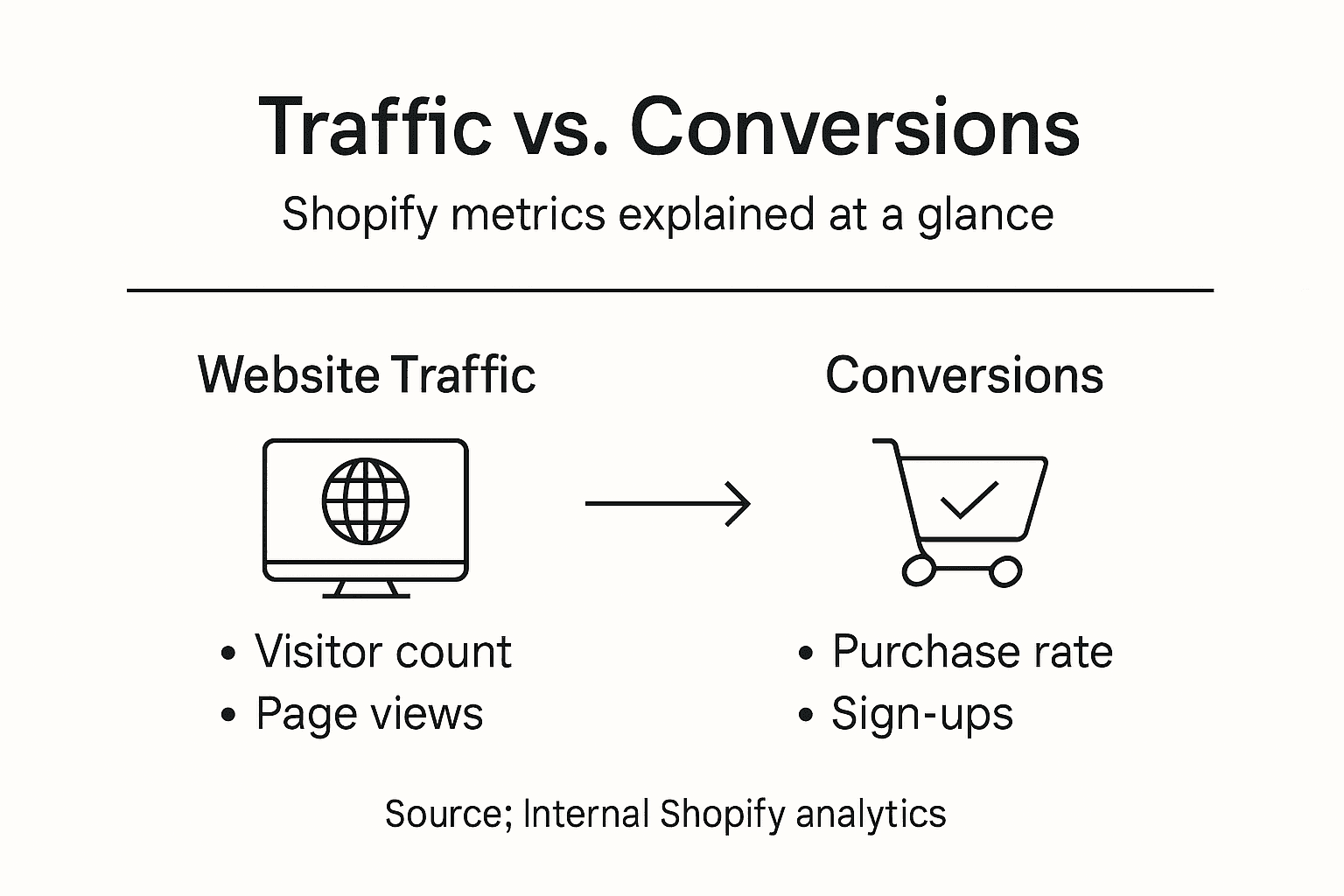
Website traffic represents the total number of visitors arriving at your online store through various channels, including:
- Organic search results
- Paid advertising
- Social media referrals
- Direct website visits
- Email marketing campaigns
Conversions, by contrast, are specific measurable actions that indicate a visitor’s meaningful interaction with your store. These can include:
- Completed product purchases
- Email newsletter sign-ups
- Added items to shopping cart
- Account registrations
- Product page downloads
The critical distinction lies in quality over quantity. While high traffic volumes might seem promising, comprehensive traffic pattern studies demonstrate that targeted, high-intent traffic produces superior conversion rates.
Pro tip: Track your conversion rate by dividing total conversions by total website visitors to understand your store’s true performance effectiveness.
Key Differences Between Traffic and Conversions
Navigating the digital marketing landscape requires understanding the nuanced relationship between website traffic and conversions. Marketing science perspectives reveal these are distinctly different metrics that play critical roles in e-commerce success.
Website traffic represents the raw volume of visitors arriving at your Shopify store, including:
- Total number of page visits
- Unique visitor count
- Traffic sources (organic, paid, social)
- Geographic and demographic visitor data
- Session duration and bounce rates
Conversions, by contrast, are the strategic outcomes that transform casual browsers into paying customers. These measurable actions include:
- Completed purchases
- Product page interactions
- Newsletter sign-ups
- Cart additions
- Customer account creations
Comprehensive digital marketing research emphasizes that while high traffic volumes are desirable, they represent merely potential opportunity. The true measure of success lies in converting those visitors into tangible business results.
Quantitative analysis shows that traffic and conversions have an intricate, non-linear relationship. More traffic does not automatically guarantee more conversions. Instead, targeted, high-quality traffic from relevant sources tends to produce significantly better conversion rates.
Pro tip: Focus on attracting qualified traffic that matches your ideal customer profile to improve overall conversion performance.
Here’s a comparison highlighting the impact of website traffic versus conversions for Shopify stores:
| Aspect | Website Traffic | Conversion Rate |
|---|---|---|
| Main Focus | Attracting visitors | Turning visitors into customers |
| Business Impact | Expands reach and awareness | Directly drives revenue growth |
| Optimization Benefit | Wider audience exposure | Increased profitability |
| Key Challenge | Reaching the right audience | Improving user experience |
How Conversions Impact eCommerce Revenue
Conversion rates are the critical bridge transforming website visitors into tangible revenue streams for Shopify stores. Conversion rate optimization statistics demonstrate that even marginal improvements can dramatically multiply an online store’s financial performance.
The direct financial impact of conversions becomes evident through several key metrics:
- Increased average order value
- Higher customer lifetime value
- Reduced customer acquisition costs
- Improved return on marketing investment
- Enhanced overall revenue per visitor
Comprehensive research on conversion effectiveness reveals that strategic conversion optimization can transform seemingly minor website adjustments into substantial revenue gains. Even a 1% improvement in conversion rate can translate into significant financial benefits for e-commerce businesses.
Understanding conversion impact requires analyzing multiple financial dimensions:
- Direct sales revenue generated
- Potential repeat purchase opportunities
- Customer retention rates
- Long-term customer value
- Cost-efficiency of marketing strategies
Successful Shopify stores recognize that conversions are not just about immediate transactions, but about creating a sustainable, profitable customer relationship that extends far beyond a single purchase.
Pro tip: Calculate your store’s conversion value by multiplying average order value with conversion rate to understand the true financial potential of your traffic.
Measuring and Improving Both Metrics Effectively
Tracking website traffic and conversion metrics requires a strategic, data-driven approach that goes beyond surface-level analysis. Website analytics and traffic data insights provide the foundation for understanding and optimizing your Shopify store’s performance.
Key metrics to monitor for effective measurement include:
- Unique visitor count
- Traffic source breakdown
- Bounce rates
- Average time on site
- Conversion rates
- Cart abandonment rates
- Revenue per visitor
Practical optimization approaches demonstrate that improving these metrics requires a multifaceted strategy. Successful Shopify stores implement comprehensive tracking methods to gain actionable insights:
- Set up goal tracking in analytics platforms
- Segment traffic by source and quality
- Analyze user behavior patterns
- Identify conversion funnel drop-off points
- Implement continuous A/B testing
The most effective measurement strategies combine quantitative data with qualitative insights. This means looking beyond raw numbers to understand the actual user experience, motivation, and potential barriers to conversion.

Transforming data into actionable improvements requires a systematic approach that balances both traffic generation and conversion optimization techniques. By continuously monitoring and adapting, Shopify store owners can create a dynamic, high-performing online business.
Pro tip: Create custom dashboards that overlay traffic and conversion data to visualize the direct relationship between visitor interactions and revenue generation.
Here’s a summary of effective strategies for enhancing both traffic and conversions:
| Strategy | Traffic Improvement | Conversion Enhancement |
|---|---|---|
| Analytics setup | Better source tracking | Goal-based performance monitoring |
| User segmentation | Customized messaging | Targeted conversion incentives |
| Funnel analysis | Identifies drop-off points | Reveals conversion barriers |
| Continuous testing | Optimizes campaigns | Refines site experience |
Common Mistakes Shopify Owners Should Avoid
Conversion rate optimization research reveals several critical errors that can significantly undermine Shopify store performance. Understanding and avoiding these common pitfalls is essential for sustainable e-commerce success.
The most prevalent mistakes Shopify store owners make include:
- Obsessing over traffic volume instead of quality
- Neglecting mobile user experience
- Ignoring conversion funnel analytics
- Using generic, non-targeted marketing approaches
- Failing to implement strategic A/B testing
- Overlooking customer trust signals
- Complicated checkout processes
Traffic source analysis demonstrates that not all website visitors are created equal. Successful stores recognize the importance of understanding traffic quality and intentionality rather than simply chasing raw visitor numbers.
Potential revenue-killing mistakes in Shopify store management involve:
- Misattributing traffic source effectiveness
- Neglecting cross-device user journeys
- Failing to optimize page load speeds
- Inconsistent brand messaging
- Poor product presentation
Transforming these potential weaknesses requires a holistic approach that combines technical optimization, user experience design, and data-driven decision-making. By systematically addressing these common pitfalls, Shopify store owners can create more engaging, conversion-focused online experiences.
Pro tip: Regularly audit your store’s performance metrics and user feedback to proactively identify and address potential conversion barriers.
Unlock Higher Shopify Conversions by Harnessing AI-Powered Testing
The article highlights a critical challenge Shopify store owners face: attracting quality traffic yet struggling to turn visitors into paying customers. If you find yourself overwhelmed by chasing raw visitor numbers without seeing the revenue boost you expect, you are not alone. The key lies in optimizing conversion rates with data-driven strategies like engaging user experiences, targeted messaging, and continuous experimentation. This is where AI-powered A/B testing becomes a game changer. Automagic.li offers Shopify stores a powerful solution with over 40 ready-made, high-impact A/B test variations requiring no coding skills. By automatically customizing tests to your unique store design, it ensures you focus on the most effective improvements that drive real sales growth.
Elevate your store from merely drawing traffic to consistently converting visitors with ease. Start unlocking your Shopify store’s true earning potential at Automagic.li. Discover the impact of AI-driven conversion optimization and see why so many Shopify merchants trust our platform to turn clicks into revenue. Don’t wait to transform your traffic into lasting success—visit Automagic.li now and take the first step toward smarter, effortless growth.
Frequently Asked Questions
What is the difference between website traffic and conversions in e-commerce?
Website traffic refers to the total number of visitors to your online store, while conversions are specific actions taken by those visitors, such as completing a purchase or signing up for a newsletter. High traffic does not always lead to high conversions; quality traffic tends to yield better results.
How can I improve my Shopify store’s conversion rate?
To improve your conversion rate, focus on attracting qualified traffic that matches your ideal customer profile, optimize the user experience, streamline the checkout process, and implement strategies like A/B testing to refine your site layout and messaging.
Why is it important to analyze both traffic and conversion metrics?
Analyzing both metrics is crucial because it provides a comprehensive view of your store’s performance. While traffic indicates potential customer interest, conversion metrics reveal how effectively you are turning that interest into sales. This balance helps inform your marketing and operational strategies.
What are some common mistakes to avoid that can hinder conversions?
Common mistakes include focusing too much on traffic volume over quality, neglecting mobile optimization, ignoring conversion funnel analytics, and failing to implement strategic A/B testing. Addressing these issues can significantly enhance user experience and boost conversions.