
7 Essential Conversion Rate Hacks for Shopify Store Owners
Over 80 percent of American e-commerce businesses struggle to keep up with fast-changing technology and consumer expectations. Optimizing your Shopify store no longer takes deep coding skills or endless trial and error, thanks to new advances in artificial intelligence. From AI-powered A/B testing to personalized shopping experiences and automated continuous improvements, discover practical strategies you can use right now to increase conversions and outpace your competition.
Table of Contents
- Leverage AI-Powered A/B Testing For Fast Results
- Use Pre-Tested Variations To Maximize Impact
- Deploy High-Converting Elements Without Coding
- Showcase Social Proof To Build Trust Instantly
- Personalize User Experience For Better Engagement
- Analyze Test Results To Guide Store Decisions
- Automate Continuous Improvements For Ongoing Growth
Quick Summary
| Key Insight | Explanation |
|---|---|
| 1. Utilize AI for Rapid A/B Testing | Leverage AI technologies for real-time insights and faster testing, optimizing conversion rates without extensive technical skills. |
| 2. Implement Pre-Tested Variations | Use scientifically backed variations to minimize guesswork and enhance optimization, drawing from proven data-driven strategies. |
| 3. Adopt No-Code Solutions | Easily modify and optimize website elements without coding skills, enabling quick iterations in design for better user engagement. |
| 4. Showcase Authentic Social Proof | Utilize genuine customer testimonials and success metrics to build trust and credibility, positively influencing potential buyers’ decisions. |
| 5. Personalize Shopping Experiences | Adapt your Shopify store dynamically for individual users based on behavior analysis, enhancing engagement and fostering customer loyalty. |
1. Leverage AI-Powered A/B Testing for Fast Results
AI-powered A/B testing represents a revolutionary approach for Shopify store owners to rapidly optimize conversion rates without extensive technical expertise. By utilizing advanced machine learning algorithms, you can now implement sophisticated testing strategies that adapt and improve in real time.
Traditional A/B testing often required manual configuration and significant time investment. However, modern AI technologies have transformed this process. Autonomous agents can now perform complex user interaction experiments, enabling store owners to generate insights faster and more accurately than ever before.
The magic happens through intelligent systems that automatically analyze user behavior, identify potential optimization points, and generate test variations with minimal human intervention. These AI systems can process massive amounts of data quickly, detecting subtle patterns human analysts might miss.
Key Advantages of AI Powered A/B Testing:
- Faster experiment deployment
- More precise statistical analysis
- Continuous learning and adaptation
- Reduced manual configuration time
Implementing AI-driven testing means you can focus on strategic decisions while the technology handles complex experimental design. Store owners can now access advanced optimization techniques previously reserved for large enterprises with dedicated data science teams.
By strategically integrating AI testing tools, you transform your Shopify store from a static sales platform into a dynamic, continuously improving conversion engine. The result? Smarter design choices, higher engagement rates, and ultimately more revenue.
2. Use Pre-Tested Variations to Maximize Impact
Stop wasting time guessing what might improve your Shopify store’s conversion rates. Pre-tested variations offer a data driven shortcut to optimization, allowing store owners to leverage proven design and content strategies that have already demonstrated success.
Sophisticated reinforcement learning frameworks can now automatically generate and select high performing content variants, transforming how online businesses approach website improvements. These advanced algorithms analyze massive datasets to identify precise modifications that drive customer engagement and sales.
Why Pre-Tested Variations Work:
- Eliminate guesswork from design decisions
- Reduce time spent on manual testing
- Leverage collective performance data
- Minimize risk of poor performing changes
Unlike traditional A/B testing that requires extensive manual configuration, pre-tested variations provide ready made solutions backed by comprehensive performance metrics. By selecting variations that have already demonstrated success across similar store types, you dramatically increase the likelihood of positive outcomes.
The key is understanding that these variations are not random suggestions but scientifically derived recommendations. Each variation represents a strategic modification proven to influence user behavior positively.
Implementing pre-tested variations allows you to rapidly iterate your Shopify store’s design without the typical risks associated with experimental changes. You gain the advantage of collective intelligence distilled from thousands of successful online stores, giving you a competitive edge in a crowded digital marketplace.
3. Deploy High-Converting Elements Without Coding
Technology has transformed website optimization, making it possible for Shopify store owners to implement advanced conversion strategies without writing a single line of code. No technical background? No problem.
AI driven automation can now help businesses test multiple design variations simultaneously, eliminating the traditional barriers that once required extensive programming knowledge. Modern tools leverage artificial intelligence to intelligently modify website elements and track performance.
Key Benefits of No-Code Conversion Optimization:
- Accessible for non technical entrepreneurs
- Rapid implementation of design changes
- Real time performance tracking
- Minimal technical investment required
The breakthrough lies in intelligent platforms that understand your store’s unique design language. These systems analyze your existing layout and suggest precise modifications most likely to increase user engagement. By using pre configured templates and drag-and-drop interfaces, you can experiment with different page elements without needing developer skills.
Consider critical conversion elements like product descriptions, call to action buttons, image placements, and checkout processes. No-code tools now allow you to test variations of these elements quickly, measuring their impact on customer behavior with unprecedented speed and accuracy.
The future of e-commerce optimization is about democratizing advanced marketing techniques. Store owners can now access powerful testing capabilities previously reserved for large enterprises with dedicated technology teams. Your technical limitations no longer need to restrict your growth potential.
4. Showcase Social Proof to Build Trust Instantly
In the digital marketplace, trust is the invisible currency that transforms casual browsers into committed customers. Social proof represents your most powerful tool for instantly establishing credibility and reducing purchase hesitation.
AI driven algorithms can now analyze and personalize content distribution to enhance user trust and engagement, making it easier than ever to showcase compelling evidence of your product’s value. These intelligent systems help you strategically present customer testimonials, reviews, and success stories that resonate with potential buyers.
Powerful Social Proof Strategies:
- Display genuine customer testimonials
- Highlight quantitative success metrics
- Share real user experiences
- Incorporate verified purchase badges
- Feature industry awards or certifications
Customers make purchasing decisions based on perceived risk. When potential buyers see others have successfully used your product, their confidence increases dramatically. The psychological principle of social validation means people are more likely to take action when they see evidence that others have already done so.
Effective social proof goes beyond simple star ratings. Dynamic platforms now enable you to showcase contextual testimonials that speak directly to specific customer segments. A fitness equipment store might display different reviews for athletes versus beginners, creating targeted trust signals.
Remember that authenticity matters more than volume. A few detailed, genuine testimonials will always outperform generic praise. Prioritize real customer stories that provide specific outcomes and tangible benefits your product delivers.
5. Personalize User Experience for Better Engagement
In the competitive world of online retail, a one size fits all approach is a recipe for missed opportunities. Personalization transforms your Shopify store from a generic marketplace into a tailored shopping experience that speaks directly to individual customers.
Advanced AI systems can now automate the creation of dynamic website versions that adapt to user interactions, creating a responsive environment that feels uniquely crafted for each visitor. This intelligent approach goes beyond simple product recommendations.
Personalization Strategies That Work:
- Analyze customer browsing history
- Segment users by behavior
- Create dynamic content zones
- Use intelligent product recommendations
- Customize user journey based on past interactions
Modern personalization tools leverage machine learning to understand subtle user preferences. By tracking interactions such as time spent on product pages, previous purchases, and browsing patterns, you can create micro targeted experiences that dramatically increase engagement.
Consider implementing intelligent features like location based pricing, personalized welcome messages, or recommended products that align with a customer’s specific interests. These small touches can transform a generic shopping experience into a memorable interaction that feels curated just for them.
The goal is not just to sell but to make customers feel understood. When users perceive that your store recognizes their unique needs and preferences, they are more likely to trust your brand and complete their purchase. Personalization is no longer a luxury its a fundamental expectation in modern e commerce.
6. Analyze Test Results to Guide Store Decisions
Turning raw data into actionable insights separates successful Shopify stores from those merely treading water. Understanding how to deeply analyze your A/B testing results means transforming numbers into strategic business decisions.
Advanced Bayesian decision frameworks now enable precise multi variant experiment optimization, helping store owners move beyond simplistic statistical significance toward meaningful business outcomes. These sophisticated approaches prevent common pitfalls like premature result interpretation or misaligned performance metrics.
Strategic Result Analysis Techniques:
- Look beyond statistical significance
- Evaluate actual business impact
- Consider long term revenue implications
- Understand contextual performance variations
- Track incremental improvements
Effective analysis means understanding not just what changed but why it changed. Each test result provides a narrative about customer behavior deeper than surface level metrics. Are customers responding to visual changes? Do specific demographic groups interact differently with your design modifications?
The goal is creating a continuous learning loop. Your Shopify store becomes an adaptive system where each test informs the next experiment. By treating data as a strategic asset rather than just numbers, you develop an intuitive understanding of your customer base.
Remember that statistical significance does not always equate to business value. A test might show a technically significant result that delivers minimal actual revenue impact. Smart store owners dig deeper analyzing metrics like customer lifetime value customer acquisition cost and net revenue change to make truly informed decisions.
7. Automate Continuous Improvements for Ongoing Growth
Growth is not a destination but a continuous journey of refinement and adaptation. Shopify store owners who embrace automated optimization can transform their online business from a static platform into a dynamic revenue generating engine.
AI powered A/B testing can systematically uncover marketing strategies that significantly increase conversion rates and average order values, creating a self improving ecosystem for your online store.
Automation Strategies for Continuous Improvement:
- Set up recurring performance tracking
- Implement machine learning algorithms
- Create adaptive testing workflows
- Establish baseline performance metrics
- Configure automatic optimization triggers
The magic happens when you shift from manual intervention to intelligent systems that learn and adapt automatically. These advanced platforms continuously analyze user behavior patterns identifying subtle opportunities for enhancement that human analysts might overlook.
Automation allows you to implement complex optimization strategies without constant manual oversight. Imagine a system that automatically tests different product descriptions adjusts website layouts and refines marketing messaging based on real time performance data.
The future of e commerce belongs to store owners who treat their online platform as a living evolving organism. By leveraging automated testing and optimization tools you create a self sustaining mechanism of continuous growth that operates efficiently with minimal direct intervention.
Below is a comprehensive table summarizing the strategies and benefits of AI-driven approaches for Shopify stores discussed in the article.
| Strategy | Implementation | Benefits/Expected Results |
|---|---|---|
| AI-Powered A/B Testing | Utilize autonomous agents for real-time testing and insights. | Faster results, more precise analysis, continuous adaptation. |
| Pre-Tested Variations | Use pre-tested content and design strategies for immediate improvements. | Eliminate guesswork, reduce testing time, leverage proven success. |
| No-Code Conversion Optimization | Implement design changes without coding using AI-driven tools. | Accessible for non-technical users, rapid changes, real-time tracking. |
| Social Proof | Display testimonials and reviews using AI for personalization. | Build trust, increase credibility, reduce hesitation. |
| Personalized User Experience | Use AI for dynamic website personalization based on user data. | Increased engagement, higher customer satisfaction. |
| Analyze Test Results | Apply advanced frameworks for deeper analysis beyond surface metrics. | Informed decisions, better understanding of customer behavior. |
| Automate Continuous Improvements | Set up automated, adaptive testing and optimization systems. | Ongoing growth, efficient operations, continuous learning. |
Unlock Your Shopify Store’s Full Potential with AI-Driven Conversion Optimization
Shopify store owners face the challenge of improving conversion rates quickly while lacking the technical resources or time to run complex A/B tests. This article highlights essential tactics like AI-powered testing, pre-tested variations, and no-code optimization tools that promise faster, smarter results without guesswork or developer headaches. If you want to stop wasting time on manual testing and start harnessing data-backed improvements tailored to your unique store design, your solution is within reach.
Automagic.li offers exactly that. With a powerful library of over 40 pre-tested A/B test variations and AI automation that customizes and deploys tests automatically, you can continuously improve your Shopify store’s conversion rate without any coding. The platform takes complex experimental design off your plate and puts real-time, personalized optimization at your fingertips.
Ready to transform your Shopify marketing strategy today? Experience how effortless conversion rate growth feels with Automagic.li.
Discover how AI-powered A/B testing can work for you
Stop guessing and start optimizing with pre-tested high-impact variations
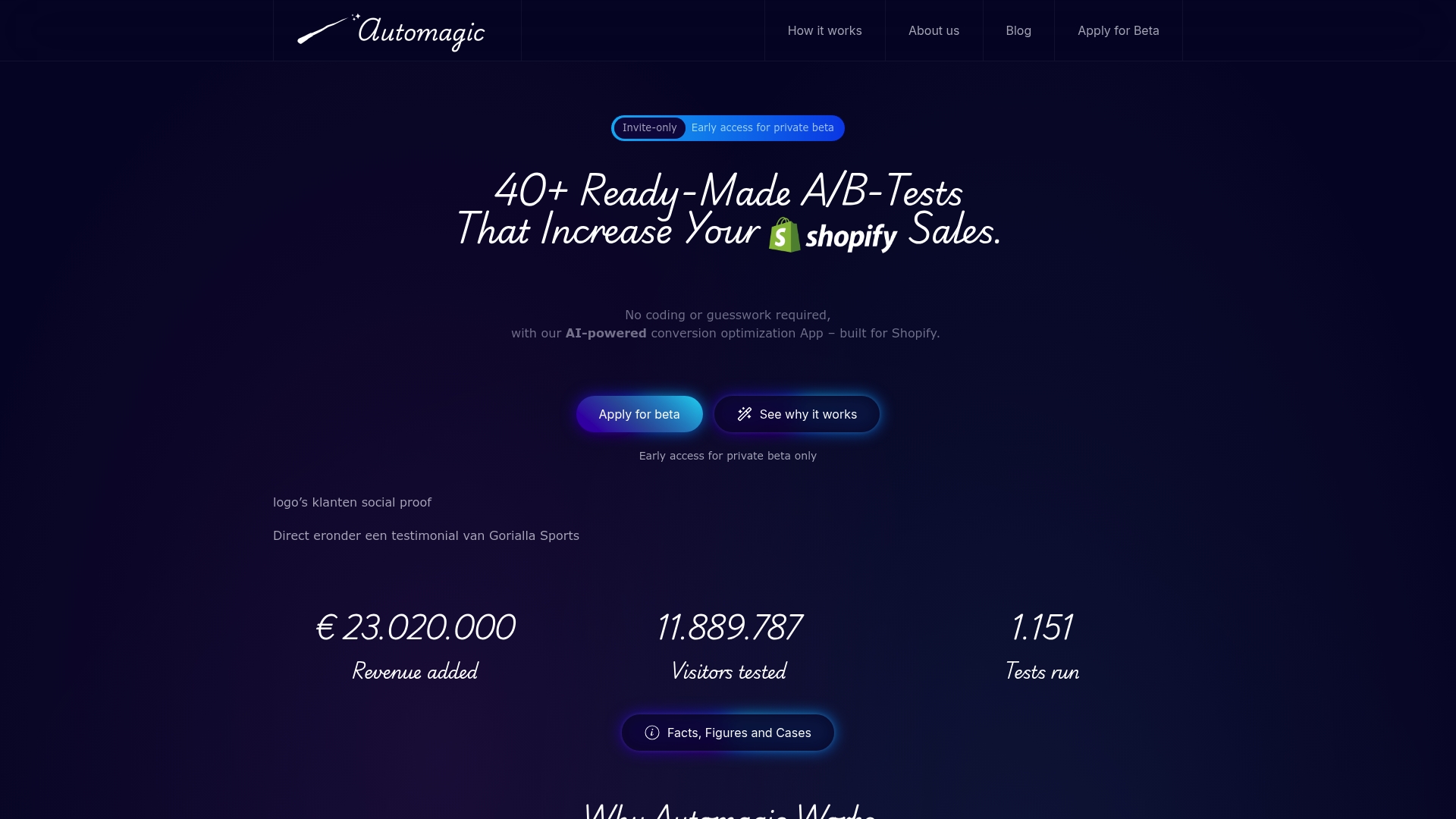
Take control of your store’s future now and join the growing number of Shopify merchants maximizing revenue effortlessly. Visit https://automagic.li and start your journey to better conversions today.
Frequently Asked Questions
How can AI-powered A/B testing improve my Shopify store’s conversion rate?
Using AI-powered A/B testing allows you to optimize conversion rates rapidly by automatically analyzing user behavior and generating test variations with minimal input. Implementing this can lead to faster and more accurate insights, transforming your store into a dynamic sales platform within weeks.
What are pre-tested variations and how do they help with conversion rate optimization?
Pre-tested variations are proven design and content strategies based on successful performance data. By incorporating these variations, you can eliminate guesswork and reduce the time spent on manual testing, helping to maximize your store’s conversion rates quickly.
Can I implement design changes on my Shopify store without coding?
Yes, you can implement high-converting design changes without any coding knowledge. Many modern platforms offer no-code tools that allow you to easily test and modify website elements using user-friendly interfaces, making it accessible for all Shopify store owners.
What social proof strategies should I use to build trust on my Shopify store?
To effectively build trust, showcase genuine customer testimonials, highlight success metrics, and display industry awards. Implement these social proof strategies to instantly increase customer confidence and reduce purchase hesitation on your site.
How can I personalize the user experience to enhance engagement in my Shopify store?
Personalizing the user experience involves analyzing customer behavior and implementing dynamic content that speaks directly to individual preferences. By segmenting users and customizing their journeys, you can significantly improve engagement and increase the likelihood of conversions.
What steps should I take to analyze test results effectively for my Shopify store?
To analyze test results effectively, focus on understanding the actual business impact rather than just statistical significance. Look for patterns in customer behavior and track metrics like customer lifetime value to inform your future store decisions and improve overall performance.