
What Is Conversion Rate and Why It Matters
Nearly every American Shopify store owner faces the challenge of turning website visitors into paying customers. Conversion rates often fluctuate between 1 percent and 4 percent across online retailers, revealing just how competitive the ecommerce market can be. Understanding what drives those numbers is essential for anyone determined to outperform global rivals. This article demystifies conversion rate basics, explores advanced optimization factors, and offers actionable strategies for mastering user-friendly, AI-powered A/B testing—so you can grow your store with confidence and without complex coding.
Table of Contents
- Defining Conversion Rate In Ecommerce
- Different Types Of Conversion Rates Explained
- How Conversion Rates Are Measured
- Factors That Influence Conversion Rate
- Common Pitfalls And How To Avoid Them
- Optimizing Rates With Ai And A/B Testing
Key Takeaways
| Point | Details |
|---|---|
| Importance of Conversion Rate | Conversion rate reflects the effectiveness of a website in turning visitors into customers, typically ranging from 1% to 4% across industries. |
| Types of Conversions | Focus on both macro conversions (e.g., purchases) and micro conversions (e.g., add to cart) to gain insights into customer engagement. |
| Measurement Techniques | Use comprehensive metrics and analytics tools to monitor conversions across various dimensions for better optimization insights. |
| Role of AI in Optimization | AI-driven methods enhance conversion rate tests by providing real-time adjustments and personalized experiences more effectively than traditional methods. |
Defining Conversion Rate in Ecommerce
A conversion rate represents the percentage of website visitors who complete a desired action, which in ecommerce typically means purchasing a product. The proportion of e-commerce website visits transformed into actual purchases serves as a critical performance metric for online businesses.
In practical terms, conversion rate calculation is straightforward: divide the total number of completed transactions by the total number of website visitors, then multiply by 100. For instance, if 100 people visit an online store and 3 make a purchase, the conversion rate would be 3%. This metric provides immediate insight into how effectively a website turns potential customers into actual buyers.
Advanced ecommerce analytics demonstrate that conversion rates can vary dramatically across industries, typically ranging between 1% to 4% for most online retailers. Factors influencing conversion rates include website design, product pricing, checkout process complexity, and overall user experience. Understanding these variables allows store owners to strategically improve their online performance.
Pro Tip for Conversion Optimization: Consistently track your conversion rate weekly and identify specific pages or steps in your purchase funnel where potential customers drop off, then systematically test and improve those specific elements to incrementally boost your overall conversion performance.
Different Types of Conversion Rates Explained
In ecommerce, conversion rates are not a one-size-fits-all metric. Digital commerce analytics reveal multiple distinct conversion types that businesses can track, each offering unique insights into customer behavior and website performance.
Typically, conversion rates fall into two primary categories: macro conversions and micro conversions. Macro conversions represent the primary business objectives, such as completed product purchases, service subscriptions, or membership registrations. These are the most direct indicators of revenue generation. Micro conversions, by contrast, are smaller interactions that signal potential customer interest, including actions like adding items to a cart, signing up for newsletters, downloading product guides, or initiating a free trial.
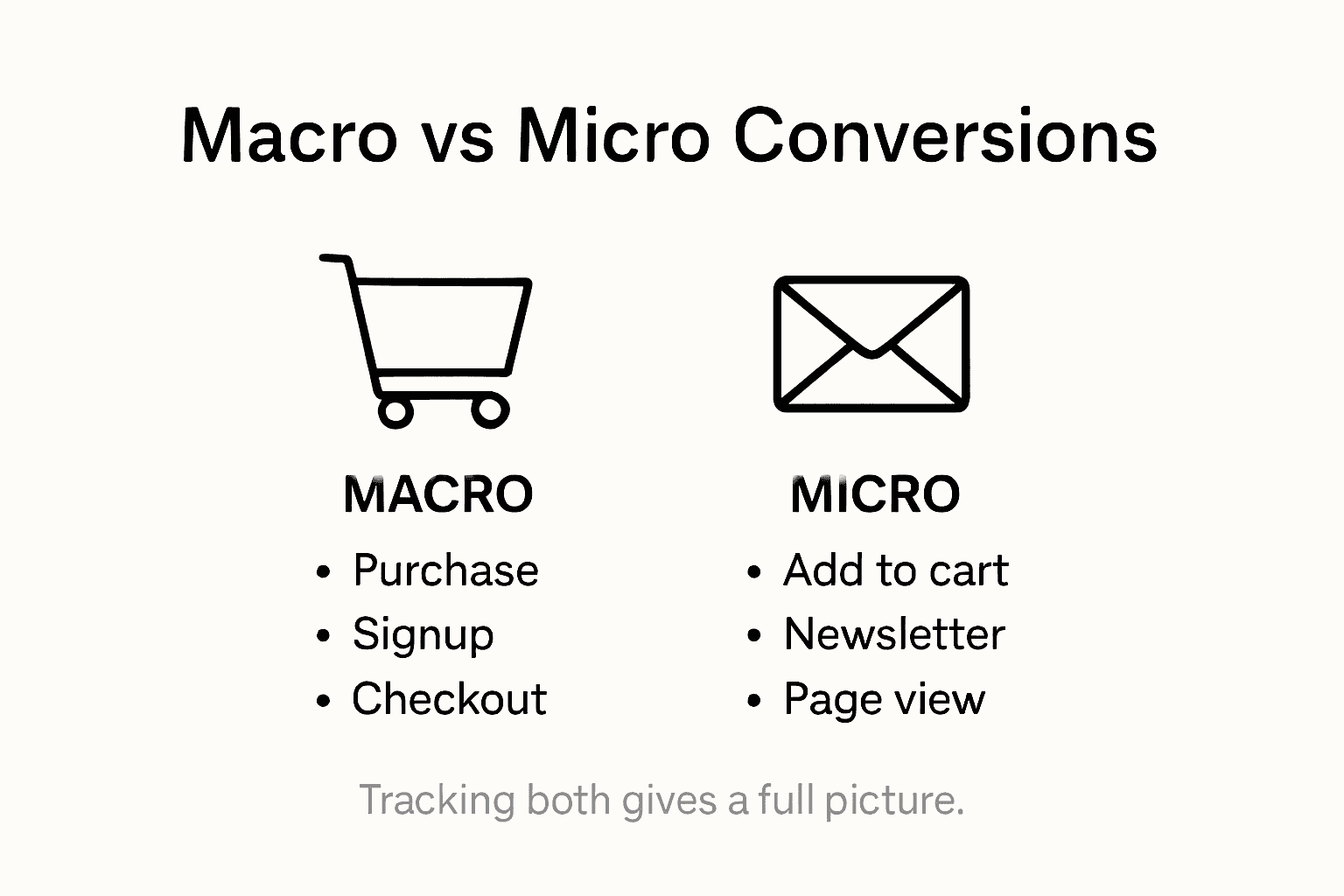
Here’s a quick summary comparing macro and micro conversions in ecommerce:
| Conversion Type | Description | Typical Examples |
|---|---|---|
| Macro Conversion | Primary goal, reflects main revenue event | Completed purchase, subscription |
| Micro Conversion | Smaller engagement, signals future intent | Add to cart, email signup |
Comprehensive analytics strategies often incorporate both macro and micro conversion tracking to provide a holistic view of customer engagement. For Shopify store owners, this means tracking not just final sales, but also intermediate steps that indicate a customer’s journey toward making a purchase. Understanding these nuanced conversion types allows for more sophisticated marketing strategies and more targeted optimization efforts.
Pro Tip for Conversion Tracking: Start by identifying your most critical macro and micro conversions, then set up tracking for each in your analytics platform to gain a comprehensive understanding of how customers interact with your online store.
How Conversion Rates Are Measured
Conversion rate measurement is a systematic process that transforms raw website traffic data into actionable business insights. Web analytics platforms use standardized mathematical formulas to calculate precise conversion performance metrics, enabling businesses to understand their online effectiveness with remarkable accuracy.
The fundamental conversion rate calculation is straightforward: divide the number of successful conversions by the total number of website visitors, then multiply by 100 to obtain a percentage. For example, if an online store receives 1,000 visitors and 25 make a purchase, the conversion rate would be 2.5%. Modern analytics tools automatically track these interactions, capturing detailed information about user behaviors, traffic sources, and conversion pathways.
Comprehensive conversion tracking involves segmenting rates by multiple dimensions, including traffic source, device type, user demographics, and specific conversion events. This granular approach allows businesses to identify high-performing channels, understand customer journey variations, and pinpoint exactly where potential customers might be abandoning their purchase process. Advanced analytics platforms can even provide real-time conversion rate data, enabling swift strategic adjustments.
Pro Tip for Measurement Precision: Configure your analytics platform to track multiple conversion events and set up custom goal tracking to capture both macro and micro conversions, giving you a more comprehensive view of your online performance.
Factors That Influence Conversion Rate
Conversion rates are not randomly determined but emerge from a complex interplay of strategic website elements. Scientific research has consistently identified key factors that dramatically impact online purchasing behaviors, revealing nuanced insights into customer decision-making processes.
Website design and user experience play pivotal roles in conversion performance. Critical factors include page load speed, mobile responsiveness, intuitive navigation, clear product descriptions, high-quality images, and streamlined checkout processes. Visual elements like professional product photography, trust badges, customer reviews, and transparent pricing can significantly reduce purchase hesitation. The psychological comfort a customer feels while browsing directly correlates with their likelihood of completing a transaction.

Trust signals represent another crucial conversion rate determinant. Potential customers need reassurance about product quality, shipping reliability, return policies, and overall business legitimacy. Elements like secure payment icons, detailed customer testimonials, transparent shipping information, and clear contact details can substantially increase conversion probabilities. Advanced analytics demonstrate that websites displaying comprehensive trust indicators can experience conversion rate improvements ranging from 15% to 50% across different industry segments.
Pro Tip for Conversion Enhancement: Conduct regular user experience audits focusing on removing potential friction points in your website’s purchase journey, systematically testing and improving each step to create a smoother, more intuitive customer experience.
Common Pitfalls and How to Avoid Them
Conversion rate optimization requires strategic thinking and careful execution. Systematic analysis reveals multiple recurring mistakes that can dramatically undermine online business performance, making it critical to understand and proactively address potential challenges.
One significant pitfall is data misinterpretation and insufficient testing. Many Shopify store owners rush to implement changes without robust statistical validation, leading to misguided decisions. Common errors include drawing conclusions from inadequate sample sizes, failing to control variables during A/B testing, and overlooking potential seasonal or contextual influences on conversion rates. Successful optimization demands disciplined, methodical approaches that prioritize comprehensive data collection and rigorous statistical analysis.
Organizational barriers frequently obstruct effective conversion rate improvement strategies, with siloed departments and inconsistent communication hampering meaningful progress. Effective conversion optimization requires cross-functional collaboration, clear goal setting, and a unified understanding of key performance metrics. Stores that develop structured workflows, establish shared performance benchmarks, and maintain transparent communication between marketing, design, and technical teams are significantly more likely to achieve sustainable conversion improvements.
Pro Tip for Optimization Success: Implement a structured testing protocol that mandates minimum sample sizes, controls critical variables, and requires statistical significance before implementing any website changes.
Optimizing Rates With AI and A/B Testing
Artificial intelligence is revolutionizing conversion rate optimization, transforming traditional testing methodologies into sophisticated, data-driven strategies. Machine learning models are now automating experiment design and enabling predictive targeting with unprecedented precision, allowing ecommerce businesses to move beyond manual, time-consuming optimization processes.
Traditional A/B testing involved manually creating multiple website variations and waiting weeks or months to gather statistically significant results. AI-powered testing dramatically accelerates this process by simultaneously analyzing multiple design elements, user behaviors, and potential conversion paths. Modern algorithms can now dynamically adjust website elements in real-time, creating personalized experiences for different user segments and instantly identifying the most effective design configurations.
Advanced AI integration enables more nuanced user segmentation and real-time performance optimization, breaking down complex user interactions into actionable insights. These intelligent systems can predict user preferences, anticipate potential conversion barriers, and recommend targeted improvements with a level of accuracy far beyond traditional human analysis. By continuously learning from user interactions, AI-driven A/B testing platforms provide ecommerce stores with a dynamic, adaptive optimization strategy that evolves alongside changing consumer behaviors.
Below is a comparison of traditional A/B testing and AI-driven optimization for ecommerce sites:
| Aspect | Traditional A/B Testing | AI-Driven Optimization |
|---|---|---|
| Speed | Slow, weeks for results | Instant, real-time adjustments |
| Personalization | General, one-size-fits-all | Individualized experiences |
| Experiment Scale | Limited to few variations | Can test many elements simultaneously |
| Data Insights | Manual analysis required | Automated, predictive recommendations |
Pro Tip for AI Testing: Start with small, incremental AI-assisted tests focusing on high-impact website elements like product descriptions, images, and checkout flows, gradually expanding your optimization strategy as you gain confidence in the machine learning insights.
Boost Your Shopify Store Conversion Rate with AI-Powered Testing
The article highlights how conversion rate is a key performance metric deeply affected by website design, trust signals, and user experience. If you struggle with identifying exactly which elements to test or feel overwhelmed by A/B testing’s complexity, you are not alone. Many Shopify store owners face challenges with data interpretation and managing multiple test variations without the technical skills needed to implement changes. Automagic.li understands these pain points by offering a powerful SaaS platform that simplifies ecommerce conversion optimization specifically for Shopify.
Why struggle with slow, manual testing processes or costly developer involvement? Automagic.li provides a library of over 40 pre-tested, high-impact variations you can deploy without any coding. Its AI-driven customization adjusts tests to fit your unique store design and automates deployment so you can rapidly improve key metrics like checkout flow and product descriptions. Plus, you can track both macro and micro conversions as explained in the article to get a full picture of your customer journey and boost sales effectively.
Explore how you can transform your conversion rate with ready-to-use A/B tests specially designed for Shopify stores at Automagic.li.
Ready to grow your ecommerce sales with smarter testing today Take the first step now by visiting Automagic.li and discover an easier path to conversion optimization that delivers real results.
Frequently Asked Questions
What is conversion rate in ecommerce?
Conversion rate is the percentage of website visitors who complete a desired action, such as making a purchase. It is calculated by dividing the number of completed transactions by the total number of website visitors, then multiplying by 100.
Why is conversion rate important for online businesses?
The conversion rate is a critical performance metric for online businesses because it indicates how effectively a website turns visitors into customers. A higher conversion rate generally leads to increased sales and revenue.
How can I improve my ecommerce conversion rate?
To improve your conversion rate, focus on optimizing website design, enhancing user experience, simplifying the checkout process, and building trust through customer reviews and clear policies. Regularly track and analyze conversion data to identify and address drop-off points in your purchase funnel.
What are macro and micro conversions?
Macro conversions refer to the primary business goals, such as completed purchases or service subscriptions, while micro conversions are smaller interactions that indicate potential customer interest, like signing up for a newsletter or adding items to a cart.
Recommended
- Conversion Metrics Explained: Driving Shopify Sales Success – Automagic
- Conversion Rate Optimization Workflow for Shopify Success – Automagic
- Importance of Conversion Tracking for Shopify Stores – Automagic
- Role of Feedback in Conversion: Boosting Shopify Sales – Automagic
- Top Conversion Rate Optimization Tips for US Businesses 2025 – seo analytic
- Understanding Landing Pages: What They Are and Why They Matter | Gammatica
- 7 Essential Marketing Metrics Every Business Owner Must Track – Jarrod Harman