
Complete Guide to Conversion Funnels for Shopify
Over 68 percent of american e-commerce managers say understanding conversion funnels is the secret to improving their sales. Knowing how customers move from browsing to buying makes a direct difference in store results. When you learn how each step impacts success, you can spot hidden trouble spots and see exactly where opportunity lies for your Shopify store.
Table of Contents
- Defining Conversion Funnels For Shopify Stores
- Key Stages In The Conversion Funnel Journey
- Types Of Ecommerce Conversion Funnels
- Optimizing Funnels With Ai-Powered A/B Testing
- Common Mistakes And How To Avoid Them
Key Takeaways
| Point | Details |
|---|---|
| Understanding the Conversion Funnel | A conversion funnel outlines the customer journey from awareness to purchase, highlighting stages for optimization. |
| Key Stages of the Funnel | The crucial stages include Awareness, Interest, Decision, and Action, each requiring tailored strategies for engagement. |
| Utilizing AI for Optimization | AI-powered A/B testing offers advanced capabilities for analyzing customer behavior and enhancing funnel performance. |
| Common Testing Mistakes | Avoid premature test terminations and ensure sufficient sample sizes to prevent misleading conclusions in conversion optimization. |
Defining Conversion Funnels for Shopify Stores
A conversion funnel represents the strategic customer journey potential buyers navigate through before completing a purchase on your Shopify store. When tracking visitor progression, you map out each critical interaction point where customers might engage or potentially abandon their purchasing path.
In essence, a conversion funnel breaks down the entire customer experience into distinct stages. These stages typically include awareness, interest, consideration, intent, evaluation, and final purchase. For Shopify store owners, understanding this funnel means recognizing how customers move from initial website discovery to becoming paying customers. Each step in the funnel represents an opportunity to optimize and improve your store’s performance.
The primary components of a Shopify conversion funnel include:
- Website Traffic: The initial entry point where potential customers first encounter your store
- Product Page Views: Where visitors explore specific items and evaluate their options
- Add to Cart: The critical stage indicating strong purchase intent
- Checkout Process: The final conversion stage where customers complete their transaction
Successful conversion funnel optimization requires continuously analyzing drop-off points and creating seamless, intuitive pathways that guide customers smoothly from initial interest to final purchase. By understanding and strategically improving each stage, Shopify store owners can significantly enhance their overall conversion rates and e-commerce performance.
Key Stages in the Conversion Funnel Journey
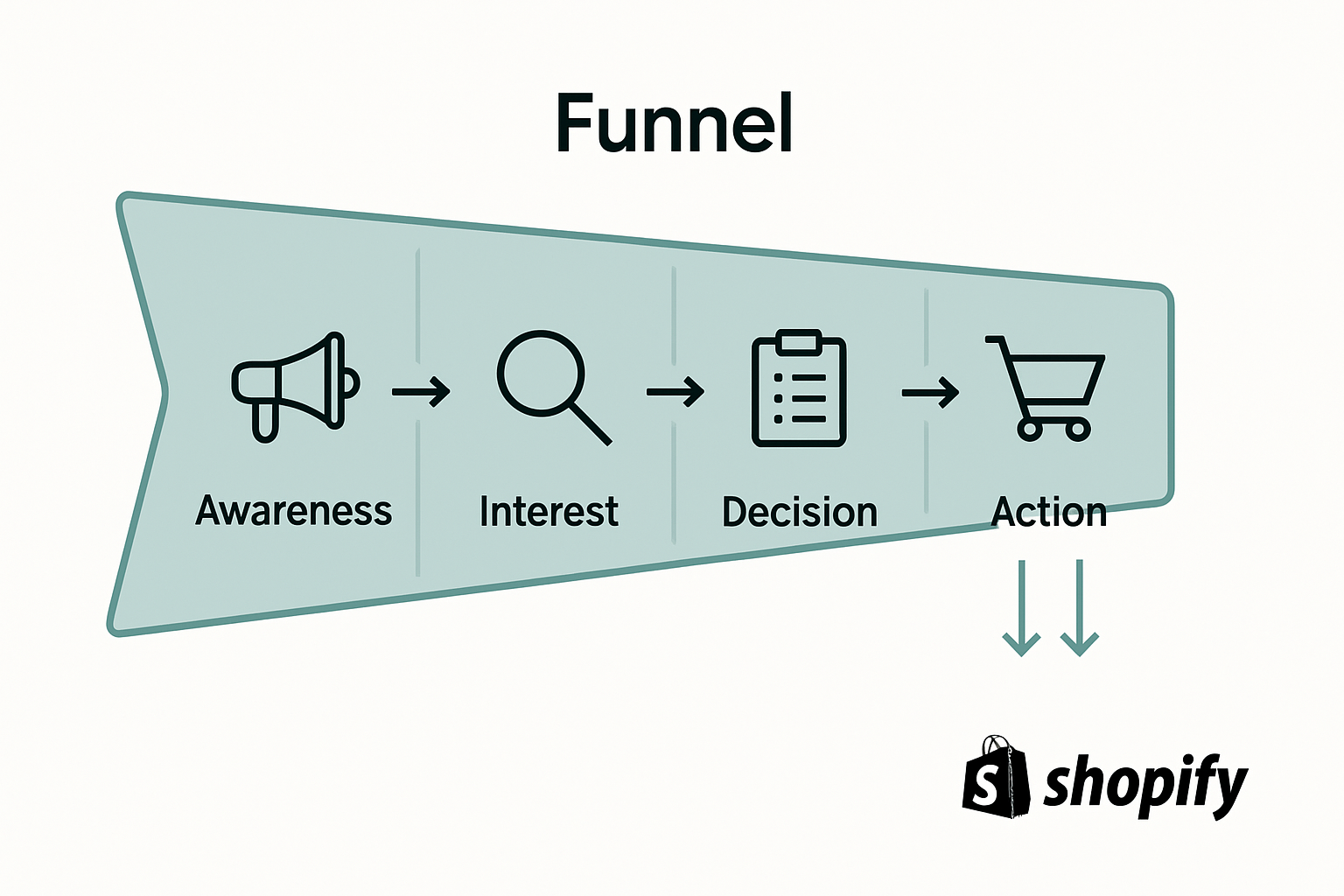
Conversion funnels follow a structured journey that transforms potential customers from initial awareness to final purchase. This strategic progression involves four fundamental stages that help Shopify store owners understand and optimize their customer acquisition process.
The first stage is Awareness, where potential customers first discover your Shopify store through various marketing channels like social media, search engines, or advertisements. During this initial phase, your goal is to capture attention and generate interest by presenting compelling brand messaging and unique value propositions.
Next comes the Interest stage, where potential customers begin actively exploring your products. They might browse product pages, read descriptions, and compare offerings. This critical phase requires creating engaging content, high-quality product images, and clear value communication that encourages deeper exploration.
The Decision stage represents the point where potential customers evaluate whether to make a purchase. Here, strategic elements like customer reviews, detailed product specifications, pricing transparency, and trust signals become crucial. Shopify store owners can optimize this stage by tracking key sales funnel metrics such as conversion rates and average deal size.

The final Action stage is where customers complete their purchase. Streamlining the checkout process, offering multiple payment options, and providing clear shipping information can significantly reduce cart abandonment and improve overall conversion rates.
Key metrics to monitor throughout these stages include:
- Conversion Rate: Percentage of visitors who complete a purchase
- Lead-to-Customer Ratio: Number of potential customers who become actual buyers
- Cost per Acquisition: Marketing expenses required to gain each new customer
- Average Deal Size: Typical transaction value
- Sales Cycle Length: Time between initial contact and purchase
By understanding and strategically optimizing each stage of the conversion funnel, Shopify store owners can create more effective customer journeys that drive sustainable business growth.
Types of eCommerce Conversion Funnels
E-commerce conversion funnels come in various configurations, each designed to address specific business objectives and customer journey stages. Understanding these different funnel types can help Shopify store owners strategically guide potential customers through their purchasing process.
The Linear Conversion Funnel represents the most straightforward approach, following a traditional top-down progression from awareness to purchase. This model assumes customers move sequentially through stages: discovering your brand, evaluating products, and ultimately making a purchase. It works best for businesses with relatively simple product offerings and direct sales processes.
A more complex Micro-Moment Conversion Funnel recognizes that modern online shoppers have non-linear purchasing behaviors. This approach focuses on capturing customer attention during specific, intent-driven moments across multiple touchpoints. By tracking key sales metrics, such as conversion rates and customer acquisition costs, store owners can optimize interactions at each critical decision point.
Another sophisticated model is the Retention-Focused Conversion Funnel, which extends beyond the initial purchase to emphasize customer loyalty and repeat business. This funnel includes additional stages like post-purchase engagement, customer support, and loyalty program integration. Its key stages typically include:
- Awareness: Initial brand discovery
- Consideration: Product exploration and evaluation
- Conversion: First purchase
- Retention: Encouraging repeat purchases
- Advocacy: Transforming customers into brand promoters
The Multi-Channel Conversion Funnel acknowledges the complexity of modern e-commerce, recognizing that customers interact with brands through various platforms. This approach tracks customer journeys across social media, email marketing, direct website visits, and other digital touchpoints, providing a holistic view of the conversion process.
Successful Shopify store owners understand that no single funnel type fits all businesses. The most effective strategy involves carefully analyzing your specific product, target audience, and business model to design a conversion funnel that maximizes customer acquisition and retention.
Optimizing Funnels With AI-Powered A/B Testing
AI-powered A/B testing represents a revolutionary approach to conversion funnel optimization, enabling Shopify store owners to make data-driven decisions with unprecedented precision and speed. Advanced reinforcement learning techniques are transforming how online businesses analyze and improve their customer conversion strategies.
The core advantage of AI-driven A/B testing lies in its ability to process massive amounts of data and generate insights far beyond traditional testing methods. Unlike manual approaches that require extensive time and resources, AI-powered testing can simultaneously analyze multiple variables, identifying subtle patterns and potential improvements that human analysts might overlook. Scalable Bayesian decision frameworks now enable more nuanced and statistically robust experiment designs that focus on maximizing profit and reducing uncertainty.
Key capabilities of AI-powered A/B testing for Shopify stores include:
- Automated Variation Generation: Creating multiple test versions without manual intervention
- Real-time Performance Tracking: Continuously monitoring and adjusting test parameters
- Predictive Analytics: Forecasting potential conversion rate impacts
- Personalization at Scale: Tailoring experiments to specific customer segments
- Rapid Iteration: Quickly implementing and evaluating design changes
The most effective AI testing approaches combine sophisticated machine learning algorithms with deep understanding of user behavior. These systems can dynamically adjust test parameters, prioritize high-impact variations, and provide actionable recommendations that go beyond simple statistical significance.
Successful implementation requires a strategic approach that balances technological capabilities with clear business objectives. Shopify store owners should view AI-powered A/B testing not as a replacement for human insight, but as a powerful tool that amplifies their ability to understand and optimize customer conversion paths.
Common Mistakes and How to Avoid Them
Online controlled experiments in e-commerce conversion optimization are fraught with potential pitfalls that can derail your testing efforts. Understanding these common mistakes is crucial for Shopify store owners seeking to improve their conversion funnels effectively and accurately.
One of the most significant errors is premature test termination, where store owners stop A/B tests too early based on initial promising results. Reinforcement learning frameworks demonstrate that long-term treatment effects require comprehensive statistical evaluation. Rushing to conclusions can lead to false positives and misguided strategic decisions that actually harm conversion rates.
Key mistakes Shopify store owners frequently encounter include:
- Insufficient Sample Size: Running tests without statistically significant traffic
- Lack of Clear Hypothesis: Testing without a specific, measurable objective
- Ignoring Statistical Significance: Making decisions based on random variations
- Testing Multiple Variables Simultaneously: Reducing the clarity of test results
- Neglecting Segment-Specific Insights: Applying broad results without considering customer diversity
Another critical mistake is failing to account for external factors that might influence test results. Seasonal variations, marketing campaigns, and unexpected market shifts can dramatically impact conversion funnel performance. Successful A/B testing requires a holistic approach that considers broader contextual elements beyond immediate website changes.
To mitigate these risks, Shopify store owners should establish rigorous testing protocols. This includes defining clear hypotheses, determining appropriate sample sizes, setting statistical significance thresholds, and creating controlled testing environments that minimize external interference. Patience, methodical analysis, and a willingness to learn from both successful and unsuccessful tests are fundamental to effective conversion funnel optimization.
Boost Your Shopify Store’s Conversion Funnel with AI-Powered Testing
If you are ready to take full control of your Shopify conversion funnel and eliminate guesswork in optimizing each stage of your customer journey you need an easy and powerful solution. The challenges you face such as reducing drop-offs, streamlining checkout, and personalizing experiences can be solved through smart data-driven A/B testing designed specifically for Shopify stores. Automagic.li offers a library of over 40 pre-tested, high-impact variations that require no coding and adapt automatically to your store’s design using AI. This means you can enhance website traffic engagement, improve add-to-cart rates, and increase final purchase actions without hiring developers.

Start turning those key funnel stages into conversion machines today. Visit Automagic.li to explore how AI-powered optimization can help you avoid common testing mistakes, speed up results, and effortlessly boost sales. Don’t wait until abandoned carts become lost revenue take control with ready-made A/B tests created to maximize your Shopify store’s conversion potential now.
Frequently Asked Questions
What is a conversion funnel in a Shopify store?
A conversion funnel in a Shopify store represents the strategic customer journey that potential buyers navigate through, from initial awareness of the store to completing a purchase. It includes various stages like awareness, interest, consideration, intent, evaluation, and final purchase.
How can I optimize my Shopify store’s conversion funnel?
You can optimize your Shopify store’s conversion funnel by analyzing key drop-off points, streamlining the checkout process, enhancing product page engagement, and using data-driven strategies such as A/B testing to improve customer experiences at each stage of the funnel.
What metrics should I track in my conversion funnel?
Key metrics to track in your conversion funnel include conversion rate, lead-to-customer ratio, cost per acquisition, average deal size, and sales cycle length. These metrics help you understand customer behavior and identify opportunities for improvement.
What types of conversion funnels are there for eCommerce?
There are several types of eCommerce conversion funnels, including linear conversion funnels, micro-moment conversion funnels, retention-focused conversion funnels, and multi-channel conversion funnels. Each type addresses different customer behaviors and business objectives, allowing you to tailor your approach accordingly.